
Zerus
Open-source Agent Development Environment that unifies coding agent sessions like Claude Code and Codex across your machines and phone in one workspace.
At a Glance
About Zerus
Zerus is an open-source Agent Development Environment (ADE) published by ufna on GitHub under the MIT license. It brings sessions, conversations, tasks and approvals from several coding agents into one workspace across desktop, CLI and Android and iOS companion apps. The latest release listed is v0.48.3, and the Android and iOS apps are in early access and public beta respectively.
What It Is
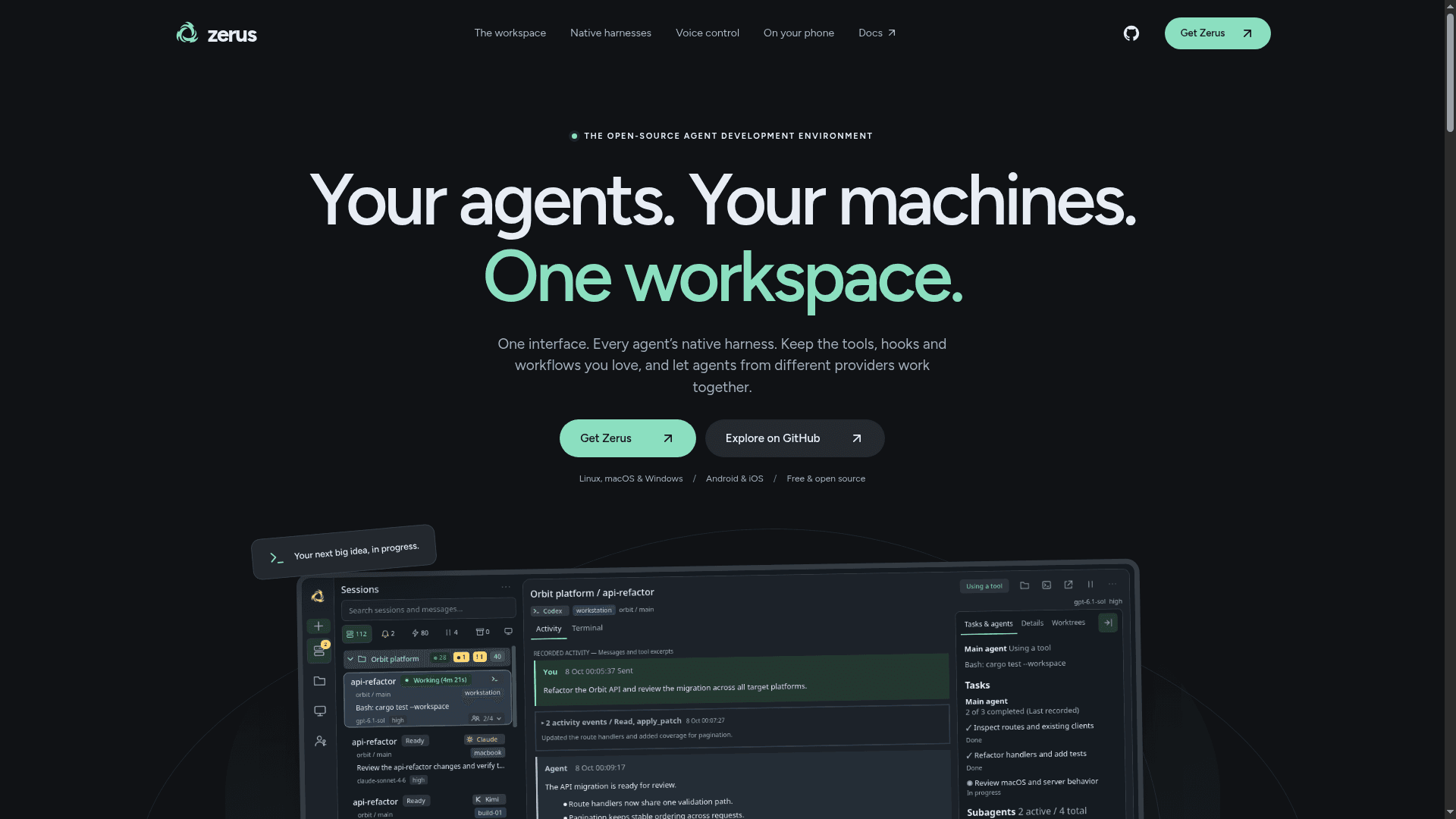
Zerus is a workspace for running and supervising multiple AI coding agents on your own computers. Claude Code, Codex, Kimi Code, DeepSeek Harness and OpenCode run in their own native runtimes, so their tools, hooks, permissions and history stay with them. Zerus adds a shared view of Activity, messages, questions, approvals and session controls. Any terminal command can be run through the bundled hgs CLI, though full ADE features need an adapter for the agent.
How the workspace works
A project can combine folders and agent sessions on a laptop, workstation and servers. The project catalog, session assignments and shared recovery settings sync peer to peer over SSH, with no permanent main machine. Offline peers catch up when they reconnect, while SSH settings and credentials stay local. Existing project folders are used in place, with or without Git. A fleet overview lets you search and filter sessions and see machine load and account limits. Terminal agents run in tmux, so sessions survive closing the app or losing an SSH connection.
Cross-agent collaboration and voice
The hgs CLI lets agents with shell access list sessions, inspect progress and send tasks and results to another provider's agent, locally or on another machine. For example, Codex can implement a change while Claude reviews it. Voice control records speech on desktop or mobile, transcribes it and delivers the text to the selected agent. Providers include local GigaAM v3 for Russian and OpenAI-compatible transcription servers. Voice messages stay in history with playback and a transcript.
Mobile companions
The Android and iOS apps let you read replies, answer questions and approvals, send text, files, images or voice, start sessions and follow tasks and subagents. Phones connect through a self-hostable HTTPS relay. The documentation notes the current mobile protocol is TLS-protected but not end-to-end encrypted.
Community Discussions
Be the first to start a conversation about Zerus
Share your experience with Zerus, ask questions, or help others learn from your insights.
Pricing
Open Source
Zerus is free and open source under the MIT license. Users bring their own agent accounts; provider subscriptions or API usage are handled by those providers.
- MIT license
- Linux, macOS & Windows, Android & iOS
- Peer-to-peer project sync over SSH
- Native harnesses: Claude Code, Codex, Kimi Code, DeepSeek Harness
- Provider subscriptions/API usage billed separately by providers (bring your own agents)
Capabilities
Key Features
- Fleet overview of sessions and machines with search and filters
- Peer-to-peer project sync over SSH with no central cloud
- Native harness support for Claude Code, Codex, Kimi Code, DeepSeek Harness and OpenCode
- Agent-to-agent messaging through the hgs CLI
- Notifications that link to the right session
- Voice control with local GigaAM or OpenAI-compatible transcription
- Persistent tmux-backed terminal sessions
- Android and iOS companion apps with self-hostable HTTPS relay
- Local coding models via Ollama
- Machine load and account limit display