
A pattern language of 33 patterns for delivering AI-written software, where quality is enforced by governed parts, proven checks and locked user intent instead of human code review.
At a Glance
ZTHR pattern language paper and site content, freely available under CC BY 4.0 with attribution. This is content, not a software product.
Engagement
Available On
Listed Nov 2026
About ZTHR
ZTHR (Zero Trust – High Reliability) is a pattern language for delivering software written by AI, authored by Russ Little and published as a paper (v1.0, request for comments) with a DOI on Zenodo. It is a set of ideas and documents rather than a toolset, accompanied by a reference application built under its rules.
The project argues that generating code is now cheap while deciding whether it is right is not, so quality should come from the environment the author works in rather than from reviewers reading diffs.
What It Is
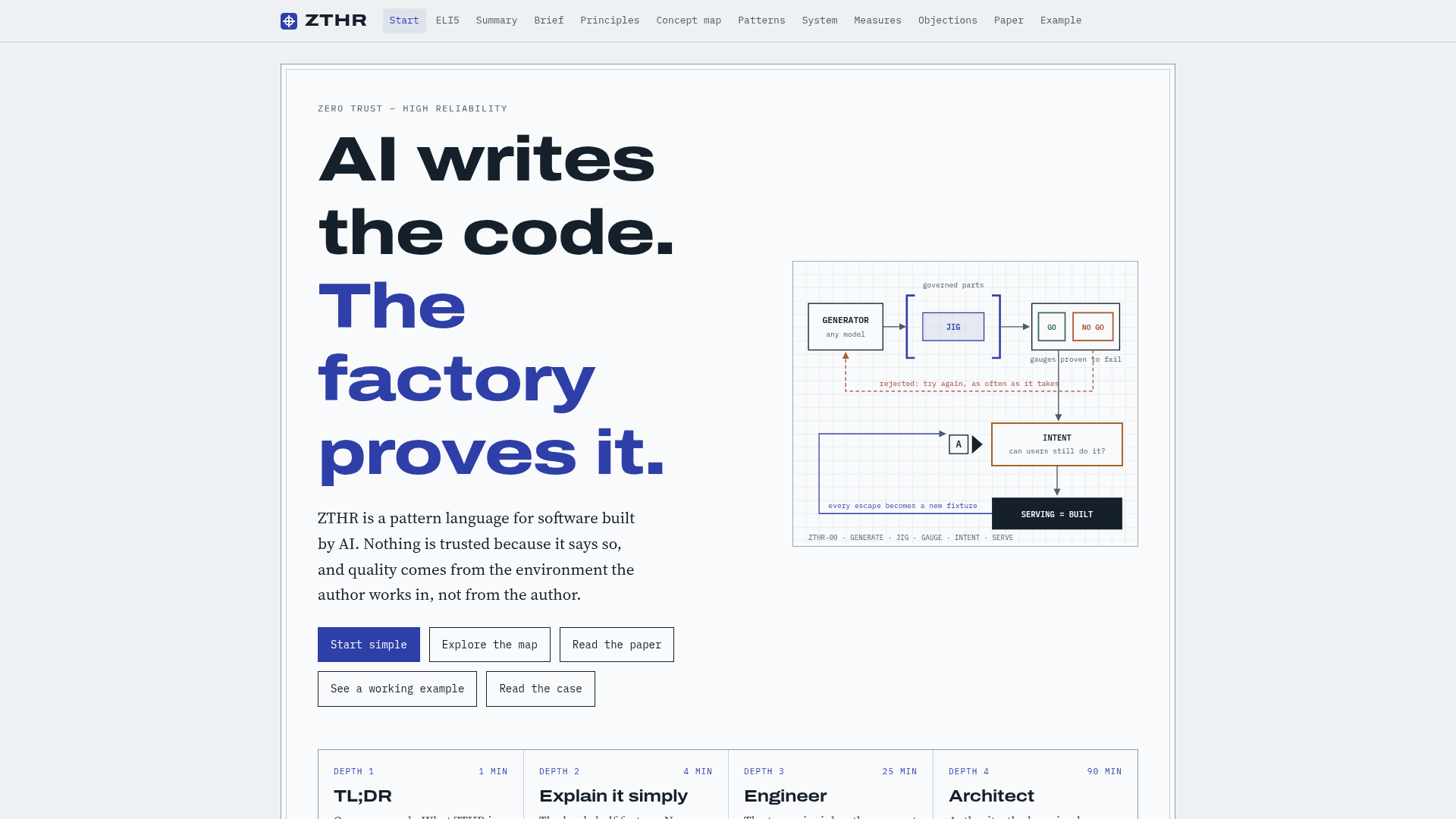
ZTHR is a framework for autonomous software delivery built on two principles. Symmetric Zero Trust holds that no author, reviewer, model, operator or report gains authority by asserting success; a claim counts only on evidence the claimant does not control. The Fixture Inversion moves quality out of the author's skill and into fixtures: governed parts that constrain what can be built, checks proven to fail on the defects they target, and locked statements of user intent. Models generate candidates and iterate until every fixture is satisfied.
The guiding review question is: which fixture forces that, and has it been shown to bite?
The Thirty-Three Patterns
The patterns are grouped into six families, each stating a problem, forces, a solution and consequences:
- Construction (P1–6): governed foundation, parts catalog, authorship tiers.
- Verification (P7–14): zero-bypass admission, proving gates can fail, three-valued verdicts, ratchets, mutation-measured tests.
- Intent (P15–18): user journeys as the primary datum, locked against the author.
- Independence (P19–22): multi-family model review and reading the system in different representations.
- Operational (P23–27): deploy by identity, a bounded persistent operator, leases.
- Runtime and environment (P28–33): deterministic layers around models, fail-closed behavior, twins of external services.
All patterns are also published as machine-readable data in zthr-patterns.json for people building agents or tooling.
Reference Implementation
The Student Advocate is a reference app built by agents under ZTHR fixtures. The site offers a live version with twelve sample students, an admin view, an evidence factory showing gates, tests and mutation scores, a block library, and the full source on a reference-implementation branch. The author states ZTHR is in production use for greenfield systems in a regulated industry.
Reading Paths and Limits
Content is offered at several depths: a TL;DR, a plain-language bookshelf-factory explanation, a two-page executive summary, a five-page brief and the full paper, with PDF downloads. The paper states its limits openly: the system builds what it is told, fixtured software is only as correct as its fixtures are faithful, and model diversity reduces but does not remove correlated error. Discussion takes place in GitHub Discussions.
Community Discussions
Be the first to start a conversation about ZTHR
Share your experience with ZTHR, ask questions, or help others learn from your insights.
Pricing
Free
ZTHR pattern language paper and site content, freely available under CC BY 4.0 with attribution. This is content, not a software product.
- Paper and site content licensed under CC BY 4.0
- Use, adapt and build on it with credit to the source
- Executive summary, brief and full paper (33 patterns) in Markdown and PDF
Capabilities
Key Features
- Two principles: Symmetric Zero Trust and the Fixture Inversion
- Thirty-three patterns in six families
- Concept map of pattern relationships
- Machine-readable patterns file (zthr-patterns.json)
- Executive summary, brief and full paper with PDF downloads
- Student Advocate reference application with live demo and admin
- Evidence factory with gates, tests, mutation scores and block library
- Intent completion as headline measure
- Multi-family model review and mutation-measured tests