Google DeepMind Is Rethinking the Mouse Pointer With Gemini

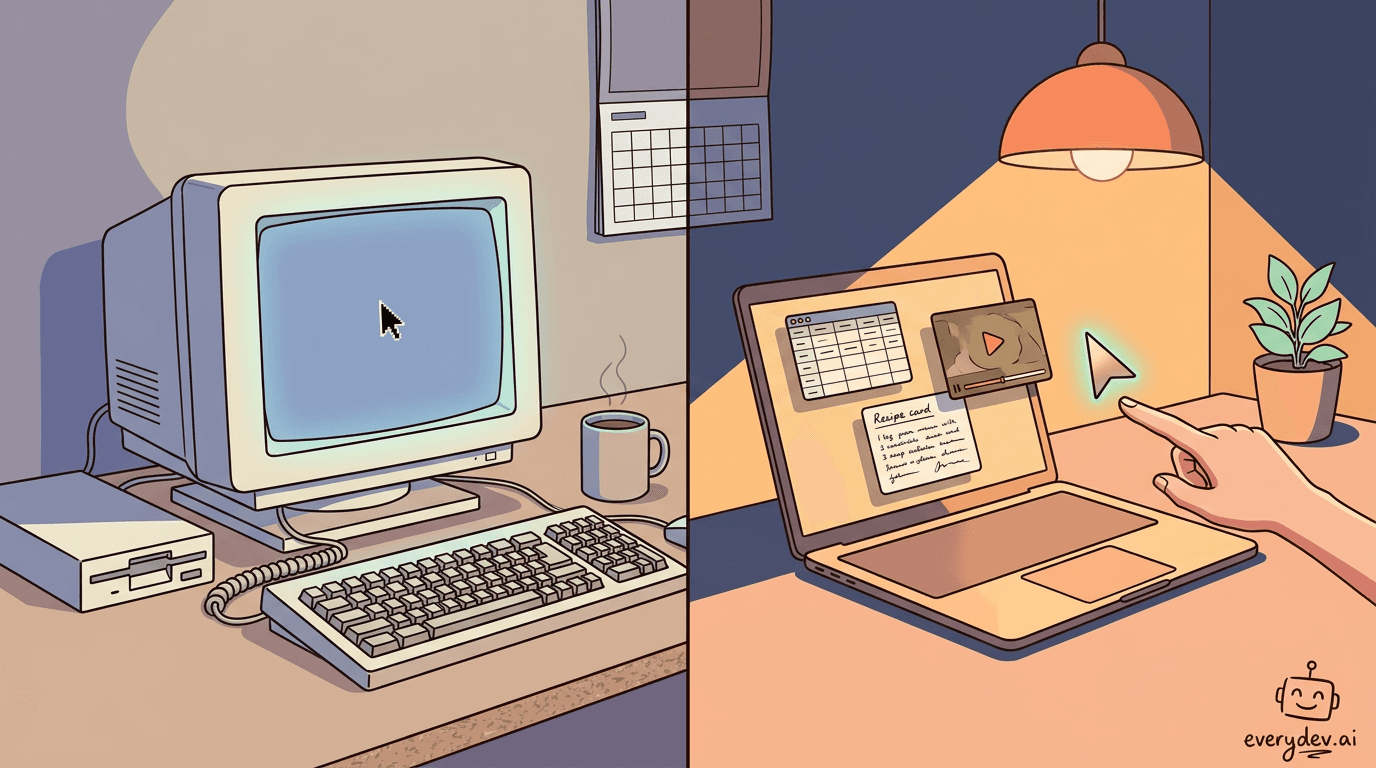
The mouse pointer has worked roughly the same way since the 1970s: it tracks position and reports clicks. Google DeepMind is now running experiments that treat cursor position as a live signal for Gemini, letting the model understand what a user is pointing at rather than just where the cursor happens to be.
The project, described by the DeepMind team on X and linked to experimental demos in Google AI Studio, is framed explicitly as a rethink of a 50-year-old interface primitive. The demos are described as experimental, not a shipping product, but the team says the work is shaping how they think about next-generation interfaces.
What the AI Pointer Actually Does
The core idea is spatial context. Current LLM-based assistants require users to describe what they want help with, often in full sentences, and to manually copy or paste the relevant content into a chat window. The AI pointer collapses that step by using cursor position and hover state to tell the model what the user is looking at.
According to DeepMind's description, the system can respond to gestures combined with short spoken or typed phrases. A user hovering over a data table and saying "make a pie chart" gives the model enough context to act without a longer prompt. Pointing at a PDF and asking for "bullet points for an email" works the same way. The examples given also include highlighting a recipe and saying "double these ingredients," pausing a video frame to generate a restaurant booking link, and converting a photo of a handwritten note into an interactive to-do list.
The framing from the team is that people naturally communicate with shorthand and gesture in the physical world. "Fix this" and "move that" are complete instructions when you are pointing at something. The AI pointer tries to bring that register into software interaction.
Why This Is Worth Watching for Builders
For teams building AI-native tools or developer assistants, the pointer concept surfaces a real design tension that has been present since chat-based AI interfaces became mainstream: the gap between what a user sees and what the model sees.
Most current AI coding assistants and productivity tools solve this with explicit context injection, file attachments, selected-text APIs, or structured prompts. Those approaches work, but they put the burden of context assembly on the user. The AI pointer is a different architectural bet: let the UI layer continuously feed spatial and visual context to the model, so the user never has to narrate what is already visible on screen.
That has practical implications for anyone building on top of multimodal models. If cursor position and screen region become first-class inputs alongside text and voice, the design surface for AI-assisted workflows expands considerably. A developer tool that knows a user is hovering over a stack trace is in a different position than one waiting for the user to paste that trace into a chat box.
The DeepMind team notes that current models require precise instructions and that the AI pointer is intended to remove that burden. That is a meaningful claim about where the friction in AI-assisted work actually lives, and it aligns with feedback that has been consistent across developer surveys: prompt construction is a skill tax that slows adoption.
Google I/O Is Next Week, and This Feels Like Setup
The timing is hard to ignore. Google I/O 2026 runs May 19-20, with the Developer Keynote on the 19th at 1:30 PT. DeepMind dropping experimental demos in AI Studio a week out from a big developer event is not how Google handles concepts it wants to keep quiet. It is how they prime developers to recognize a feature when it lands on stage.
Whether the AI pointer gets a dedicated demo at I/O or shows up as part of a broader Gemini capability story is the open question. The Developer Keynote has been the venue for experimental Gemini features that aren't quite ready for a full product announcement, and the pointer fits that profile. The thing to watch is whether Google frames it as a Gemini API surface developers can build on, or keeps it as an AI Studio playground demo. Those are very different signals about how seriously they intend to ship it.
If you're already on the I/O watch list, this is worth keeping in mind. If you weren't planning to tune in, the pointer story is a reason to at least catch the Developer Keynote.
How It Compares to Hey Clicky
Also, the cursor-as-context idea is not new this week. A small team is already shipping a version of it. Hey Clicky is a macOS AI assistant that sits next to your cursor, watches the screen in real time, and answers spoken questions about whatever app you're in. The pitch is that you can ask "what's wrong with this color grade?" while looking at DaVinci Resolve, or "how do I do this in Figma?" without leaving the canvas. Say "clicky agent" and it spawns a background agent to handle a longer task.
The two efforts solve adjacent problems with very different deployment models.
Hey Clicky is a system-wide layer on macOS. It uses screen vision broadly across any app, leans on voice as the primary input, and is shipping today to anyone with a Mac. The AI pointer is a Gemini capability surfaced through AI Studio. It treats cursor hover and position as a structured signal the model can act on, runs in Google's stack rather than on the user's machine, and is experimental rather than commercial.
If you want the rough split: Clicky is the OS-level take from a small team that got there first. DeepMind's pointer is the platform-level take from the company that owns the model. Both bet on the same insight, which is that telling the AI what you're looking at should not require typing a paragraph. The interesting question is whether a built-in Gemini feature will eat the third-party app category in the way platform features usually do, or whether being deeply native to macOS keeps Clicky on a separate track. For now they are not really competing on the same surface.
What Is Confirmed and What Is Not
It is worth being precise about what has been published. The source material is a social post from the DeepMind team and a link to experimental demos in Google AI Studio. The primary blog URL returned a 404 at time of writing. There are no technical specifications, no model architecture details, no latency figures, and no announced integration timeline in the available material.
The demos are described as experimental. DeepMind has not announced a product, a release date, or a specific Gemini model version powering the pointer behavior. The examples given, converting a paused video frame into a booking link or turning a scribbled note into a to-do list, are illustrative of the concept's direction but should be read as demo scenarios rather than confirmed shipping capabilities.
What to Watch Next
A few things are worth tracking as this develops.
The AI Studio availability is the most immediate signal. If DeepMind is routing developers to AI Studio to try the experiments, that suggests the underlying capability is built on accessible Gemini APIs rather than a closed prototype. Developers who want to understand the implementation surface should start there.
The broader question is how spatial and visual context gets standardized as an input modality. Screen-aware AI is not unique to this project. Several accessibility tools, OS-level AI integrations from Apple and Microsoft, and browser extensions already attempt versions of this. What DeepMind is doing differently, at least in framing, is treating the pointer itself as the primary context signal rather than a full screenshot or a selected region.
For developer-tool teams, the relevant design question is whether cursor-as-context becomes an expected capability in AI-assisted environments, similar to how inline autocomplete became a baseline expectation after GitHub Copilot. If it does, tools that require users to manually describe visible content will start to feel like extra work.
The experiments are early and the technical details are thin. But the interface problem DeepMind is pointing at is real, and the direction is worth following. I/O next week will tell us how serious Google is about turning the demo into a developer surface.
References
| Source | URL |
|---|---|
| deepmind.google | https://deepmind.google/blog/ai-pointer |
| Google I/O 2026 preview | https://www.everydev.ai/p/dev-google-io-is-next-week-may-1920 |
| Hey Clicky | https://www.everydev.ai/tools/hey-clicky |
Sponsored
ChatGPT Codex
OpenAI's agentic coding tool that runs in ChatGPT, your IDE, and the terminal—completing engineering tasks end to end across parallel cloud environments.
View toolAbout the Author
Founder at EveryDev.ai
Apple, Disney, Adobe, Eventbrite, Zillow, Affirm. I've shipped frontend at all of them. Now I build and write about AI dev tools: what works, what's hype, and what's worth your time.
Comments
No comments yet
Be the first to share your thoughts