iOS 27 Ships Tomorrow: What the Rebuilt Siri Means for App Developers

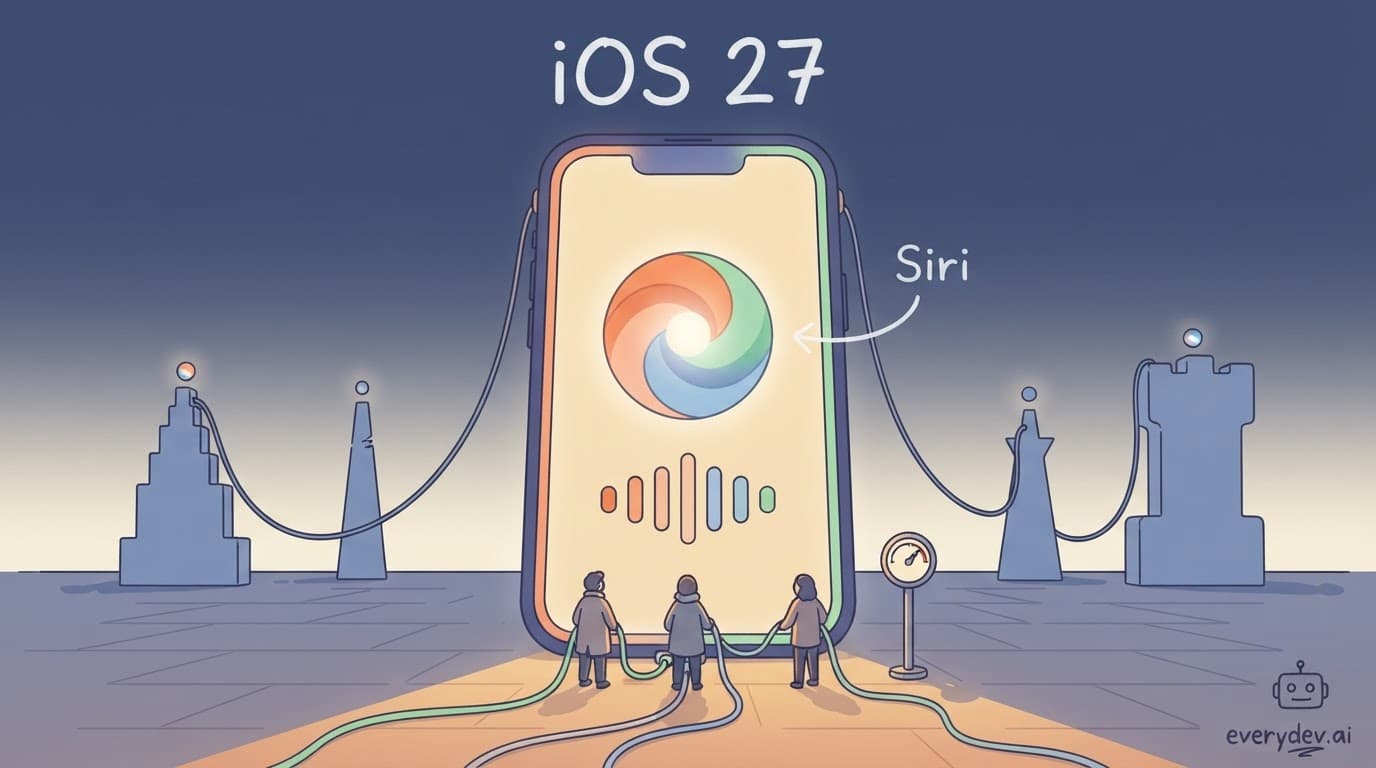
iOS 27 goes live tomorrow, September 14, and for developers who have been watching Apple's AI story unfold since the botched iOS 18 promises of 2024, this release is the one that actually matters. The rebuilt Siri, internally codenamed Campos, is the headline. But the more consequential story for builders is what Apple is opening up around it: new entry points into the system, a loosened grip on AI provider defaults, and a usage-limit model that will shape how you architect anything that touches Apple Intelligence.
This is not a minor iteration. Apple is making a structural bet that Siri becomes the ambient AI layer of iOS rather than a voice shortcut bolted onto the side of the OS. Whether that bet pays off for your users depends heavily on decisions you make in the next few months.
What the New Siri Actually Is
The rebuilt Siri runs on a custom model based on Google's Gemini, confirmed through a multi-year partnership Apple announced earlier this year. Queries routed to cloud models run through Apple's Private Cloud Compute infrastructure, which Apple says keeps user data off Google's systems directly. According to reporting relayed by MacRumors, Apple pays Google roughly $1 billion annually for model access.
Functionally, the new Siri can handle open-ended questions drawing on web results, read what is currently on the user's screen, pull context from Photos, Mail, Messages, and Music, and complete multi-step tasks across apps in a single request. That last capability is the one developers should pay closest attention to. A user asking Siri to find a restaurant mentioned in a text message, check their calendar, and make a reservation is now a single command rather than three separate app interactions. If your app sits in that workflow and you have not surfaced the right intents, you may simply get bypassed.
The new Siri also lives in more places than before. A "Search or Ask" interface replaces Spotlight as the primary system search entry point. Siri surfaces in the Dynamic Island on supported hardware, expanding from a pill animation into a translucent results card. A dedicated standalone Siri app appears on the Home Screen for the first time, with a conversation history interface resembling a Messages thread. And Apple is reportedly testing "Ask Siri" buttons in third-party app menus, letting users send app content directly to Siri alongside a request, as well as a "Write with Siri" option in the iOS keyboard.
That is a lot of surface area. For developers, it means Siri is no longer a single invocation point you can choose to ignore. It is woven into search, the keyboard, the Dynamic Island, and app menus simultaneously.
The API Picture: What Developers Can and Cannot Do Yet
This is where the honest answer is that the picture remains incomplete. The sources confirm the user-facing capabilities and the general architecture, but specific developer API documentation, permission models, and integration requirements for the new Siri have not been fully detailed in pre-release reporting.
What is confirmed: Apple is extending its "Extensions" system to support Claude, Gemini, and other third-party models alongside the existing ChatGPT integration. Users can switch between AI providers from the system search bar, with Siri as the default routing layer. Apple has also confirmed it will allow users to set third-party AI services as the default for Apple Intelligence features including Writing Tools and Image Playground, a meaningful loosening of platform control.
For developers building apps that use Apple Foundation Models in Private Cloud Compute, the MacRumors reporting on usage limits is directly relevant. Apple confirmed that starting with 2027 software releases, developer apps using Apple Foundation Models in Private Cloud Compute will be subject to the same daily usage limits as first-party features like Siri AI, Intelligent Photo Editing, and Image Playground. Limits will vary by feature, request complexity, system demand, and other factors. Expanded access will be available for a fee, tied to higher iCloud+ tiers.
That last point deserves attention. If your app relies on Apple's cloud AI infrastructure for core functionality, you now have a dependency on a metered resource. Users who hit their daily limit will see that feature become unavailable until a timeout period expires. Apple has not published the specific thresholds. Designing around this means either building graceful degradation into AI-dependent features or being transparent with users about the constraint.
Hardware Fragmentation Is a Real Design Problem
Full Gemini-powered Siri capabilities require an iPhone 15 Pro or newer, with an A17 Pro chip and at least 8GB of RAM. The Dynamic Island interface requires iPhone 14 Pro or newer. Users on iPhone 12 through iPhone 14 get software improvements and some Apple Intelligence features, but not the full rebuilt Siri experience. iPhone 11 and second-generation iPhone SE lose iOS support entirely with this release.
This creates a meaningful fragmentation problem for developers targeting AI features. The users most likely to engage with Siri-integrated app functionality are concentrated on a subset of the installed base. If you are building an "Ask Siri" integration or surfacing content through the new search interface, you need to decide whether to gate those features by device capability or design a fallback experience for older hardware. Apple has not addressed what the Dynamic Island-centric Siri interface looks like on devices without that hardware, which is a gap worth watching in the day-one release.
The Provider Openness Is Genuinely New
Apple's decision to let users set third-party AI services as the default for Writing Tools and Image Playground is worth taking seriously as a platform signal. For years, Apple's approach to AI on iOS was to control the model, control the interface, and control the data flow. The Gemini partnership already broke the first of those constraints. Allowing Claude, Gemini, and other models to serve as defaults for system-level features breaks the second.
For developers building AI-powered writing tools, image editors, or productivity apps, this creates both an opportunity and a threat. The opportunity is that Apple is now treating AI provider choice as a user preference rather than a platform decision, which normalizes the idea that your app's AI backend is a differentiator worth surfacing. The threat is that users who set a third-party model as their Writing Tools default may have less reason to switch into your dedicated app for the same task.
The routing layer Siri occupies is the key variable. Siri remains the default invocation point even when a third-party model handles the response. That means Apple retains the relationship with the user at the moment of intent, even if it outsources the answer. Developers building on top of this architecture are, in effect, building on Apple's routing decisions.
What to Do Before and After Launch
The practical checklist for development teams shipping or maintaining iOS apps:
- Audit your app's Siri intents and SiriKit donations. If you have not updated these for the new cross-app action model, your app may not surface correctly when Siri handles multi-step requests that touch your domain.
- Review your use of Apple Foundation Models in Private Cloud Compute. If any core user-facing feature depends on cloud model calls, design a degraded state for when usage limits are hit. Do not assume unlimited access.
- Check your hardware capability flags. Features that depend on the new Siri interface, Dynamic Island expansion, or full Apple Intelligence require explicit capability checks. Shipping without them will produce broken experiences on older devices.
- Watch the WWDC 2026 session recordings and updated developer documentation closely. The API surface for "Ask Siri" buttons in third-party app menus and the "Write with Siri" keyboard integration has not been fully documented in pre-release reporting. Those details will determine how much integration work is actually required.
- Consider the default provider question strategically. If your app competes with Writing Tools or Image Playground functionality, Apple's new default-provider setting is a distribution question as much as a technical one.
The Credibility Debt Is Still Being Paid
Apple heads into this launch carrying real history. The personal context, onscreen awareness, and cross-app action features it announced for iOS 18 in 2024 were pulled because they did not work reliably enough, as confirmed by reporting at the time. Those same capability categories are now the core of the iOS 27 pitch.
The difference this time is that Apple has shipped developer betas since June, the release candidate is out, and iOS 27 goes live tomorrow. The features are either there or they are not. Early user reports and developer testing over the next few days will establish quickly whether the rebuilt Siri performs at the level the pre-release reporting described, or whether Apple is again shipping a promise rather than a product.
For builders, the right posture is to integrate where the APIs are clear, design defensively around the usage limits and hardware fragmentation, and treat the first few weeks of live user data as the actual signal. The architecture Apple has built around the new Siri is genuinely different from what came before. Whether the execution matches the architecture is a question tomorrow answers.
References
Sponsored
ChatGPT Codex
OpenAI's agentic coding tool that runs in ChatGPT, your IDE, and the terminal—completing engineering tasks end to end across parallel cloud environments.
View tool
Comments
No comments yet
Be the first to share your thoughts