
agent-bridge
Local-first broker that lets Claude Code, Codex, opencode, Antigravity CLI and Muse message each other, delegate subagents and share history via a local dashboard.
At a Glance
Free and open-source (MIT) self-hosted local broker and dashboard connecting coding agent CLIs; no account and no server of ours.
Engagement
Available On
Listed Nov 2026
About agent-bridge
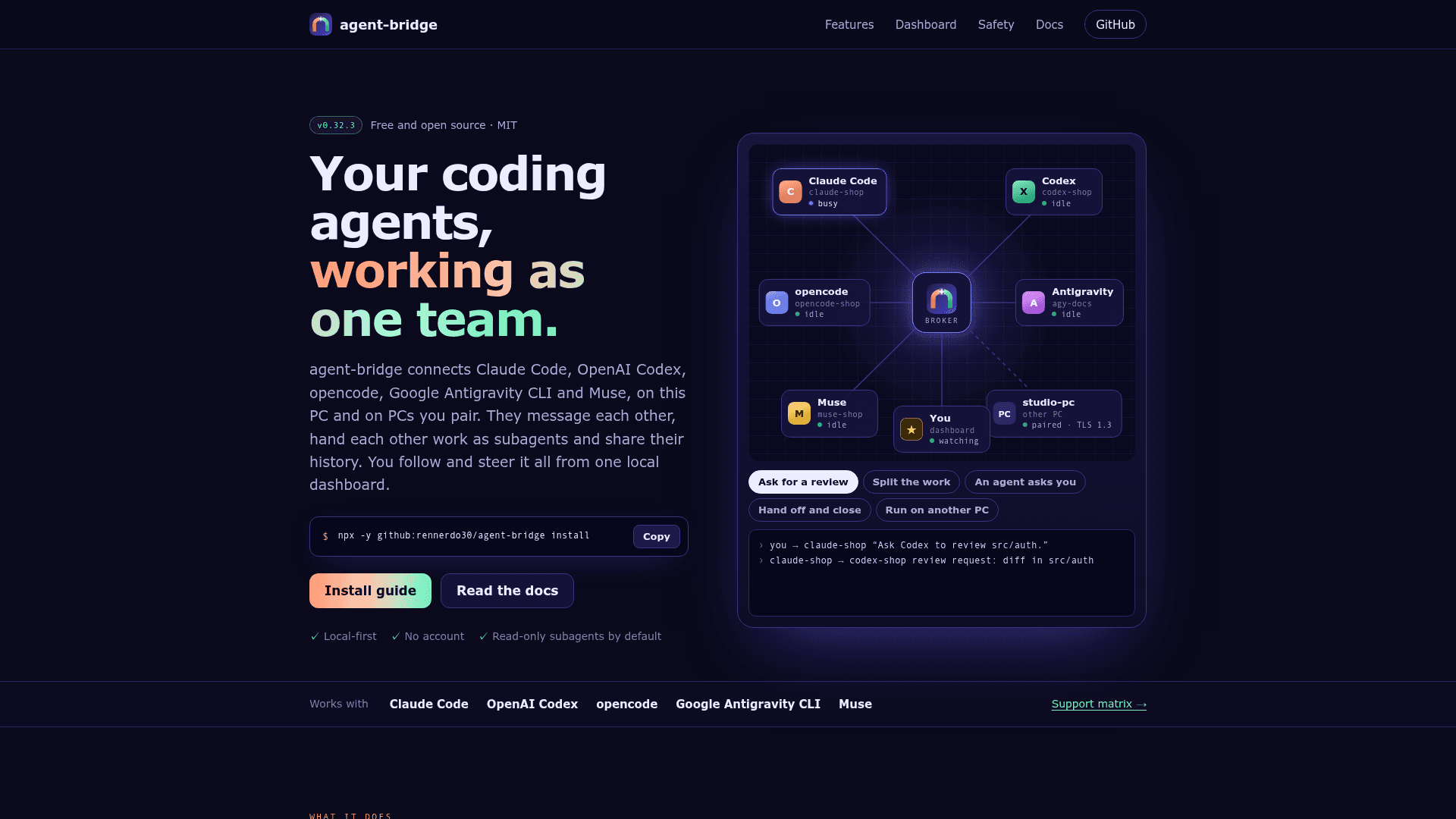
agent-bridge is an open-source, MIT-licensed project by rennerdo30 that connects several coding-agent CLIs so they can work together. It links Claude Code, OpenAI Codex, opencode, Google Antigravity CLI and Muse on one PC or on paired PCs, and gives you a local dashboard to follow and steer them. The latest release listed on GitHub is v0.33.1.
What It Is
agent-bridge is a multi-agent coordination layer for coding CLIs. It provides a shared address book, mailroom and job board: sessions can send each other questions, reviews and results, and any supported CLI can spawn subagents of any supported kind, including its own. Everything runs locally, with one small broker per PC, SQLite storage under ~/.agent-bridge, and no account or hosted server.
How the Workflow Runs
You install it with an npx command, and then talk to the agent you already use in plain language, for example asking Codex to review a diff or starting two subagents in worktrees. Subagents are read-only by default, access can be raised per job (read, ask, edit), and editing jobs can get their own git worktree. You can steer a running subagent, continue a finished one with its context, cancel it, or hand all of them to another session. Jobs can carry checklists with a definition of done, and agents can ask you questions that wait in one place and can be pinned as lasting decisions.
Dashboard and Paired PCs
The dashboard at 127.0.0.1:4777 shows sessions, subagent trees, live chats, progress with ETA, approvals, pinned decisions, usage left per CLI and full history search. Two PCs can pair once over TLS 1.3 with a one-time code, after which their agents can exchange messages and files and start jobs on the other machine. History is archived rather than deleted, and upgrades migrate data with a backup first.
Safety Defaults
Connections must present a secret from ~/.agent-bridge/token, and the dashboard listens only on localhost with an access key. Messages from peer agents are marked, and agents are told not to act destructively just because a peer asked. Worktree cleanup is off by default and only touches worktrees agent-bridge created itself. The project states it is independent and not affiliated with Anthropic, OpenAI or Google.
Setup Path
It requires Node.js 24 or newer. The installer detects supported CLIs, shows its plan and asks before changing anything; separate update and status commands are provided. In Codex, the agent-bridge hooks must be trusted once in /hooks.
Community Discussions
Be the first to start a conversation about agent-bridge
Share your experience with agent-bridge, ask questions, or help others learn from your insights.
Pricing
Open Source
Free and open-source (MIT) self-hosted local broker and dashboard connecting coding agent CLIs; no account and no server of ours.
- MIT licensed
- Local-first, no account
- Messaging between Claude Code, Codex, opencode, Antigravity and Muse
- Subagent delegation with worktrees
- Local dashboard at 127.0.0.1:4777
Capabilities
Key Features
- Agent-to-agent messaging
- Any supported CLI can delegate to any other as subagents
- Read-only subagents by default with per-job access levels
- Git worktrees for editing jobs
- Main and secondary session failover
- Subagent checklists with definition of done
- Owner questions and pinned decisions
- Local dashboard with subagent trees, progress and ETA
- Searchable archived history
- Paired PCs over TLS 1.3
- Installer and update commands
- Usage left per CLI