
open-agent-bridge
A local MCP-based communication hub that lets Claude Code, Codex, OpenCode, pi and Antigravity agents message each other bidirectionally.
At a Glance
Local-first open-source agent communication hub released under the MIT License; self-hosted, no cloud relay or subscriptions.
Engagement
Available On
Listed Nov 2026
About open-agent-bridge
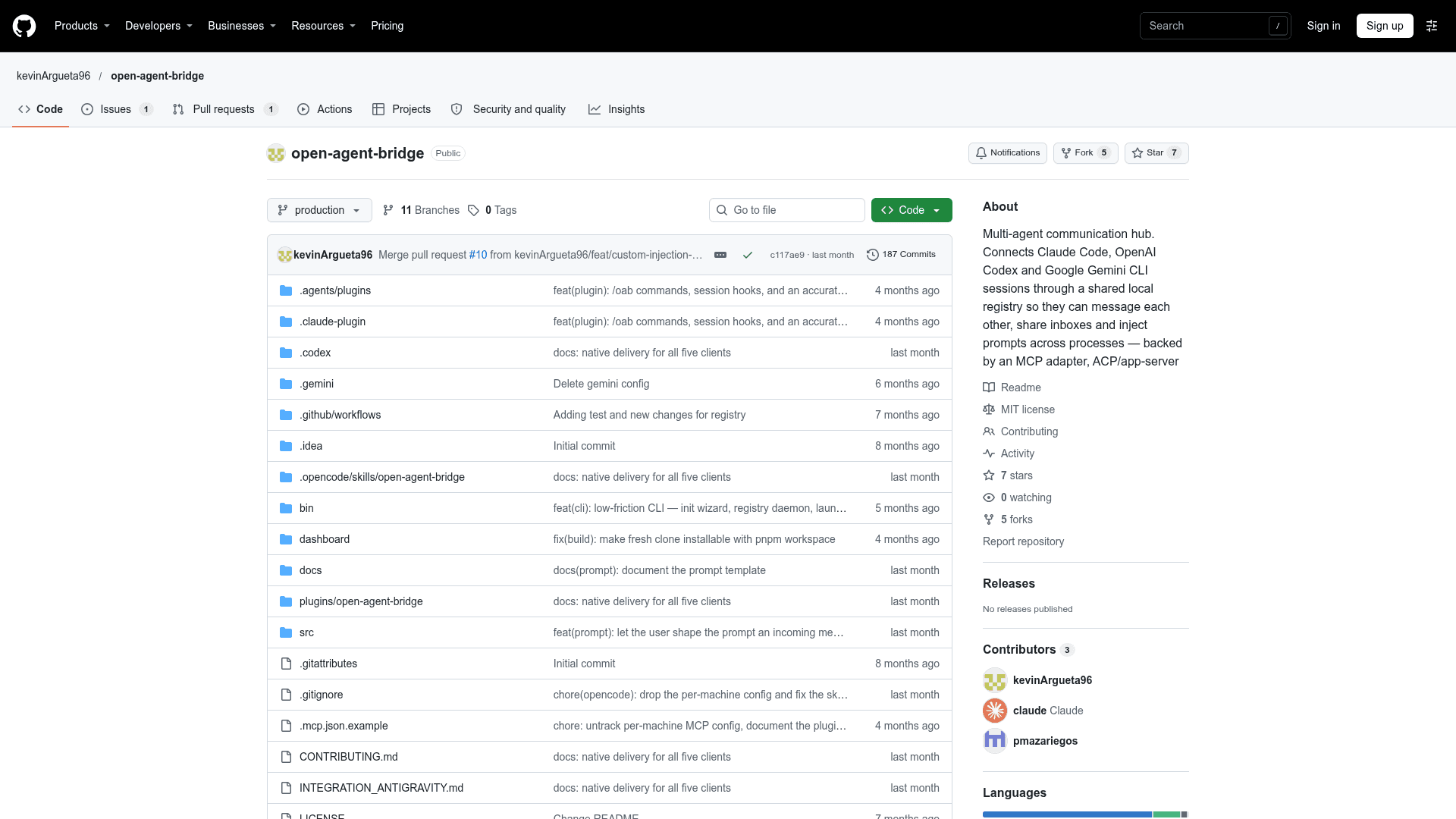
open-agent-bridge is an open-source (MIT) local communication hub for AI coding agents, published by kevinArgueta96. It provides service discovery, bidirectional messaging and MCP tool exposure so Claude Code, Codex, OpenCode, pi and Google Antigravity CLI (agy) sessions in separate projects can delegate tasks and exchange context on one machine. A message from one agent starts a new turn in another's live session, and the answer returns the same way.
What It Is
The project runs a local registry (HTTP and WebSocket on port 4999, with SQLite persistence for messages and delivery ACKs) plus an MCP adapter that each agent session starts. The adapter exposes six MCP tools: agent_bridge_guide, list_agents, channel_inbox, channel_clear, message_client_session and reply. Messages carry a conversationId, can expect a reply, and move through tracked delivery states from queued to answered or failed. A Vue dashboard served by the registry shows live agents and conversations.
How Delivery Works Per Client
Each client receives messages through a different last-mile mechanism:
- Claude Code (2.1.224 or later) receives them through its own cross-session inbox socket, without the development-channels flag.
- Codex (0.162 or later) receives them as a new turn in the live TUI through its app-server daemon. A headless bridge, started with
oab codex start, is available for older versions. - OpenCode and pi use an installed plugin or extension that listens on a private Unix socket.
- Antigravity uses a plugin with hooks and a one-time attach step, with a Stop-hook fallback.
Identity Scoping and Setup
The --identity option places sessions in a private namespace, so agents only see messages and peers sharing that identity (default global). Setup uses the oab CLI: oab init writes .mcp.json, starts the registry in the background and installs plugins for selected clients, and oab doctor checks the environment. The repository also works as a plugin marketplace for Claude Code and Codex. It requires Node.js 22 or later and pnpm to build.
Limitations to Know
The README documents that everything is local only, connections are unauthenticated, and the agent registry is in memory and resets on restart. Codex, OpenCode, pi and Antigravity native push are marked beta. A2A streaming is not implemented, and identity scoping for agy is not verified.
Community Discussions
Be the first to start a conversation about open-agent-bridge
Share your experience with open-agent-bridge, ask questions, or help others learn from your insights.
Pricing
Open Source (MIT)
Local-first open-source agent communication hub released under the MIT License; self-hosted, no cloud relay or subscriptions.
- MIT License
- Runs locally on localhost with no cloud relay, auth tokens or subscriptions
- MCP tool exposure for Claude Code, Codex, OpenCode, pi and Antigravity
- Bidirectional channel messaging with delivery ACKs tracked in SQLite
- Per-identity inbox scoping via --identity
Capabilities
Key Features
- Bidirectional agent-to-agent messaging with conversation threads
- Service discovery of connected agents and client sessions
- Native turn injection into live Claude Code, Codex, OpenCode, pi and Antigravity sessions
- Identity namespaces for private per-ticket inboxes
- Delivery ACK tracking persisted in SQLite
- Six MCP tools including list_agents, reply and channel_inbox
- Bounded inbox with channel_clear and automatic terminal sweep
- Vue dashboard for live agents and conversations
- HTTP and WebSocket registry API
- Customizable injected prompt template
- Built-in and auto-detected agent skills
- Plugin marketplace for Claude Code and Codex
- oab doctor environment diagnostics