
Agent Pilot
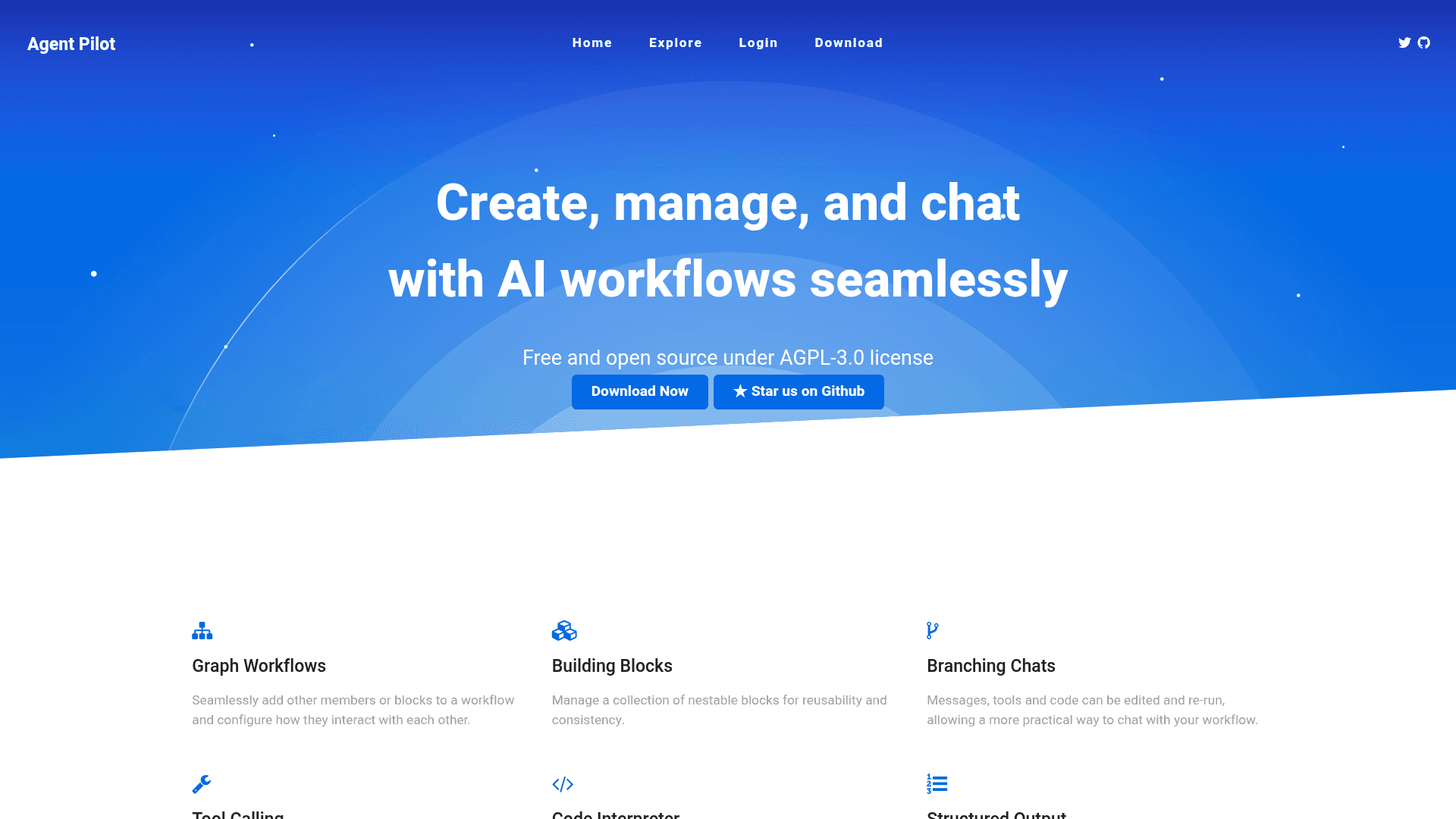
An open-source desktop application for creating, managing, and chatting with AI workflows, from single LLMs to complex multi-agent graph-based pipelines.
At a Glance
Open-source core with source code access and limited support.
Engagement
Available On
Listed Jul 2026
About Agent Pilot
Agent Pilot is a free, open-source workflow automation system licensed under AGPL-3.0, built in Python and available as pre-compiled binaries for Windows, Linux, and Mac Intel. It lets users design AI-driven workflows visually, chat with them in real-time, and extend them through a plugin and module system. The project is maintained by GitHub user jbexta and reached v0.5.1 in May 2025.
What It Is
Agent Pilot is a desktop application that sits at the intersection of AI chat interfaces and workflow automation engines. Rather than simply wrapping a single LLM, it provides a graph-based canvas where users compose multi-member workflows from agents, text blocks, code runners, prompts, and nested sub-workflows. The result can be chatted with interactively, scheduled to run automatically, or used as a reusable building block inside other workflows.
Graph Workflows and Building Blocks
The core design unit in Agent Pilot is the workflow graph. Members placed vertically in the graph execute in parallel; sequential execution is controlled by layout. Available member types include:
- Agent – LLM-backed member with integrated tools and message history
- User – awaits human input at runtime
- Text – nestable text block supporting inline block references via
{block-name}syntax - Code – executes arbitrary code and returns output
- Prompt – single-prompt LLM call
- Module – runs or retrieves from a Python module imported at runtime
- Workflow – any combination of the above, nestable infinitely
Blocks and tools share this same member architecture, so a "tool" assigned to an agent can itself be an entire multi-step workflow.
Model and Plugin Support
LiteLLM is integrated as the primary model provider layer, giving access to 100+ models across providers including OpenAI, Anthropic, Google Gemini, Mistral, Groq, DeepSeek, Ollama, AWS Bedrock, Azure OpenAI, Cohere, Huggingface, Replicate, Together AI, and many others. The plugin system supports custom agent behaviors, workflow behaviors, and provider extensions. Open Interpreter is bundled as a plugin and can execute code in nine languages: Python, Shell, AppleScript, HTML, JavaScript, PowerShell, R, React, and Ruby. Structured outputs are supported via the Instructor library.
Customizable UI and Modules
Agent Pilot's UI is itself built on a set of base classes that developers can extend or replace at runtime. Python module files imported at runtime ("Modules") enable persistent behaviors such as custom memory systems, daemon processes, toolkits, and entirely custom configuration pages. The README notes that the entire application is built on this same framework, making it possible to modify or create configuration pages while the app is running.
Update: Release v0.5.1
The latest release is v0.5.1, published on May 15, 2025. The GitHub repository was last updated in July 2026 and last pushed in April 2026, indicating ongoing maintenance. The project has accumulated 559 stars and 80 forks on GitHub as of the data available. A premium membership tier unlocks the Scheduler feature, which supports natural language time expressions for recurring workflow execution (e.g., "every 2nd Tuesday of the month"). Voice support is listed as "coming back soon" in the README, indicating it was previously available and is planned for re-introduction.
Community Discussions
Be the first to start a conversation about Agent Pilot
Share your experience with Agent Pilot, ask questions, or help others learn from your insights.
Pricing
Free
Open-source core with source code access and limited support.
- Source code access
- Graph workflows
- Branching chats
- Tool calling
- Code interpreter
Members
Premium membership unlocking binaries, full support, and the Scheduler feature.
- Pre-compiled binaries
- Full support
- Scheduler (natural language recurring workflows)
Capabilities
Key Features
- Graph-based multi-member workflow builder
- Branching chats with message/tool/code re-execution
- LiteLLM integration for 100+ model providers
- Open Interpreter code execution in 9 languages
- Structured outputs via Instructor
- Nestable blocks and reusable building blocks
- Tool creation with workflow-as-tool support
- Python module system for persistent behaviors
- Customizable and generative UI framework
- Scheduled and recurring workflows with natural language expressions
- Plugin system for agents, workflows, and providers
- AI enhancement for fields and system messages
- Folder organization for agents and chats
- Parallel execution via vertical member alignment