Stack AI
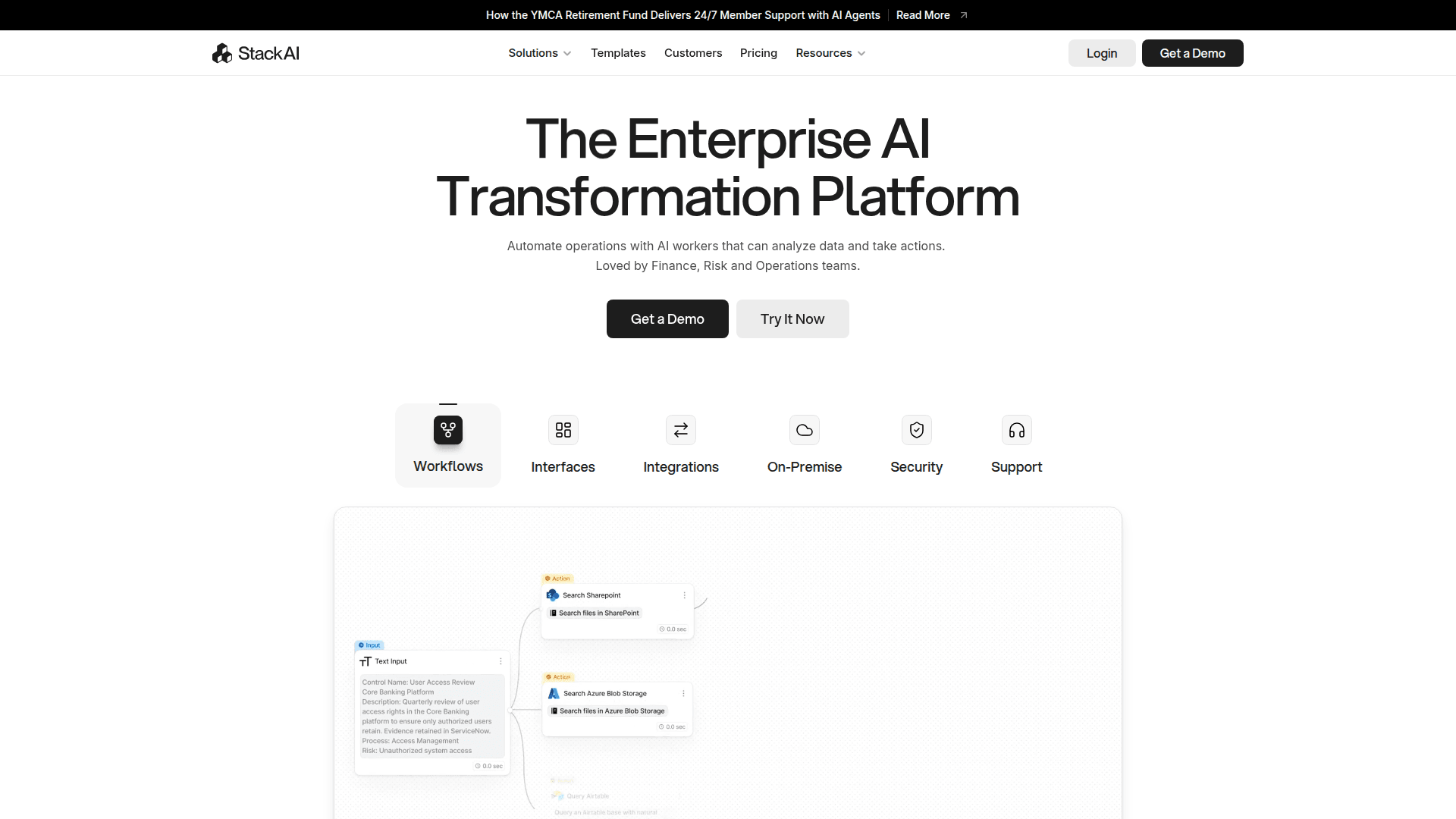
Enterprise AI transformation platform that automates operations with AI workers that can analyze data and take actions.
At a Glance
Start building AI apps with basic features.
Engagement
Available On
Listed Jan 2026
About Stack AI
Stack AI is an enterprise AI transformation platform designed to automate operations with AI workers capable of analyzing data and taking actions. Built by PhDs at MIT, the platform enables Finance, Risk, and Operations teams to deploy AI agents that transform unstructured data into structured insights through extraction, retrieval, and generation capabilities.
Key Features:
-
Data Extraction - Pull structured data from unstructured sources including PDFs, scans, and forms with built-in Optical Character Recognition (OCR) capabilities.
-
Knowledge Retrieval - Ask questions and instantly get cited answers from your knowledge base with one-click Retrieval-Augmented Generation (RAG).
-
Document Generation - Create polished, stakeholder-ready documents in minutes with export options to Google Docs, Microsoft Word, and more.
-
Visual Workflow Builder - Build AI-powered workflows without code using an intuitive drag-and-drop interface that makes development self-explanatory.
-
100+ Enterprise Integrations - Connect AI agents to existing systems including Google Drive, Notion, Slack, and REST APIs to read, write, and execute tasks.
-
Multiple AI Models - Access GPT-4, GPT-3.5, Claude 2, Claude 3, and multi-modal capabilities including vision, text-to-speech, and speech-to-text.
-
Enterprise-Grade Security - HIPAA, SOC 2 Type II, and GDPR compliant with options for on-premise deployment, VPC deployment, and SSO.
-
Custom Interfaces - Deploy AI workflows through browser extensions, Chrome extensions, REST APIs, and Slack bots.
-
Knowledge Bases - Build knowledge bases from document uploads, web scraping, and Google Drive with support for PDF, Word, and PowerPoint readers.
To get started, sign up for a free account with 500 runs per month and 2 projects. The visual workflow builder allows teams to create AI workflows quickly without coding expertise. For enterprise needs, book a demo to explore custom infrastructure, dedicated support, and advanced security features. The platform serves industries including healthcare, finance, insurance, industrials, and more.
Community Discussions
Be the first to start a conversation about Stack AI
Share your experience with Stack AI, ask questions, or help others learn from your insights.
Pricing
Free
Start building AI apps with basic features.
- 500 runs per month
- 2 Projects
- 1 Seat
- Community support on Discord
- Agents
Enterprise
Custom AI platform with advanced security and support.
- Custom number of runs
- Custom number of seats
- All features and data loaders
- Dedicated infrastructure
- Dedicated solution engineers
- On-prem deployment
- Virtual Private Cloud deployment
- Access control
- SSO (Single Sign-On)
- SOC 2, HIPAA & GDPR compliance
- Email Support
- Priority Support
- Dedicated Support
Capabilities
Key Features
- Data extraction from PDFs, scans, and forms with OCR
- Knowledge retrieval with RAG
- Document generation to Google Docs and Word
- Visual workflow builder
- 100+ enterprise integrations
- GPT-4, GPT-3.5, Claude 2, Claude 3 models
- Multi-modal capabilities (vision, text-to-speech, speech-to-text)
- Browser and Chrome extensions
- REST API access
- Slack bot integration
- Knowledge base creation
- Web scraping
- Python and JavaScript code execution
- Custom domain support
- Analytics dashboard
- SSO (Single Sign-On)
- On-premise deployment
- VPC deployment
- Access control
- HIPAA compliance
- SOC 2 Type II compliance
- GDPR compliance
Integrations
Demo Video