
Continuity
Durable project-state manager for AI sessions that tracks decisions, constraints, and rejected paths in git-backed markdown files across Claude Code, Cursor, and any MCP host.
At a Glance
Fully free and open source under the MIT license. No cost to use, modify, or distribute.
Engagement
Available On
Alternatives
Listed Sep 2026
About Continuity
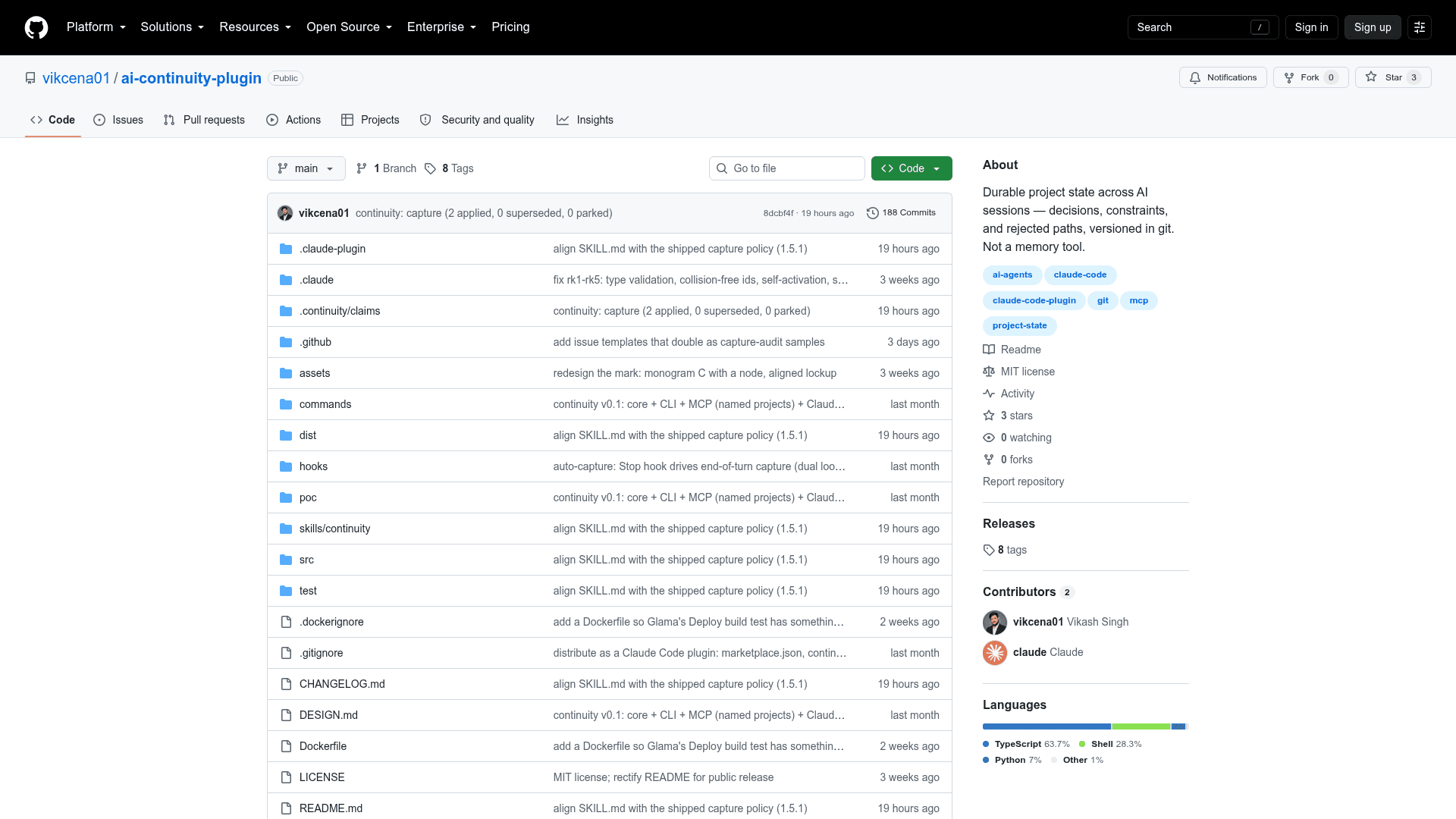
Continuity is an open-source Claude Code plugin and MCP server that preserves project state across AI sessions — not as a conversation log, but as a structured, git-versioned record of decisions, constraints, rejected alternatives, and open questions. Built by Vikash and released under the MIT license, it targets developers running long-running AI-assisted projects in Claude Code, Cursor, or any tool that speaks MCP.
What It Is
Continuity solves a specific problem: when a new AI session starts, the model has no memory of what was decided, what was ruled out, or why. Rather than replaying chat history, Continuity maintains a set of plain markdown "claim" files under .continuity/claims/ (or a named central directory for tools without a project working directory). Each claim carries a type, status, confidence level, and provenance, and the entire store is committed to git on every change — making git log the event log, git revert the rollback mechanism, and git blame the audit trail.
The README explicitly distinguishes Continuity from memory tools: "A memory tool answers 'what did we talk about?' Continuity answers a different question: 'what is true about this project now, and what must not be touched?'"
How the Two Storage Modes Work
Continuity ships two storage modes behind a single API:
- Repo mode — state lives at
<repo>/.continuity/, discovered by walking up from the working directory. Suited for editor and agent tools like Claude Code that have a projectcwd. - Central mode — state lives at
~/.continuity/projects/<name>/, addressed by project name. Suited for hosts like plain Claude Desktop that have no projectcwd.
Both modes expose the same CLI verbs and MCP tools, so the workflow is identical regardless of host.
The Claim Model and CLI
Claims are short, typeable IDs (e.g., d1k3, c2m9) composed of a type prefix, sequence number, and two-character collision-safe suffix. The suffix prevents merge conflicts when two developers record the same-numbered claim concurrently. Key CLI verbs include:
continuity init— start a project with a mission statementcontinuity record-decision / record-constraint / reject— capture statecontinuity freeze— lock an invariant; overriding a frozen claim requires a second deliberate--unfreezecontinuity resume— emit the compact state a new session receives (a deterministic projection, no LLM in the read path)continuity why— show what a decision replaced and whycontinuity resolve— the only way to close a claim; reason is mandatorycontinuity review— semantic diff of what was autonomously captured, with--acceptto mark it reviewed
Claude Code Plugin Capabilities
When installed as a Claude Code plugin, Continuity adds capabilities beyond the base MCP server:
- A SessionStart hook that auto-injects
resume_contexton new, resumed, or post-compact sessions — no manual prompt needed - A Stop hook that runs an end-of-turn capture check so decisions are recorded without anyone remembering to ask; two independent guards prevent hook loops
- Slash commands
/resume,/freeze,/why
The repo also ships .claude/settings.json registering these hooks against the committed dist/, so a collaborator who clones the repo gets auto-resume and auto-capture without installing anything separately.
Architecture and Trust Model
The resume context is a deterministic projection of the claim files — no LLM is involved in the read path. Every claim carries confidence (confirmed / tentative / unverified) and provenance (manual vs. auto-captured), so a fresh session can calibrate trust rather than accepting all state blindly. A reconciler behind every batch capture handles deduplication, lineage-preserving supersession, and a frozen-guard that parks contradicting claims as needs_review instead of silently applying them.
The claim-file schema is versioned (schema: 1). Older claims without a schema field are treated as version 1 and migrated forward in memory without rewriting files. Claims written by a newer, unknown schema version are refused loudly rather than half-parsed.
Current Status: v1.5
The README describes the current release as v1.5, featuring a deterministic core, CLI, MCP server, Claude Code plugin, versioned claim files, collision-safe IDs, fuzzy lookup, a budgeted resume projection, git-backed event log, and 211 assertions across eleven test suites. The repository was last pushed in September 2026. Known open limits tracked as claims in the repo's own .continuity/ include: the Stop-hook capture check is throttled to at most once per 10 seconds (so a decision settled in a very fast exchange can be missed), and reliable status extraction from messy sessions remains an open technical risk.
Community Discussions
Be the first to start a conversation about Continuity
Share your experience with Continuity, ask questions, or help others learn from your insights.
Pricing
Open Source
Fully free and open source under the MIT license. No cost to use, modify, or distribute.
- Full CLI with all verbs
- MCP server for Claude Desktop and other MCP hosts
- Claude Code plugin with SessionStart and Stop hooks
- Git-backed claim storage
- Zero runtime dependencies
Capabilities
Key Features
- Git-backed project state in plain markdown files
- Two storage modes: repo mode and central/named-project mode
- Deterministic resume context projection (no LLM in read path)
- Claim confidence and provenance tracking
- Frozen invariants with deliberate unfreeze requirement
- Autonomous capture via Claude Code Stop hook
- SessionStart hook for auto-resume on new/resumed/post-compact sessions
- Slash commands: /resume, /freeze, /why
- Collision-safe short claim IDs with type prefix and suffix
- Reconciler with deduplication and lineage-preserving supersession
- Versioned claim-file schema with forward migration
- CLI verbs: init, record-decision, record-constraint, reject, freeze, resume, why, resolve, review
- MCP server with named-project support for Claude Desktop
- Zero runtime dependencies
- 211 assertions across eleven test suites