AI DevOps
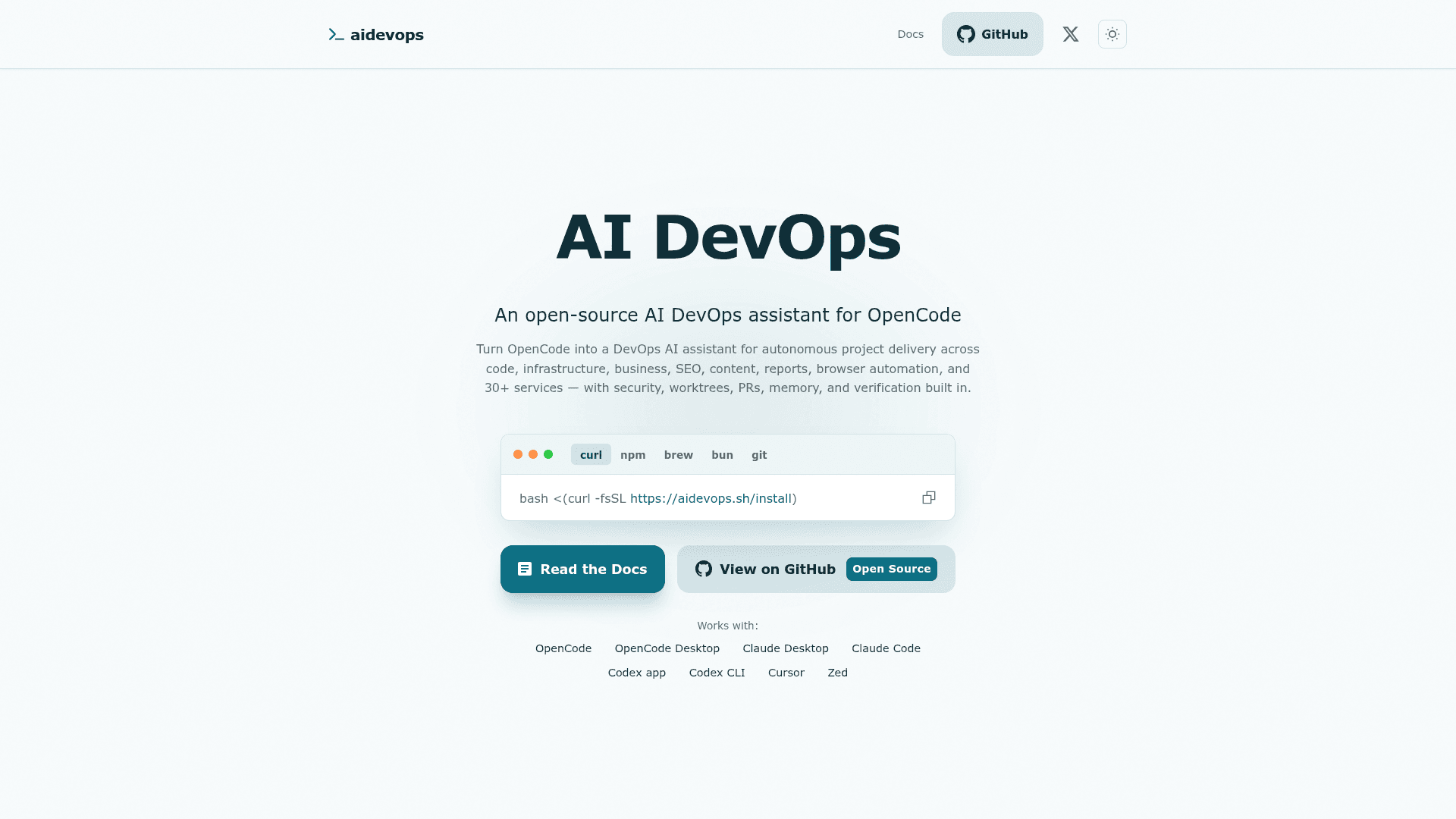
An open-source AI DevOps framework and OpenCode plugin that turns AI assistants into autonomous project delivery agents across code, infrastructure, business, SEO, and 30+ services.
At a Glance
About AI DevOps
AI DevOps (aidevops) is an open-source framework created by Marcus Quinn on 9 November 2025 that wraps OpenCode and other AI coding tools with the coordination, security, and git hygiene needed to ship real work autonomously. It is MIT-licensed, free to use, and installable via npm, Homebrew, Bun, or a direct curl script.
What It Is
AI DevOps is an agent harness and DevOps automation framework built for the gap between "the model can probably do this" and "the work is actually done, verified, safe, and worth the cost." Rather than replacing an AI coding tool, it layers structure on top of one — providing context routing, secret management, git worktree isolation, multi-agent orchestration, cross-model verification, and a library of 2,150+ domain-specific agent markdown files and 1,630+ helper scripts. The recommended runtime is OpenCode paired with OpenAI GPT-5.5 for complex work and GPT-5.4 mini for triage and routine tasks, though Claude (Anthropic), Gemini, Cursor, and local models via llama.cpp are all supported.
Autonomous Orchestration Architecture
The framework's core runtime primitive is the Pulse supervisor — an autonomous AI supervisor that runs every two minutes via launchd with no human at the terminal. Each pulse cycle merges ready PRs, dispatches workers to open issues, kills stuck processes, detects orphaned PRs, syncs TODO state with GitHub, triages quality findings from SonarCloud/CodeRabbit/Codacy, and advances multi-day Missions. Missions break a high-level goal into milestones, dispatch parallel workers in isolated git worktrees, validate each milestone, and track model budget automatically.
Key orchestration components include:
- SQLite-backed mailbox for inter-agent messaging across parallel sessions (WAL mode, indexed queries)
- Named runners — persistent headless agent instances with their own AGENTS.md, config, and memory namespaces
- Multi-model verification — destructive operations (force push to main, DROP DATABASE, production deploy) are blocked unless a second AI model from a different provider independently agrees
- Budget tracker — append-only cost log with burn-rate analysis and model routing decisions
- TOON format — Token-Oriented Object Notation that the project claims delivers 20–60% token reduction vs JSON/YAML for agent indexes and registries
Agent Design and Domain Coverage
The framework ships 14 primary agents (Build+, Automate, Product, SEO, Marketing-Sales, and others) with specialist subagents on demand, organized across domains including code, infrastructure, business, legal, content, research, SEO, health, reports, and framework self-improvement. A compressed TOON routing table (subagent-index.toon) maps all 2,150+ agents by domain, purpose, and dependency so agents can discover related context without loading full markdown files.
Domain coverage extends well beyond code:
- Infrastructure & hosting: Hetzner, Hostinger, Coolify, Vercel, AWS, DigitalOcean, Cloudflare DNS
- Security & quality: gopass/Vaultwarden for secrets, SonarCloud, CodeFactor, Codacy, CodeRabbit, Snyk, Socket, Secretlint, OSV Scanner, Cisco Skill Scanner for imported agent skills
- SEO: 40+ SEO subagents covering Ahrefs, DataForSEO, Serper, Semrush, Google Search Console, Bing Webmaster Tools
- Browser automation: Playwright, Stagehand, Crawl4AI, Chrome DevTools MCP, agent-browser
- Communications: Matrix bot dispatch, SimpleX Chat gateway, Matterbridge bridging 20+ platforms
- Voice: Whisper MLX → OpenCode → Edge TTS pipeline with ~6–8 second round-trip on Apple Silicon
MCP Integration and Skill System
The framework configures 20 MCP servers for OpenCode, split between globally loaded tools (Augment Context Engine, Claude Code MCP) and per-agent tools that load on demand to avoid context overhead. MCP packages are installed globally via bun install -g for ~0.1s startup vs 2–3s with npx.
An importable skills system lets users pull external SKILL.md files from GitHub or ClawdHub registries. Imported skills are automatically security-scanned via Cisco Skill Scanner; CRITICAL/HIGH findings block the import. The framework ships curated skills for Cloudflare Workers, HeyGen video, Remotion, Anime.js, CalDAV, and Proxmox VE.
Update: v3.32.220
The latest release is v3.32.220, published on 4 August 2026. Recent framework additions documented in the README include OpenCode GUI/control-plane planning with ADRs and threat-model guidance, mobile and simulator workflows (Expo, Xcode, App Store Connect, Maestro, iOS Simulator MCP), self-hosted GitHub runner lifecycle runbooks, pulse diagnostics with compact API-budget reporting, worker and PR observability with causal lineage tracking, and OpenCode runtime polish including versioned session title suffixes and OAuth pool hardening. The GitHub repository shows 23,879 commits to date with daily commit activity, 359 stars, and 59 forks as of the data collected.
Setup Path and System Requirements
Installation takes a single command. The recommended path is npm install -g aidevops && aidevops update, which deploys agents to ~/.aidevops/agents/ and installs the CLI. Homebrew (brew install marcusquinn/tap/aidevops) and Bun alternatives are also supported. After installation, aidevops init scaffolds any git repository with planning files, agent context, and optional deployment manifests. The framework itself is lightweight (shell scripts + markdown); GPU is only needed for local voice pipeline or local LLM inference. Minimum hardware is any modern laptop with 8 GB RAM for cloud AI API use.
Community Discussions
Be the first to start a conversation about AI DevOps
Share your experience with AI DevOps, ask questions, or help others learn from your insights.
Pricing
Open Source
Fully free and open-source under MIT license. No cost to use, modify, or distribute.
- Full framework source code
- 14 primary agents and 2,150+ subagent markdown files
- 1,630+ helper scripts
- 20 MCP server integrations
- 30+ service integrations
Capabilities
Key Features
- Pulse supervisor for autonomous 24/7 AI operations
- Multi-agent orchestration with git worktree isolation
- Mission system for multi-day autonomous projects
- Cross-model verification for high-stakes operations
- 14 primary domain agents with 2,150+ subagent markdown files
- 1,630+ helper scripts for deterministic automation
- 20 MCP server integrations
- 30+ service integrations (hosting, DNS, security, SEO, comms)
- TOON format for 20-60% token reduction
- SQLite-backed inter-agent mailbox system
- Named runners with persistent identity and memory namespaces
- Budget tracking with burn-rate analysis and model routing
- Importable skills system with Cisco Skill Scanner security gate
- Voice bridge (Whisper MLX → OpenCode → Edge TTS, ~6-8s round-trip)
- Browser automation via Playwright, Stagehand, Crawl4AI
- 40+ SEO subagents
- GPG-encrypted secret management via gopass
- Multi-platform code quality (SonarCloud, CodeFactor, Codacy, CodeRabbit, Snyk)
- Self-improving agent system with privacy filtering
- Agent testing framework with before/after comparison
- Task graph visualization with Beads
- Report generation with PDF export (A4, US Letter, slides)
- Local model inference via llama.cpp
- Matrix bot dispatch and SimpleX Chat gateway
- Mobile app and simulator testing workflows