
aide
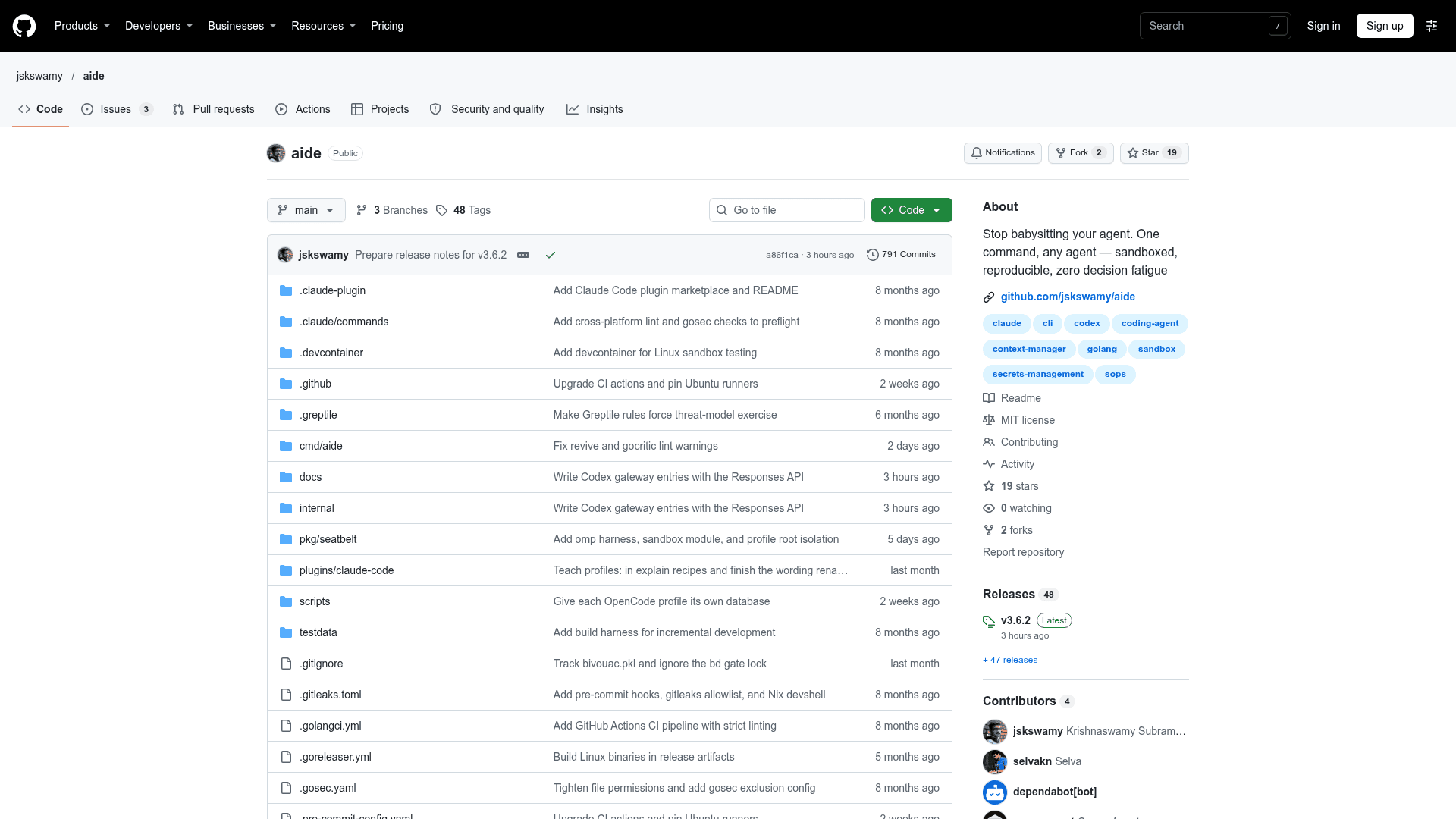
A CLI that launches any coding agent inside an OS-native sandbox with per-project profiles, encrypted secrets, and plugin provisioning.
At a Glance
aide CLI released under the MIT License (OSI-approved); free to use, copy, modify and distribute.
Engagement
Available On
Listed Nov 2026
About aide
aide is an open-source command-line tool by jskswamy that launches coding agents such as Claude, Codex, Aider and Gemini inside an OS-native sandbox. It resolves the agent, credentials and permitted capabilities from the current project directory, so a single aide command works across projects. It runs on macOS and Linux and is released under the MIT license.
What It Is
aide is a sandboxing and launch wrapper for AI coding agents. Running aide in a project matches the git remote URL and directory path against your configuration, resolves a profile (agent, credentials, capabilities, sandbox policy), decrypts secrets in-process, and then execs the agent inside the sandbox. If no config exists, it detects an agent on PATH and launches it directly.
The README lists supported agents as Aider, Amp, Claude, Codex, Copilot, Cursor, Gemini, Goose, OpenCode and Pi, and says any binary on PATH can be used as an agent target.
Sandbox and Capabilities
On macOS the sandbox uses Seatbelt. On Linux it uses Landlock plus seccomp, with a bubblewrap fallback that provides filesystem-only isolation. The README notes that if neither Landlock nor bubblewrap is available, aide logs a warning and launches the agent without OS-level isolation, and recommends aide sandbox show to confirm the active tier.
By default the agent can read code, run tests and use the network but cannot reach SSH keys, cloud credentials or browser data. Capabilities are task-oriented permission bundles enabled with --with (for example docker, k8s, gcp). The README documents 24 built-in capabilities, including aws, azure, terraform, vault, ssh, and language toolchains. Users can also create custom capabilities, extend built-ins, and set global never-allow paths or environment variables that no capability can override.
Secrets, Provisioning and Diagnostics
Secrets are sops-encrypted YAML files using age keys and are decrypted in-process at launch, so they are never written to disk as plaintext. Config and encrypted secrets can be versioned in git and reused on other machines, in Docker or in CI.
Provisioning lets you declare a plugin set in provisioning.yaml and reconcile it with aide sync, with --plan to preview changes. Per-profile config_dir_name keeps each profile's agent configuration directory separate. A statusline integration for Claude Code shows live sandbox, network and capability state. aide --diagnose captures agent stderr and writes a redacted markdown report suitable for sharing in an issue.
Current Status
The latest release listed is v3.6.1. The README lists planned work on domain-level network filtering and a command deny list.
Community Discussions
Be the first to start a conversation about aide
Share your experience with aide, ask questions, or help others learn from your insights.
Pricing
Open Source
aide CLI released under the MIT License (OSI-approved); free to use, copy, modify and distribute.
- MIT License
- OS-native sandbox (macOS Seatbelt, Linux Landlock + seccomp, bubblewrap fallback)
- Secrets encrypted via sops/age
- Plugin provisioning and sync
- --diagnose reports
Capabilities
Key Features
- OS-native sandboxing (Seatbelt on macOS, Landlock + seccomp on Linux, bubblewrap fallback)
- 11 default guards covering filesystem, network, credentials and dev tools
- 24 built-in capabilities plus custom capabilities
- never-allow paths and environment variables
- Per-project profiles matched by git remote or directory path
- sops/age encrypted secrets decrypted in-process
- Declarative plugin provisioning with aide sync, adopt and plugin list
- Per-profile agent config directories
- Live statusline for Claude Code
- Project config trust workflow (aide trust / aide deny)
- -diagnose redacted failure reports
- Argument passthrough to the agent after --