
AIPass
A CLI-native scaffold that adds persistent memory, identity, and coordination to AI agents, enabling them to remember across sessions and collaborate on shared projects.
At a Glance
Fully free and open-source under the MIT License. Install via pip and use with your existing Claude Pro/Max or Codex CLI subscription.
Engagement
Available On
Alternatives
Listed Jul 2026
About AIPass
AIPass is an open-source, CLI-native framework published under the MIT License that gives AI agents persistent memory, identity, and inter-agent coordination. Built and actively developed by a solo developer in collaboration with the AI agents themselves, it is currently in beta and available on PyPI as aipass.
What It Is
AIPass is a persistent agent workspace scaffold — a Python package you install via pip that layers agent infrastructure on top of any existing project. Rather than replacing your workflow, it adds the plumbing that lets AI agents remember who they are, pick up where they left off, and communicate with each other through a shared filesystem. There is no UI, no dashboard, and no cloud dependency; everything runs in your terminal.
How the Persistence Model Works
The core innovation in AIPass is its approach to agent memory and identity. Each agent gets a .trinity/ directory containing three JSON files that store identity and memory. When an agent starts a new session, it reads these files and resumes from its last known state. When memory files fill up, older entries automatically archive into ChromaDB for long-term semantic search — nothing is lost, and no manual management is required.
- Identity: Each agent has a stable identity defined in
.trinity/files - Mailbox: Agents communicate via
.ai_mail.local/local mailbox files - Shared workspace: All agents operate on the same filesystem simultaneously — no sandboxes, no worktrees
- Plain files: All state is stored as JSON files; delete the directory and it's gone
Architecture and the Reference Implementation
AIPass ships with 13 core agents that maintain and develop the framework itself, serving as both a reference implementation and a set of reusable services. The orchestrator agent is devpulse; users interact with it and it coordinates the rest. Key agents include drone (CLI command router), ai_mail (agent-to-agent messaging), memory (automatic archival and ChromaDB vector search), seedgo (automated quality standards), flow (plan lifecycle management), and trigger (event-driven automation and self-healing). The drone CLI router uses the syntax drone @agent command to reach any agent in the system.
CLI Support and Deployment Model
AIPass is built and tested primarily with Claude Code on Linux and WSL, with experimental support for OpenAI's Codex CLI. It runs each CLI as an official subprocess — the same binary a user would run manually — and does not extract credentials or intercept tokens. API keys are optional and only required for add-on agents using OpenRouter or OpenAI. Core functionality runs entirely on an existing Claude Pro/Max or Codex subscription with no additional API costs.
Supported environments per the README:
- Linux, macOS (CI green), and WSL (all CI-tested)
- Windows native (CI green, full test suite passing)
- Python 3.10+
Update: v2.6.0
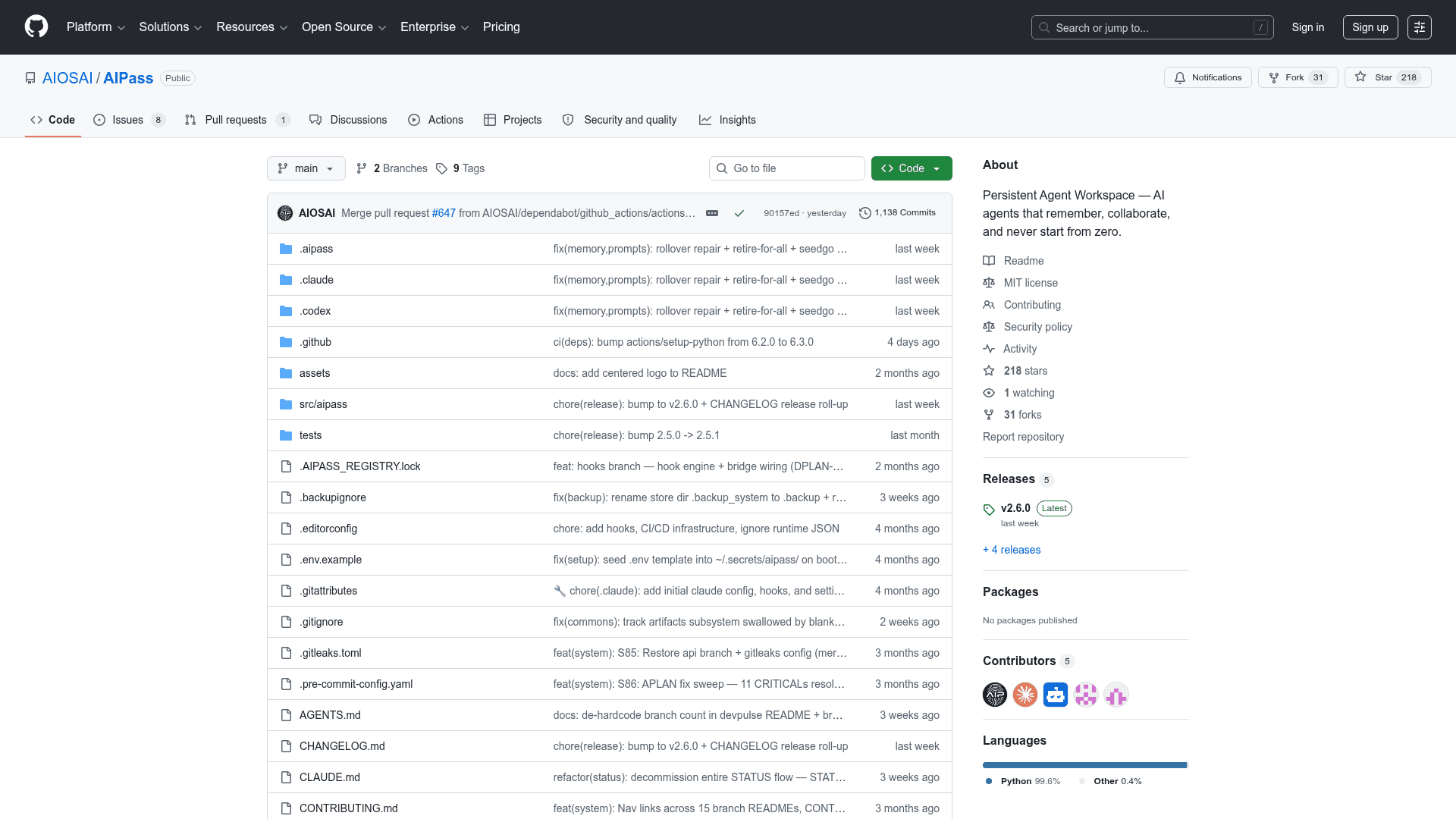
The latest release is v2.6.0, published on June 24, 2026. The project shows active development momentum — the repository was last pushed on June 30, 2026, and has accumulated 218 stars and 31 forks since its creation in February 2026. The README notes ongoing roadmap items including full macOS support, Windows native support, and end-to-end Codex CLI testing. Code coverage is CI-gated at a 75% minimum, and every agent ships its own test suite. The project carries OpenSSF Scorecard and OpenSSF Best Practices badges, signaling a focus on supply-chain security for an open-source tool.
Community Discussions
Be the first to start a conversation about AIPass
Share your experience with AIPass, ask questions, or help others learn from your insights.
Pricing
Open Source
Fully free and open-source under the MIT License. Install via pip and use with your existing Claude Pro/Max or Codex CLI subscription.
- Persistent agent memory via .trinity/ JSON files
- Agent-to-agent communication via local mailbox
- 13 core reference agents
- CLI command routing with drone
- ChromaDB automatic memory archival
Capabilities
Key Features
- Persistent agent memory across sessions using .trinity/ JSON files
- Automatic memory archival to ChromaDB for long-term semantic search
- Agent-to-agent communication via local mailbox files (.ai_mail.local/)
- CLI command routing with drone @agent syntax
- 13 core reference agents including orchestrator, quality auditor, and plan manager
- Shared filesystem workspace — no sandboxes or worktrees
- Guided project setup with aipass init run
- System health checks via aipass doctor
- Event-driven automation and self-healing via trigger agent
- Real-time monitoring and dashboards via prax agent
- Multi-provider LLM access layer via api agent (OpenRouter)
- Automated quality standards enforced across all agents via seedgo
- Agent spawning from templates via spawn agent
- Hook engine with per-project config and sound control
- Works with existing Claude Pro/Max or Codex CLI subscription