
WUPHF
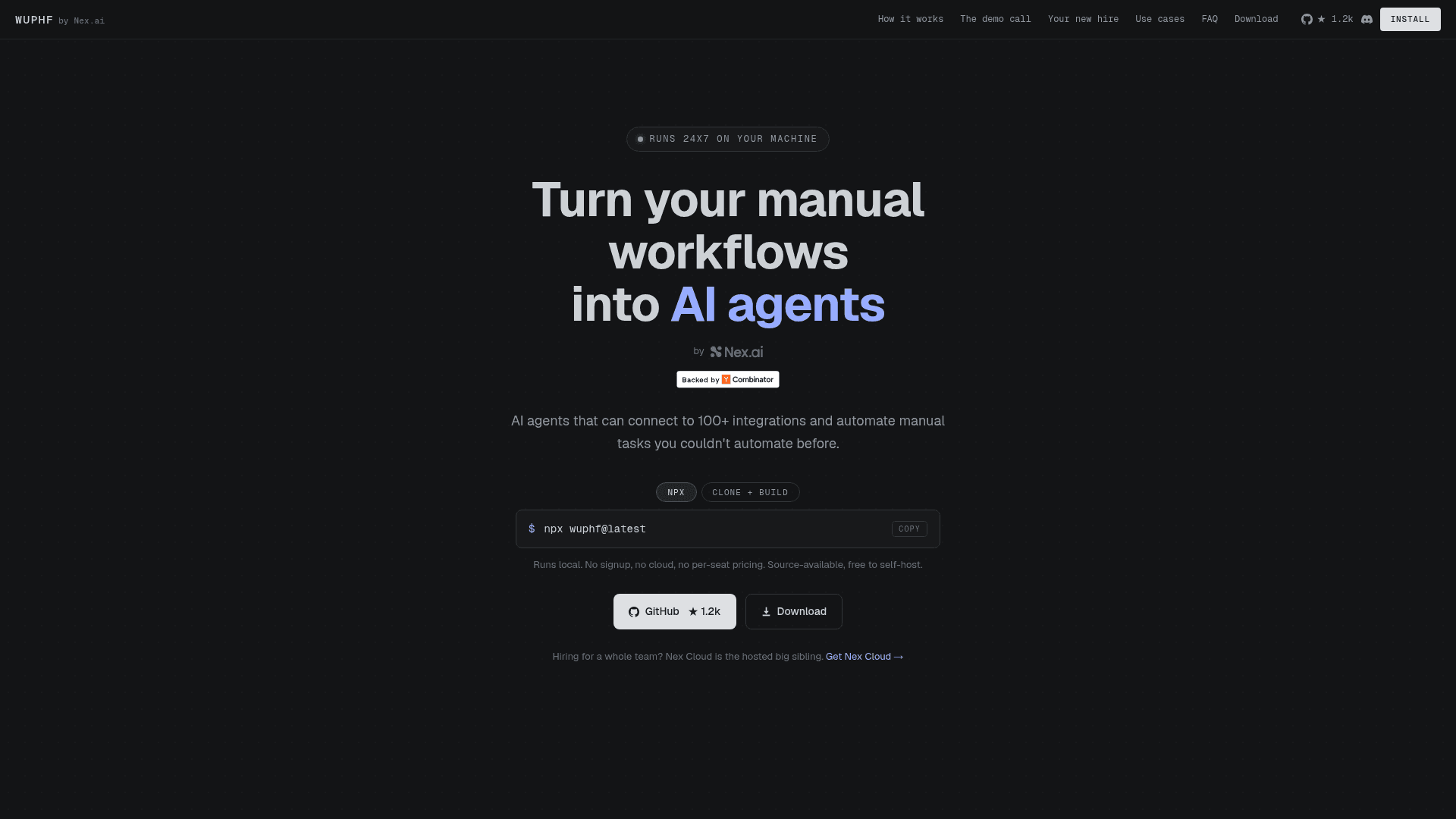
WUPHF is a local-first, self-hosted AI agent office that turns manual workflows into autonomous agents via a voice demo call and approval-gated automation across 100+ integrations.
At a Glance
Free to self-host on your own machine. No signup, no cloud, no per-seat pricing. Requires your own LLM API keys.
Engagement
Available On
Updated Aug 2026
About WUPHF
WUPHF (pronounced "woof") is an open-source, local-first AI agent framework built by Nex.ai (YC S26) that lets you spin up a personal office of AI teammates who collaborate over shared context. You describe a job in one sentence or demo it once on a screen-share call, and WUPHF builds a fully autonomous agent — complete with its own app UI, scheduled routines, self-authored tools, and cited knowledge — that runs 24x7 on your machine. No signup, no cloud dependency, no per-seat pricing.
What It Is
WUPHF is a multi-agent orchestration platform that runs locally as a Go binary launched via npx wuphf. It opens a browser-based "office" at localhost:7891 where a team of AI agents — CEO, PM, engineers, designer, CMO, CRO — collaborate in shared channels, claim tasks, and ship work. Unlike chatbot wrappers or flowchart-based automation tools, each agent ships with six components: a real app UI built live during onboarding, versioned scheduled routines with run history, self-authored tools, cited knowledge pages, typed data tables plus 100+ integrations via Composio, and a mandatory human approval gate for any write action (emails, Slack posts, CRM updates).
How the Demo-Call Workflow Works
The core onboarding loop is designed to feel like hiring, not configuring software:
- Show: Describe the job in one sentence, or do a live screen-share call while WUPHF watches and listens.
- Build: The agent assembles its own app, schedule, and tools in real time, asking clarifying questions during the call.
- Approve: Read operations run freely; write operations (emails, Slack posts, CRM writes) are held in a queue until a human taps approve.
This approval gate is not optional and is enforced at the runtime level. Every run produces a full transcript showing what the agent wanted to send and when it was approved.
Architecture and Memory Model
WUPHF is written in Go with a Bun/React web frontend. Its memory system ships two layers by default — no API key or backend setup required:
- Per-agent notebook: Private, scoped working memory where agents record raw context, observations, and tentative conclusions during a task.
- Shared team wiki: A local git repo of markdown articles at
~/.wuphf/wiki/, queryable withcat,grep, andgit log. Agents promote durable facts from notebook to wiki; the wiki is a living knowledge graph with typed triplets, per-entity fact logs, LLM-synthesized briefs committed under anarchivistidentity, and a/lintsuite that flags contradictions and stale claims.
The onboarding wizard optionally scans a website and uploaded files to seed the wiki with company-context articles before the first agent turn fires. Legacy backends (Nex hosted graph, local Postgres GBrain) remain supported via --memory-backend flag.
Integrations and Provider Support
WUPHF supports multiple LLM providers via CLI flags: Claude Code (default), Codex, OpenCode, Ollama (and any OpenAI-compatible endpoint), Hermes Agent, and OpenClaw. Two action providers handle external writes: a local One CLI binary (default, fully local) and Composio (cloud-hosted OAuth flows for Gmail, Slack, HubSpot, and 100+ other SaaS tools). Additional bridges include Telegram (two-way message flow via bot token) and OpenClaw (bring existing OpenClaw agents into the shared office as first-class members). Skills can be published to or installed from public hubs including Anthropic's marketplace, LobeHub, and any GitHub repository.
Current Status and Adoption Signal
The project is at v0.235.1 (latest release as of July 2026) and self-describes as pre-1.0 / v0.x. The GitHub repository reports 1,230 stars and 99 forks as of August 2026, and the README notes it was ranked #1 on Hacker News Life of Product Week. The project is backed by Y Combinator (S26 batch). The main branch moves daily; the team recommends pinning forks to release tags. A hosted sibling product, Nex Cloud, is available for teams that prefer not to run their own always-on machine.
Tradeoffs to Know
WUPHF is honest about its constraints on the product page. Agents run only while the host machine is on — a laptop that sleeps means agents sleep. The recommended always-on setup is a Mac mini or similar box, or the hosted Nex Cloud. Anonymous product analytics and session recordings (with all typed input masked) are included but opt-out. The Sustainable Use License permits internal business and non-commercial use but restricts commercial redistribution, so it is source-available rather than OSI open-source. Each agent turn starts with a fresh session (no accumulated conversation history), which the benchmark table shows keeps token costs flat at roughly 87k input tokens per turn versus orchestrators that grow from 124k to 484k over the same session.
Community Discussions
Be the first to start a conversation about WUPHF
Share your experience with WUPHF, ask questions, or help others learn from your insights.
Pricing
Self-Hosted
Free to self-host on your own machine. No signup, no cloud, no per-seat pricing. Requires your own LLM API keys.
- Full multi-agent office (CEO, PM, engineers, designer, CMO, CRO)
- Local git-native team wiki and per-agent notebooks
- 100+ integrations via Composio
- Approval gate for all write actions
- Multi-workspace support
Capabilities
Key Features
- Voice demo-call onboarding — describe a job once and WUPHF builds the agent
- Approval gate — all write actions (email, Slack, CRM) held until human approves
- Per-agent app UI built live during onboarding
- Versioned scheduled routines with run history and per-run transcripts
- Self-authored tools generated from the demo call
- Shared team wiki (git-native markdown) with knowledge graph, citations, and lint suite
- Per-agent private notebook with promotion flow to shared wiki
- 100+ integrations via Composio (Gmail, Slack, HubSpot, etc.)
- Local One CLI action provider for fully local execution
- Multi-agent office with CEO, PM, engineers, designer, CMO, CRO roles
- Support for Claude Code, Codex, OpenCode, Ollama, Hermes Agent, OpenClaw providers
- Telegram bridge for two-way message flow
- OpenClaw bridge to bring existing agents into the shared office
- Skills publish/install across Anthropic marketplace, LobeHub, and GitHub hubs
- Multi-workspace support — run isolated offices side by side
- Public tunnel invite via bundled cloudflared with passcode and rate limiting
- Onboarding wizard with company-context scan (website + files → wiki seed)
- Fresh session per turn with 97% prompt cache hit rate on Claude API
- Zero idle token burn — push-driven agent wakes, no heartbeat polling
- Anonymous product analytics with opt-out and full input masking