
AirLLM
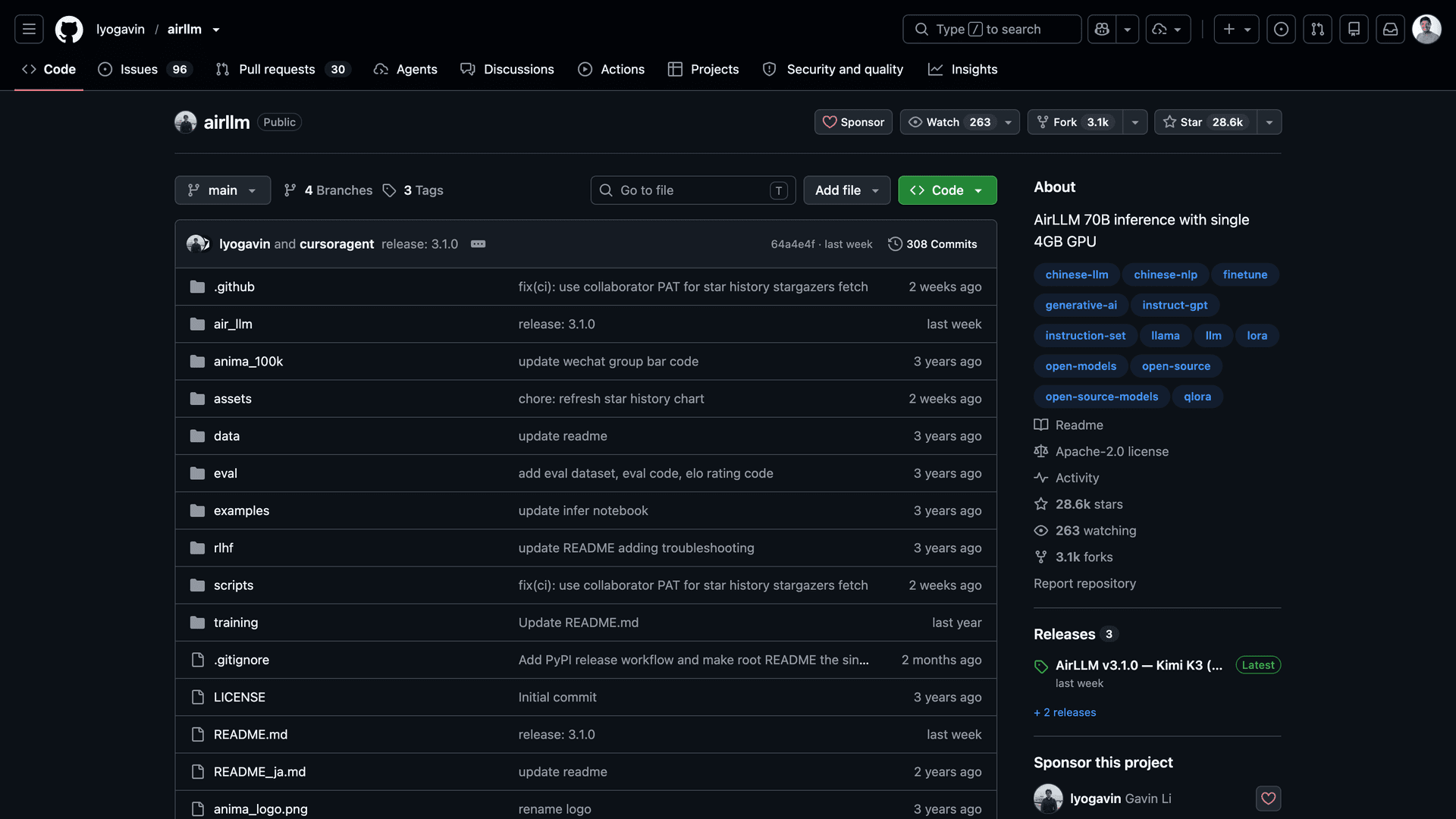
AirLLM enables inference of 70B+ large language models on a single 4GB GPU by streaming one layer at a time, without quantization, distillation, or pruning.
At a Glance
Fully free and open-source under Apache License 2.0. Install via pip and use without restrictions.
Engagement
Available On
Listed Aug 2026
About AirLLM
AirLLM is an open-source Python library created by Gavin Li that dramatically reduces the GPU memory required to run large language models at inference time. By decomposing a model into individual layers and streaming them one at a time through the GPU, AirLLM makes it possible to run models that would otherwise require dozens of gigabytes of VRAM on consumer-grade hardware with as little as 4GB. The project is licensed under Apache 2.0 and is available on GitHub and PyPI.
What It Is
AirLLM is a layer-streaming inference engine for open-weight LLMs. Instead of loading an entire model into GPU memory, it splits the model into per-layer shards saved to disk, then loads and computes each layer sequentially. The VRAM requirement therefore depends on the size of a single layer rather than the total model size. This approach requires no quantization, distillation, or pruning to achieve its memory savings, though optional block-wise quantization compression (4-bit or 8-bit) is available for up to 3x inference speed improvement with minimal accuracy loss.
How the Layer-Streaming Architecture Works
The core trick is straightforward: on first run, AirLLM decomposes the downloaded Hugging Face model into layer-wise shards and saves them to disk. During inference, it loads one layer at a time onto the GPU, runs the forward pass, then moves to the next. For sparse Mixture-of-Experts (MoE) models like DeepSeek-V3 and Kimi K3, it goes further — streaming only the experts a given token actually routes to, rather than an entire layer. This is why MoE models can run in even less VRAM than their parameter count would suggest:
- Qwen3-235B (MoE): ~3 GB VRAM
- DeepSeek-V3 671B: ~12 GB VRAM
- Kimi K3 2.8T: ~3.72 GB VRAM (measured on RTX 6000 Ada)
- Llama 3.x 70B (full precision): ~4 GB VRAM
- Llama 3.1 405B: ~8 GB VRAM
Prefetching overlaps disk loading with GPU compute to reduce idle time, and the library exposes a profiling_mode flag to measure time consumption per layer.
Supported Models and Setup Path
AirLLM works with virtually every popular open-weight LLM family via a single AutoModel.from_pretrained(huggingface_repo_id) call. Supported families include Llama (2/3/3.1/3.3/4), Qwen (1/2/2.5/3 including MoE and FP8), DeepSeek (V2/V3/R1), Mistral, Mixtral, Phi, Gemma, ChatGLM, Baichuan, InternLM, and Yi. Installation is a single pip command (pip install airllm). MacOS with Apple Silicon is supported via the mlx backend. CPU inference is also supported as of v2.10.1.
Key configuration options at initialization:
compression:'4bit'or'8bit'for block-wise quantization speed-uplayer_shards_saving_path: alternate path for the split model shardshf_token: for gated Hugging Face modelsdelete_original: removes the original downloaded model to save disk spaceprefetching: overlaps loading and compute (on by default)
Update: v3.1.0 — Kimi K3 (2.8T) Support
The latest release, v3.1.0 (published July 29, 2026), adds support for Kimi K3, described in the README as the largest open-source model released to date at 2.8 trillion parameters. The README reports it runs in 3.72 GB of VRAM on a single RTX 6000 Ada by streaming one expert at a time. K3 requires compressed-tensors, flash-attn, a CUDA 12 build of PyTorch, and transformers 4.56.x. The prior v3.0 release added FP8 model support and unified the API under a single AutoModel class covering DeepSeek-V3, Qwen3, Llama 4, Phi-4, and Gemma.
Tradeoffs to Know
Layer-streaming inference is significantly slower than standard full-model GPU inference because each layer must be loaded from disk on every forward pass. The approach trades throughput for accessibility — it is best suited for researchers, hobbyists, and developers who need to run large models on hardware that would otherwise be incapable of loading them at all. Disk space is a meaningful constraint: splitting a 70B model is disk-intensive, and insufficient disk space is the most common reported error. The library does not replace production inference servers for high-throughput workloads.
Community Discussions
Be the first to start a conversation about AirLLM
Share your experience with AirLLM, ask questions, or help others learn from your insights.
Pricing
Open Source
Fully free and open-source under Apache License 2.0. Install via pip and use without restrictions.
- Run 70B+ LLMs on 4GB GPU
- Layer-streaming inference
- AutoModel API
- 4-bit and 8-bit compression
- MacOS and CPU inference support
Capabilities
Key Features
- Run 70B LLMs on a single 4GB GPU without quantization
- Layer-by-layer streaming inference to minimize VRAM usage
- Support for 405B, 671B, and 2.8T parameter models on consumer GPUs
- Optional 4-bit and 8-bit block-wise quantization for up to 3x speed improvement
- AutoModel API auto-detects model type from Hugging Face repo ID
- Prefetching to overlap disk loading and GPU compute
- MacOS Apple Silicon support via mlx backend
- CPU inference support
- FP8 model support
- Per-expert streaming for sparse MoE models
- Configurable layer shard saving path
- Support for gated Hugging Face models via hf_token
- Profiling mode for time consumption analysis
- delete_original option to save disk space