
Apache TVM
An open-source machine learning compiler framework that compiles pre-trained ML models into optimized, deployable modules for any hardware platform.
At a Glance
About Apache TVM
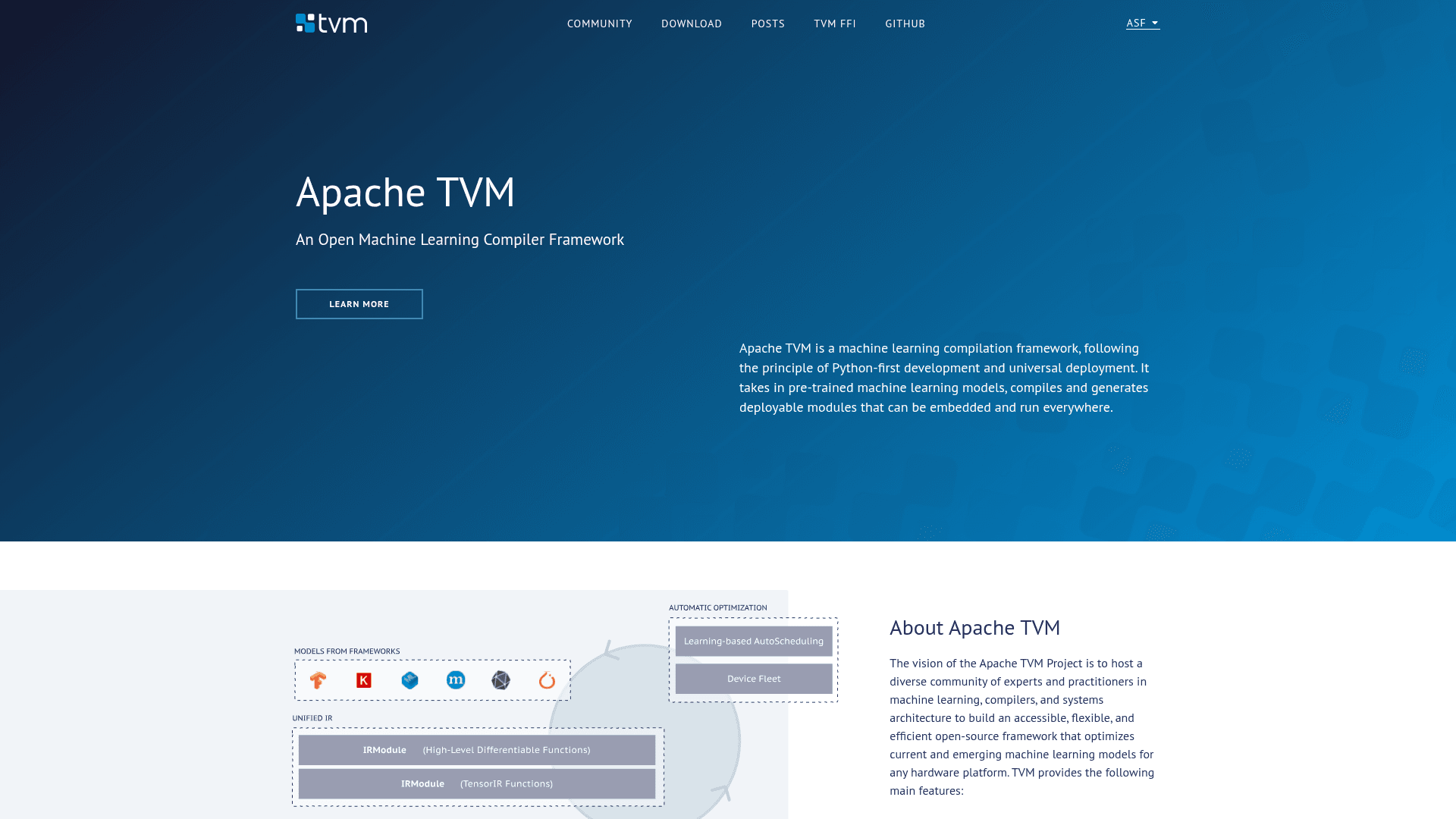
Apache TVM is an open-source machine learning compilation framework hosted under the Apache Software Foundation and licensed under Apache 2.0. It takes pre-trained machine learning models, compiles them, and generates minimal deployable modules that can run across a wide range of hardware targets — from data center GPUs to edge environments. The project started as a research initiative for deep learning compilation and has since undergone several major redesigns driven by the broader ML compiler community.
What It Is
Apache TVM is a compiler framework that sits between ML frameworks (like PyTorch or TensorFlow) and hardware backends. Its core job is to optimize computational graphs and tensor programs so that models run efficiently on target hardware without requiring hand-tuned kernels for every device. The current design centers on a cross-level architecture: TensorIR serves as the tensor-level representation, while Relax handles graph-level representation. Together, they enable joint optimization of computational graphs, tensor programs, and libraries.
Architecture and Design Philosophy
TVM follows two guiding principles: Python-first development and universal deployment. The Python-first approach means that most compiler transformations — including custom passes and optimization pipelines — can be written and customized directly in Python, lowering the barrier for ML researchers and engineers. Universal deployment means the compiled output targets a minimal runtime that can be embedded and executed on virtually any platform, including CPUs, GPUs (CUDA, ROCm, Metal, Vulkan, OpenCL), and specialized accelerators.
Key architectural components include:
- TensorIR: Low-level tensor program representation for fine-grained optimization
- Relax: Graph-level IR for high-level model transformations
- Python-first transformation API: Enables customization without deep compiler expertise
- Minimal runtimes: Compiled modules can be deployed with very small runtime footprints
Hardware and Platform Coverage
TVM targets a broad set of hardware backends, as reflected in the project's own topic tags: GPU (CUDA), ROCm, Metal, Vulkan, OpenCL, SPIR-V, and JavaScript (via WebAssembly). This cross-platform reach is central to the project's value proposition — the same compilation pipeline can target cloud inference hardware and resource-constrained edge devices.
Project Lineage and Current Status
TVM originated as a research project for deep learning compilation, with early design influences from Halide (arithmetic simplification and lowering pipeline), Loopy (integer set analysis and loop transformations), and Theano (symbolic scan operator design). The project's architecture has changed substantially since its initial release in 2016, with the current cross-level TensorIR/Relax design representing a significant departure from earlier versions.
Update: Apache TVM v0.24.0
The latest release is v0.24.0, published on May 9, 2026, indicating active ongoing development. The repository shows recent push activity as of May 2026, with over 13,000 GitHub stars and nearly 4,000 forks reported on the project page. The project operates under the Apache committer model, with governance and community ownership managed through the Apache Software Foundation. It also serves as a foundation for building Python-first vertical compilers for specific domains, including large language model (LLM) inference.
Community Discussions
Be the first to start a conversation about Apache TVM
Share your experience with Apache TVM, ask questions, or help others learn from your insights.
Pricing
Open Source
Fully free and open-source under the Apache License 2.0. Use, modify, and distribute freely.
- Full source code access under Apache 2.0
- Python-first ML compiler API
- Universal hardware deployment
- TensorIR and Relax representations
- Community support via Apache TVM forums
Capabilities
Key Features
- Python-first compiler API for ML model compilation
- Universal deployment to minimal runtime modules
- TensorIR tensor-level program representation
- Relax graph-level IR for model transformations
- Cross-level joint optimization of graphs and tensor programs
- Support for CUDA, ROCm, Metal, Vulkan, OpenCL, SPIR-V backends
- Edge and data center hardware targeting
- Customizable compilation pipelines in Python
- Foundation for LLM vertical compilers
- Apache 2.0 open-source license