
Core AI
Apple's Core AI framework for integrating on-device AI models into iOS, iPadOS, macOS, and other Apple platform apps.
At a Glance
Core AI framework is freely available to all registered Apple developers as part of the Apple platform SDK.
Engagement
Available On
Listed Jun 2026
About Core AI
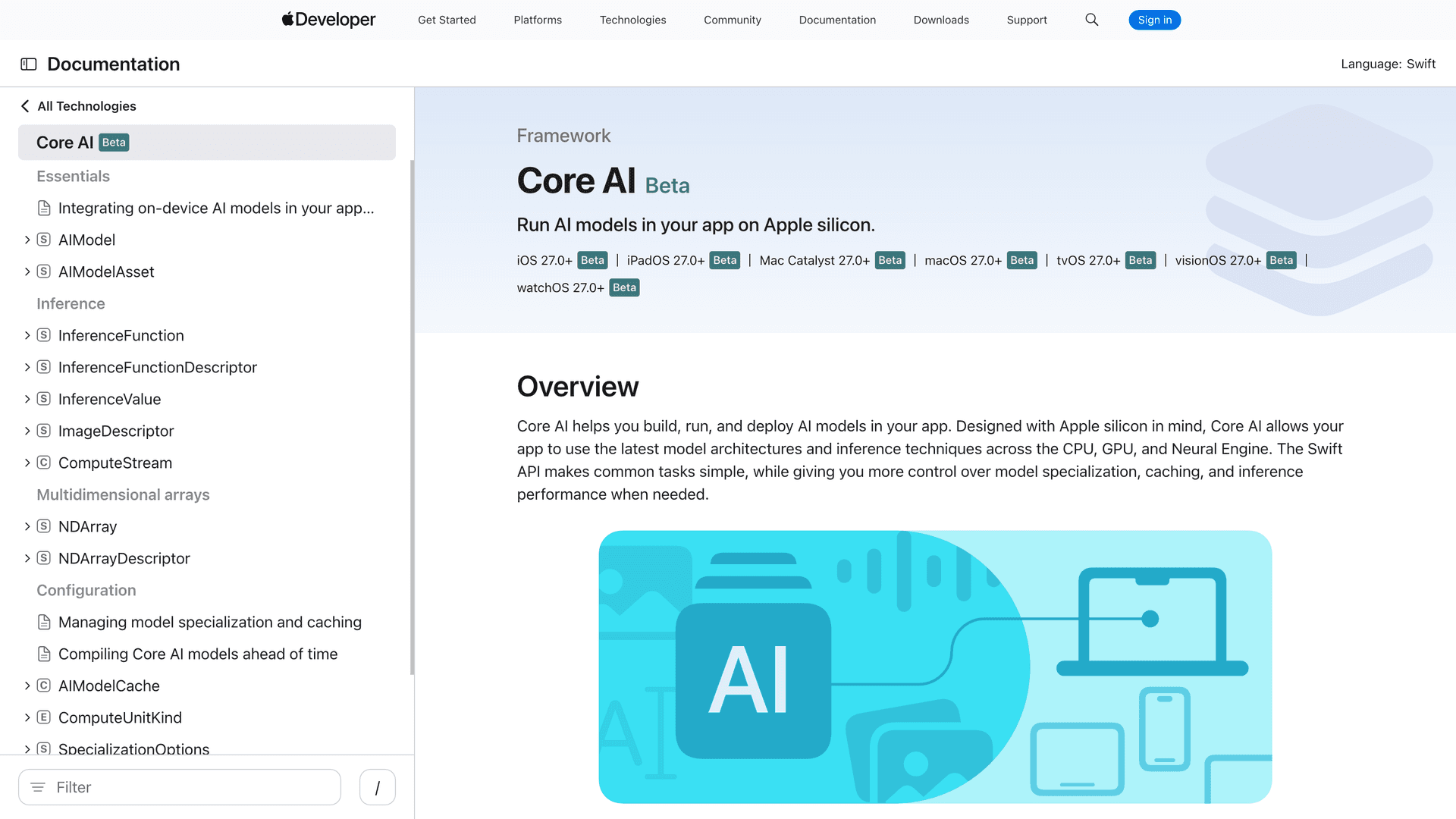
Core AI is Apple's framework for running AI models on device, directly on Apple Silicon. Introduced at WWDC26, it is the inference framework that powers on-device Apple Intelligence, now opened up so developers can bring their own models. It covers the full deployment lifecycle — converting and optimizing a model, then loading and running it locally across the CPU, GPU, and Neural Engine with no server dependency and no per-token cost.
What It Is
Core AI is built directly into the operating system and exposes a modern, memory-safe Swift API for loading, specializing, and running models on device. Apple's documentation describes its job simply as running AI models in your app on Apple silicon. Models run in a new .aimodel format and are automatically specialized for the hardware they run on, with ahead-of-time compilation for faster load times. The framework is designed to handle everything from compact vision models to large-scale generative models, and gives fine-grained control over inference memory, zero-copy data paths, and stateful execution for latency-sensitive work. It targets developers building for iOS, iPadOS, macOS, and the other Apple platforms.
The Model Toolchain
Beyond the runtime, Core AI ships with a dedicated Python toolchain for getting models onto the device. The "Meet Core AI" session describes libraries for converting, authoring, and optimizing models. The coreai-torch package converts a trained PyTorch model into the Core AI format — exporting with torch.export, specifying dynamic shapes, running the converter, and verifying that the converted model matches numerically. A companion library, coreai-opt, compresses PyTorch models for Apple Silicon using quantization, palettization, and pruning before conversion, which Apple frames as a way to cut model size, latency, and power use.
Ready-to-Run Models
Apple also publishes a Core AI models repository with ready-made export recipes for popular open-source architectures. According to the WWDC26 sessions, the catalog includes models such as Qwen, Mistral, and SAM3, optimized for Apple Silicon and downloadable as .aimodel files. Higher-level Swift entry points — like an image segmenter and a language-model session — let developers wire these models into an app in a few lines of code, and the framework interoperates with Apple's Foundation Models framework.
Tooling in Xcode
Core AI is integrated into Xcode. Developers can inspect a model in Xcode's model viewer, rely on ahead-of-time model compilation to streamline the workflow, and use a new Core AI instrument to profile inference latency and surface bottlenecks, such as slowdowns from quadratic complexity in transformer models.
On-Device Architecture and Privacy
A central design principle is that inference happens entirely on the device. No data leaves the device during execution, AI features keep working offline, and there are no server costs or token charges. The framework leans on Apple Silicon's Neural Engine, GPU, and CPU for efficient, low-latency inference, and Apple positions on-device specialization and AOT compilation as the way to keep load times and memory use under control.
Update: Introduced at WWDC26
Core AI was announced at WWDC26 (June 2026) with multiple dedicated developer sessions, and the developer beta ships with the iOS 27 SDK. Apple presents it as the platform's on-device inference framework going forward, directing developers to Core ML for non-neural-network model types such as decision trees and tabular models while Core AI handles neural networks. It builds on Apple's earlier on-device work, including the Foundation Models framework introduced at WWDC25.
Community Discussions
Be the first to start a conversation about Core AI
Share your experience with Core AI, ask questions, or help others learn from your insights.
Pricing
Apple Developer
Core AI framework is freely available to all registered Apple developers as part of the Apple platform SDK.
- Access to Core AI framework
- On-device model inference APIs
- WWDC session videos and documentation
- Developer forums access
- Sample code
Capabilities
Key Features
- On-device AI model inference
- Swift-based API for model integration
- Neural Engine, CPU, and GPU acceleration
- Offline AI capabilities
- Privacy-preserving local inference
- Cross-platform support for Apple platforms
- Integration with Apple Intelligence stack