
Ask LLM
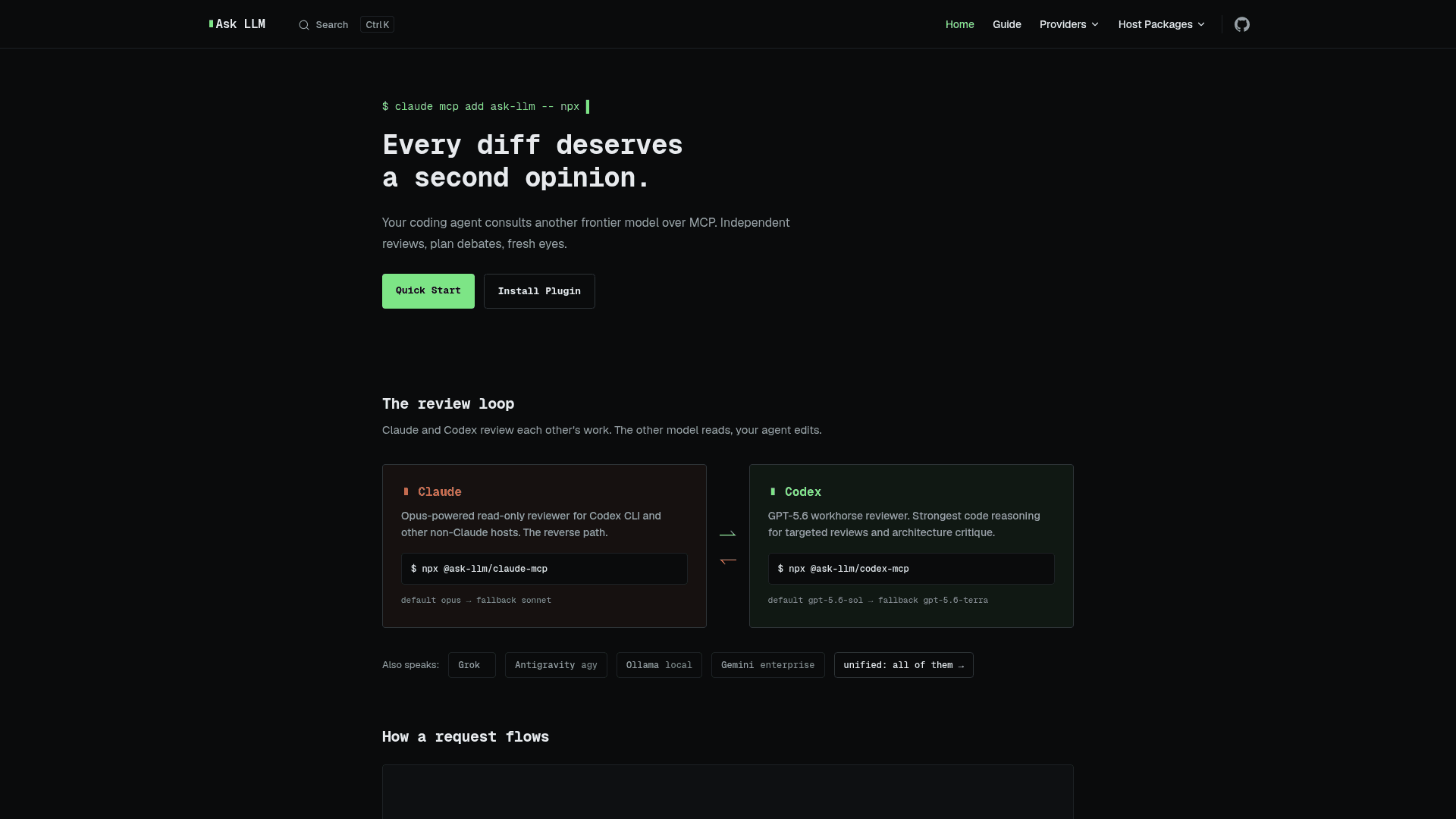
An MCP server that lets your AI coding agent consult a second frontier model for independent code review, plan debate, and second opinions.
At a Glance
Free to use under the MIT License. Requires your own provider CLI accounts and authentication.
Engagement
Available On
Alternatives
Listed Aug 2026
About Ask LLM
Ask LLM is an open-source MCP server suite built by Anton Lykhoyda that enables AI-to-AI collaboration — letting your primary coding agent (Claude Code, Codex CLI, Cursor, or any of 40+ MCP clients) consult a second model for independent code review, architecture critique, or plan debate. Released under the MIT License, it is available on npm under the @ask-llm organization and actively maintained on GitHub.
What It Is
Ask LLM bridges multiple large language model providers through the Model Context Protocol (MCP), so a coding agent can get a "second opinion" without leaving its workflow. The core idea is that confidence isn't correctness: a second model with no stake in the first one's answer can catch what the primary missed. The project ships as a family of MCP server packages — one per provider plus a unified orchestrator — and a host package for Claude Code, Cursor Agent, and Pi.
Provider Coverage and Model Routing
Ask LLM supports six distinct reviewer backends, each as a separate npm package or accessible through the unified @ask-llm/mcp orchestrator:
- Codex (
@ask-llm/codex-mcp) — GPT-5.6 Sol with Terra fallback; strongest code reasoning - Claude (
@ask-llm/claude-mcp) — Opus with Sonnet fallback; native sessions; read-only workspace tools - Grok (
@ask-llm/grok-mcp) — Grok 4.6 via xAI API or official Grok CLI; no model fallback - Antigravity (
@ask-llm/antigravity-mcp) — Google's subscription-backed successor to Gemini CLI;gemini-3.1-prowith flash fallback - Ollama (
@ask-llm/ollama-mcp) — fully local, zero cost, offline;qwen3.8:27bdefault - Gemini (
@ask-llm/gemini-mcp) — 1M+ token context; enterprise-gated from 2026-06-18
The unified ask-llm tool routes per call and can fan out to all installed providers in parallel via multi-llm.
How the Request Flow Works
When a user prompts their agent (e.g., "ask codex to review src/auth.ts for security issues"), the agent calls an MCP tool, the MCP server spawns the corresponding provider CLI, and streams the answer back as structured content. Session-capable tools accept an optional sessionId for multi-turn conversations. The orchestrator also exposes a usage://current-session MCP Resource for live JSON usage snapshots, and a diagnose/doctor command for setup verification.
Claude Code Plugin and Host Package
The @ask-llm/plugin package extends Claude Code, Cursor Agent, and Pi with slash commands and automated hooks:
/multi-review— parallel Antigravity + Codex review with a 4-phase validation pipeline/brainstorm— multi-LLM brainstorm with synthesis weighted toward verified findings/compare— side-by-side raw responses from multiple providers/codex-pair— opt-in continuous review hook that runs Codex against every file edit when a.codex-pair/context.mdmarker is present/fable-review,/grok-review,/ollama-review,/sol-review,/antigravity-review— provider-specific review commands
The review pipeline is described in the README as inspired by Anthropic's code-review plugin, using context gathering, prompt construction with false-positive exclusions, synthesis, and source-level validation.
Update: v1.6.17 and Gemini CLI Enterprise Gate
The latest release is v1.6.17, published 2026-07-24. The repository was last pushed 2026-08-24, indicating active development. A notable recent change documented in the README is that Google is restricting Gemini CLI to enterprise seats from 2026-06-18; the project recommends switching to ask-antigravity (the Google-sanctioned successor via Google AI Pro/Ultra) or other providers. All public MCP packages have also migrated to the @ask-llm npm organization from older package names like ask-gemini-mcp and ask-llm-mcp.
Setup Path
Prerequisites are Node.js v20+ and at least one authenticated provider CLI. The fastest install for Claude Code is:
claude mcp add --scope user ask-llm -- npx -y @ask-llm/mcp
A ping tool verifies the connection and lists detected providers; npx @ask-llm/mcp doctor diagnoses PATH, Node version, and provider CLI presence. An interactive REPL (npx @ask-llm/mcp repl) supports multi-provider sessions with live usage tracking.
Community Discussions
Be the first to start a conversation about Ask LLM
Share your experience with Ask LLM, ask questions, or help others learn from your insights.
Pricing
Open Source
Free to use under the MIT License. Requires your own provider CLI accounts and authentication.
- All MCP server packages
- Unified orchestrator
- Claude Code / Cursor Agent / Pi host package
- All provider integrations: Codex, Claude, Grok, Gemini, Antigravity, Ollama
- Interactive REPL
Capabilities
Key Features
- AI-to-AI code review via MCP
- Multi-provider support: Codex, Claude, Grok, Gemini, Antigravity, Ollama
- Unified orchestrator with per-call provider routing
- Parallel multi-provider fan-out via multi-llm tool
- Multi-turn sessions with sessionId
- Claude Code plugin with slash commands
- Cursor Agent and Pi host package support
- Opt-in continuous codex-pair review hook
- /multi-review with 4-phase validation pipeline
- /brainstorm multi-LLM synthesis
- /compare side-by-side provider responses
- Local/offline review via Ollama
- 1M+ token context via Gemini/Antigravity
- Interactive REPL with live usage tracking
- Doctor/diagnose command for setup verification
- MCP Resource for live usage JSON snapshots
- Automatic model fallback per provider
- Session-capable tools with structured AskResponse output