
Memora
An MCP memory layer that gives AI agents persistent, collective memory with deduplicating absorb, supersession lineage, semantic search, and an interactive knowledge graph UI.
At a Glance
Fully free and open source under the MIT license. Self-host with local SQLite or cloud backends.
Engagement
Available On
Listed Sep 2026
About Memora
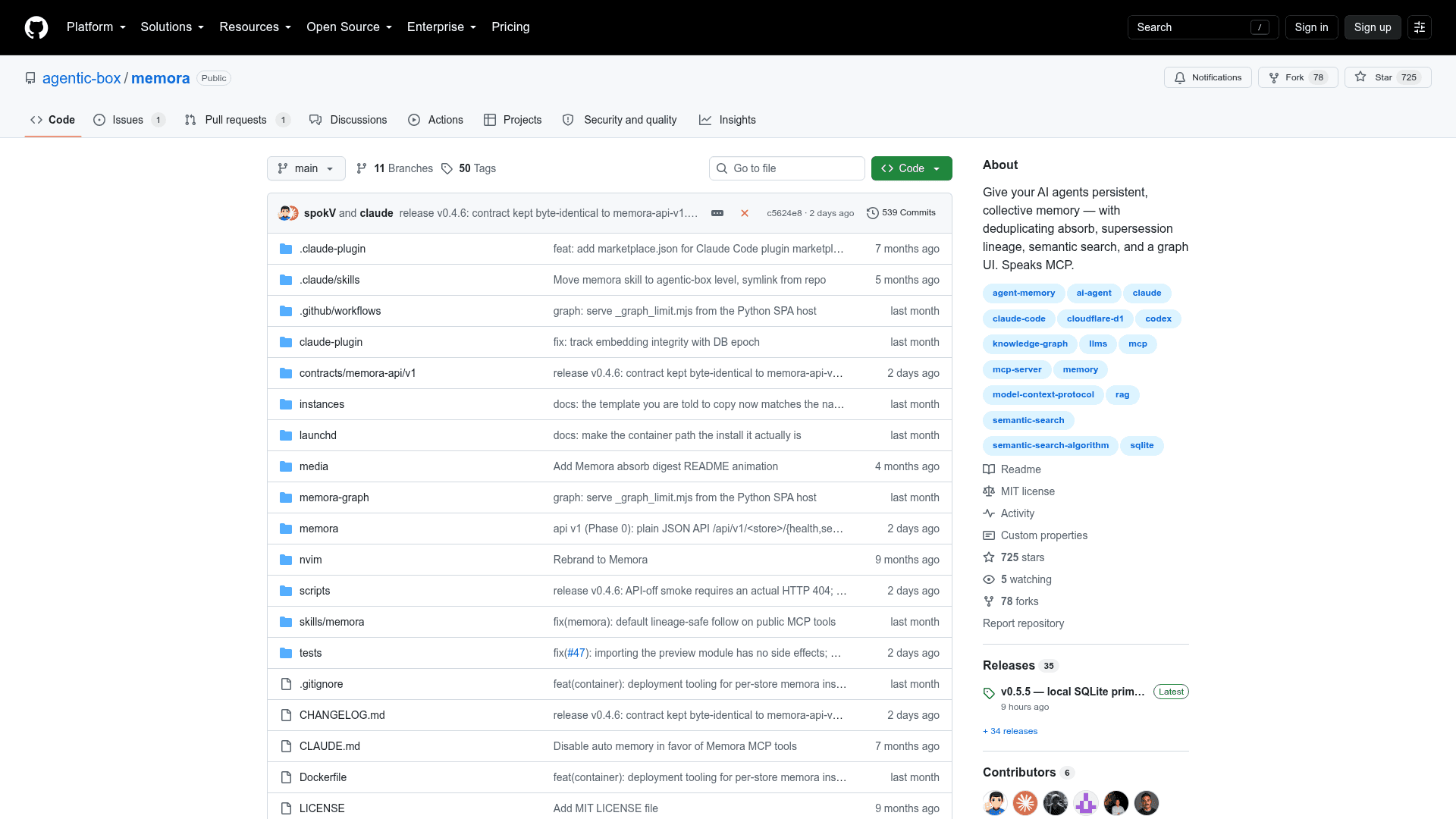
Memora is an open-source MCP (Model Context Protocol) server that provides AI agents with persistent, collective memory across sessions. Built in Python and released under the MIT license, it stores structured facts in SQLite with optional cloud sync to Cloudflare D1, S3, or R2, and exposes 44 MCP tools for creating, searching, linking, and digesting memories. The project reached v0.5.5 in September 2026 and has accumulated over 725 stars on GitHub.
What It Is
Memora sits between AI agents (such as Claude Code or Codex CLI) and a durable storage backend, acting as a memory layer that agents can read from and write to via the Model Context Protocol. Rather than each agent session starting from scratch, Memora lets agents absorb facts from prior work, retrieve relevant context through semantic search, and maintain a living knowledge graph of what they know. It is listed in the Awesome Claude Code collection, signaling community recognition as a useful tool in the Claude ecosystem.
How the Absorb-Digest Workflow Works
The core workflow centers on two operations:
memory_absorb— Feed raw facts into the store. An LLM classifies each incoming fact against existing memories as a duplicate, update, contradiction, related item, or new entry. Duplicates are skipped; updates supersede old knowledge without deleting it (supersession lineage); contradictions and related items are linked. Adry_runmode previews changes before committing.memory_digest(topic)— Retrieve a bundled context package for a topic: relevant memories, open TODOs and issues, related graph edges, and source IDs — all in one call, reducing the number of round trips an agent needs to orient itself.
This absorb-then-digest pattern is designed for multi-agent workflows where a leader agent coordinates workers, each contributing facts that accumulate into a shared store.
Storage and Deployment Architecture
Memora supports two primary deployment paths:
- pip / stdio — Install
memora-mcpfrom PyPI and spawn it as a stdio child process from.mcp.json. Local SQLite is the default backend; cloud sync to S3/R2 or Cloudflare D1 is configured via environment variables. - Container / HTTP service — Run Memora as a detached HTTP service using Apple's
containerCLI (requires Apple Silicon and macOS 26). A bundled proxy script (memora_proxy.py) holds a stable local address in front of the container's reassigned IP, and a macOS LaunchAgent supervises the proxy.
Multi-database routing (MEMORA_DATABASES) lets a single process serve multiple workspaces, each reaching its own store at /mcp/<name>. Tool profiles (MEMORA_TOOL_PROFILE) expose subsets of the 44 tools — full (all 44), leader (19), or agent (12) — so worker agents are not burdened with destructive maintenance tools.
Search, Embeddings, and Intelligence
Semantic search is powered by one of three embedding backends: OpenAI (default, included), sentence-transformers (offline, installed via pip install memora-mcp[local]), or TF-IDF (keyword-based, always available). Embeddings and the LLM used for deduplication and chat are configured separately, allowing different providers for each role. The README explicitly warns that OpenRouter has no embeddings endpoint and that mixing it into the embedding path causes silent TF-IDF fallback; MEMORA_EMBEDDING_STRICT=1 converts that silent degradation into a hard failure.
Additional intelligence features include:
- LLM deduplication — Find and merge duplicate memories with AI-powered comparison returning a verdict, confidence score, and suggested action.
- Memory insights — Activity summaries, stale TODO/issue detection, consolidation candidates, and LLM-powered pattern analysis.
- Memory linking — Typed edges (
implements,supersedes,contradicts, etc.), importance boosting, and cluster detection.
Knowledge Graph and Visualization
A built-in HTTP server (default port 8765) serves an interactive knowledge graph with a details panel, timeline panel, history panel, and a RAG-powered chat panel. The chat panel supports streaming LLM responses with tool calling, so agents or users can create, update, and delete memories directly from the UI. For Cloudflare D1 deployments, a hosted graph on Cloudflare Pages is available with WebSocket real-time updates and Cloudflare Zero Trust access control, eliminating the need for SSH tunneling.
Update: v0.5.5 — Local SQLite Primary with D1 Replication
The latest release, v0.5.5, published September 24, 2026, introduces local SQLite as the primary store with D1 replication. Earlier releases addressed D1-specific performance issues such as vector scan page size limits and absorb failures caused by Cloudflare's 30-second per-request ceiling. The project's direction continues toward multi-agent, multi-database deployments with fine-grained tool exposure and robust cloud-sync options.
Community Discussions
Be the first to start a conversation about Memora
Share your experience with Memora, ask questions, or help others learn from your insights.
Pricing
Open Source
Fully free and open source under the MIT license. Self-host with local SQLite or cloud backends.
- All 44 MCP tools
- Local SQLite storage
- Cloud sync to S3, R2, or Cloudflare D1
- Semantic search with OpenAI, sentence-transformers, or TF-IDF
- LLM deduplication and absorb
Capabilities
Key Features
- Persistent SQLite storage with optional cloud sync (S3, R2, Cloudflare D1)
- Deduplicating absorb with LLM classification (duplicate/update/contradiction/related/new)
- Supersession lineage — updates supersede old knowledge without deletion
- memory_digest(topic) bundles relevant memories, TODOs, issues, edges, and source IDs
- Semantic search with vector embeddings (OpenAI, sentence-transformers, TF-IDF)
- Full-text, date range, tag filter (AND/OR/NOT), and hybrid search
- LLM-powered deduplication with verdict, confidence, and merge strategies
- Typed memory linking with edges (implements, supersedes, contradicts, etc.)
- Interactive knowledge graph visualization with details, timeline, history, and chat panels
- RAG-powered chat panel with streaming LLM responses and tool calling
- Multi-database routing — one process serves many stores via /mcp/<name>
- Tool profiles (full/leader/agent) to expose subsets of 44 MCP tools
- Document storage — markdown parsed into searchable fragment trees
- Memory insights with activity summary, stale detection, and LLM pattern analysis
- Container deployment with proxy for stable addressing and LaunchAgent supervision
- Cloudflare Pages hosted graph with WebSocket real-time updates
- Event notifications for inter-agent communication
- Neovim integration via Telescope plugin
- Export/import with merge strategies
- Knowledge graph export as static HTML