
Atomic Agent
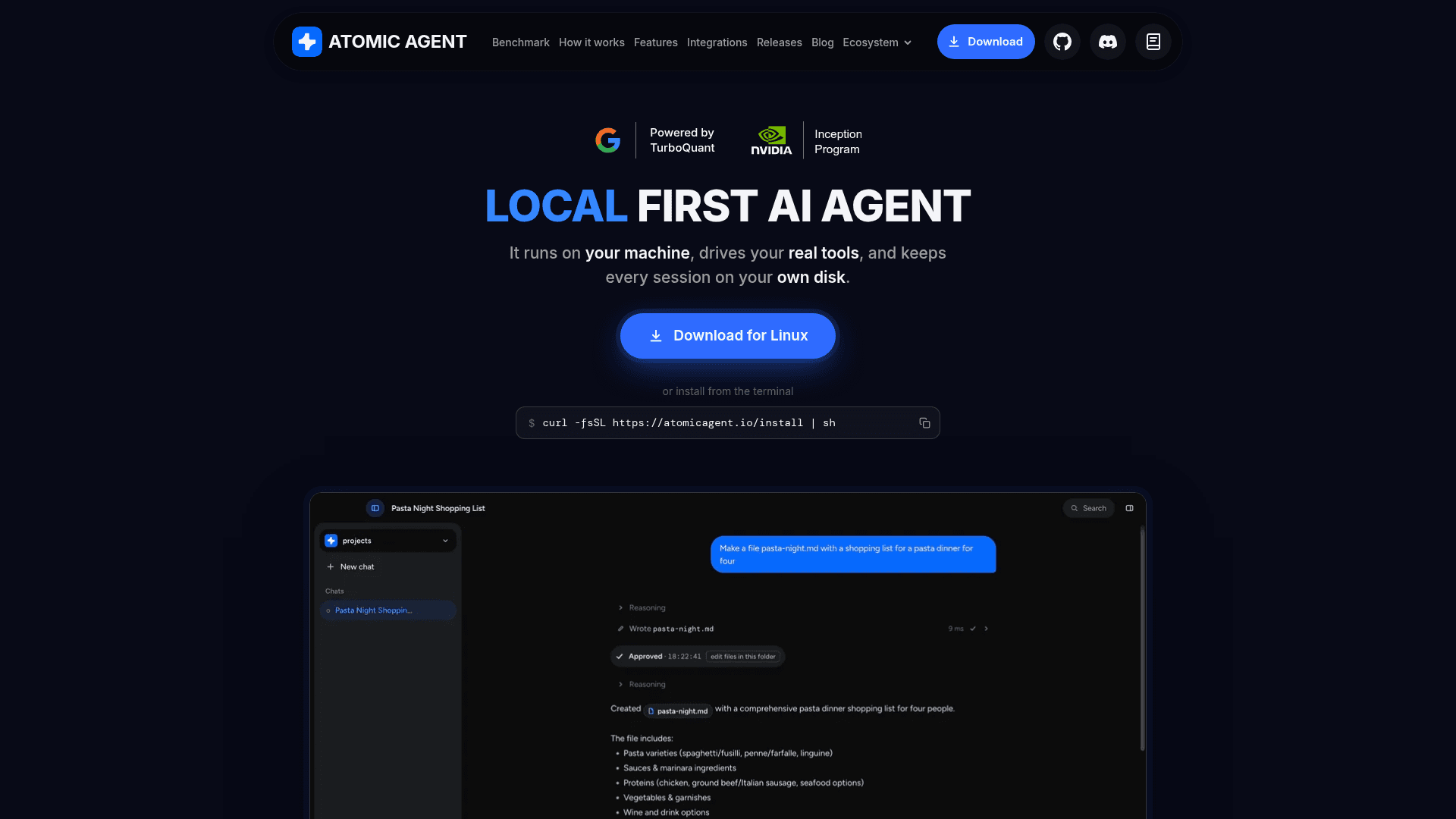
Open-source, local-first AI agent that runs on your machine via llama.cpp, driving the browser, files, shell and MCP tools.
At a Glance
About Atomic Agent
Atomic Agent is an open-source, local-first AI agent runtime built by AtomicBot and released under the MIT license. It runs the control loop and all state on your own machine, using llama.cpp to serve local models, with optional cloud providers. It is available as a desktop app and as a CLI/TUI, and the CLI is labelled a Developer Preview (v0.6.7).
What It Is
Atomic Agent is an AI assistant you run yourself. You give it a task in plain words from a terminal UI, CLI, OpenAI-compatible HTTP API, or chat apps such as Telegram and Discord. It can browse the web, read and edit files, run approved shell commands, extract text from documents, remember context across sessions, and schedule background tasks. Sessions, memory, tasks and traces are stored locally as plain files and SQLite databases.
How the Agent Loop Works
Each turn builds a compact prompt and asks the model for a JSON array of tool calls. On a local llama-server the output is constrained by GBNF grammars so tool calls stay structurally valid. The runtime executes the calls, running independent reads in parallel and pausing for approval on risky actions such as shell commands, file writes and HTTP requests. Results are compressed back into state, and the loop repeats until the agent replies or is stopped. A byte-stable prompt prefix keeps the KV-cache warm, and memory lives in SQLite rather than in the context window.
Models and Run Modes
The CLI can manage a llama.cpp backend and download curated GGUF quantized models, or you can point it at your own llama-server. The project says its TurboQuant llama.cpp build gives +30-50% throughput on small local models. Cloud providers (OpenAI-compatible, OpenRouter, Gemini and presets for others) and Ollama or LM Studio servers can be configured. Fusion mode lets one model plan while a pool of workers executes delegated parts.
Extending and Connecting
MCP servers add external tools, Markdown skills provide reusable playbooks, and Composio exposes SaaS toolkits such as Gmail and Slack. The first run can import data from Claude Code, Codex, Hermes, OpenClaw and others. Anonymous analytics and crash reports are on by default and can be switched off.
Benchmark Claim
The project reports 69.8% (37/53) on GAIA Level 1 versus 58.5% for Hermes Agent on the same local model and hardware, with about 217 s versus 351 s per task. These figures are the vendor's own published results.
Community Discussions
Be the first to start a conversation about Atomic Agent
Share your experience with Atomic Agent, ask questions, or help others learn from your insights.
Pricing
Open Source
Atomic Agent is free and open source under the MIT license, running locally with no token bill when using local models.
- MIT-licensed open-source core
- Runs locally via llama.cpp with local models
- Cloud models and BYOK providers are external costs
- Claude Code and OpenAI Codex subscriptions work via their own signed-in CLIs (external costs)
- MCP tool integration
Capabilities
Key Features
- Local-first agent loop with state on your own disk
- GBNF grammar-constrained tool calls
- KV-cache-friendly stable prompt prefix
- Browser automation, filesystem, shell, git and document extraction tools
- SQLite-backed memory with notes, lessons and procedures
- Approval gates for risky actions
- Scheduled tasks via cron, intervals and webhooks
- MCP client and Markdown skills
- Managed local llama.cpp models with TurboQuant
- Fusion mode with orchestrator and worker models
- Telegram and Discord remote control
- OpenAI-compatible HTTP server and Tauri sidecar
- Import from Claude Code, Codex, Hermes and OpenClaw