Atomic Agents framework
A lightweight, modular Python framework for building AI agents and pipelines with Pydantic-defined input and output schemas.
At a Glance
Atomic Agents framework is free and MIT-licensed.
Engagement
Available On
Alternatives
Listed Nov 2026
About Atomic Agents framework
Atomic Agents is an open-source Python framework by Kenny Vaneetvelde (Eigenwise) for building agentic AI pipelines and applications from small, reusable components. It is built on Instructor and Pydantic, and the latest release listed is v2.15.0. All logic and control flow is written in plain Python.
What It Is
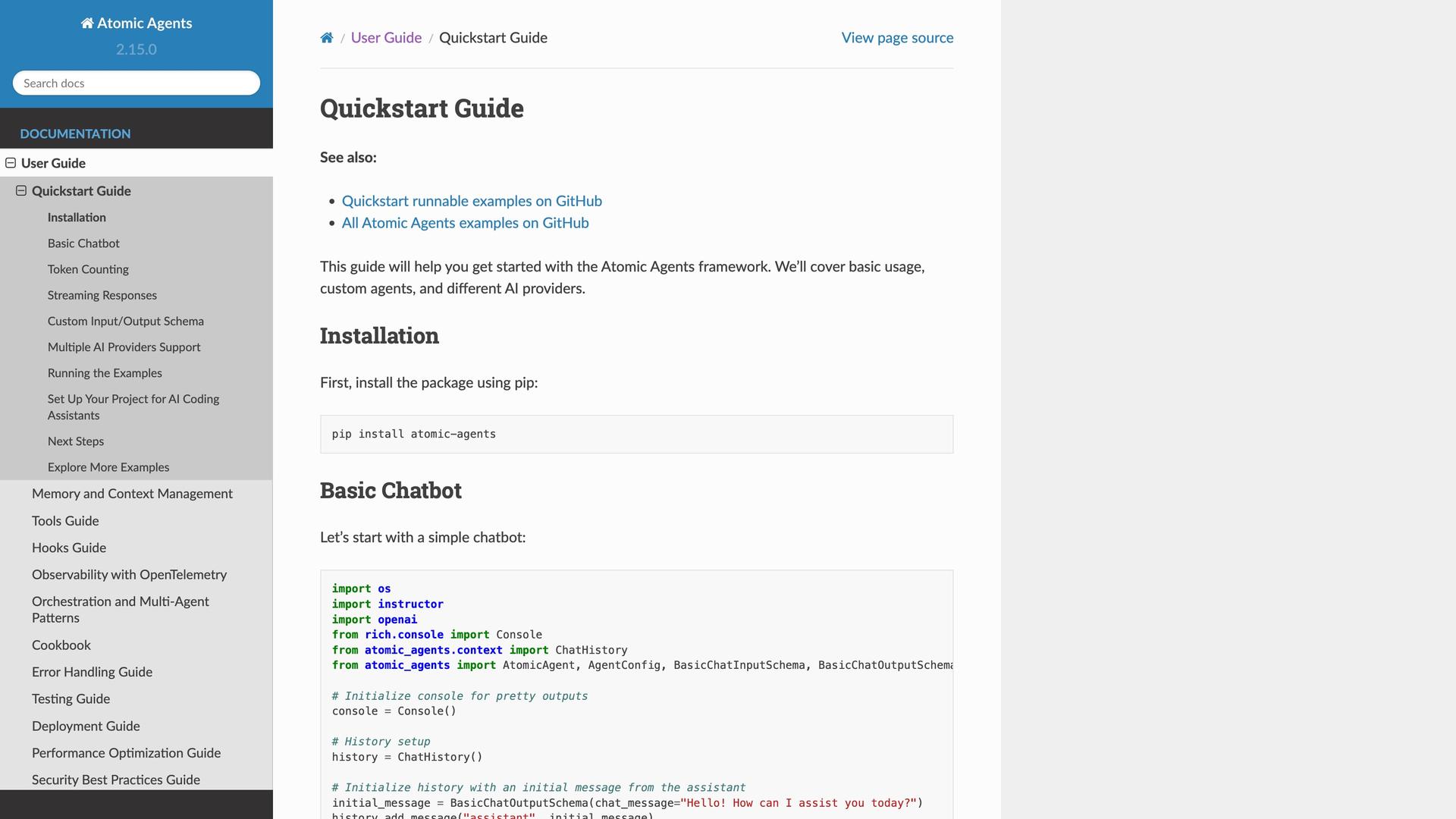
Atomic Agents is an agent-building library organized around "atomicity": each agent, tool, and context provider is single-purpose, reusable, and composable. An agent is assembled from a system prompt, an input schema, an output schema, history, and context providers. Developers install it with pip or uv and add the provider SDK they want, such as Groq, Anthropic, or Gemini, through Instructor extras (OpenAI is included by default).
How Agents Are Built
Agents are typed with Pydantic input and output schemas, so outputs follow a defined structure. Context providers inject dynamic information, such as search results, into the system prompt at runtime. Because one component's output schema can match another's input schema, agents and tools can be chained, and tools such as search providers can be swapped without rewriting the pipeline.
Tools, CLI, and Examples
The Atomic Forge is a collection of downloadable tools, including arXiv, Tavily, SearXNG, Calculator, PDF Reader, Webpage Scraper, Wikipedia, and YouTube Transcript tools. The Atomic Assembler CLI, started with the atomic command, lets users download these tools into their projects. Example projects cover a RAG chatbot, web search agent, deep research, YouTube summarizer, multimodal image analysis, orchestration, MCP agents, hooks, and Phoenix tracing.
Observability and AI-Assisted Development
Every agent and tool run can be emitted as an OpenTelemetry span, compatible with backends such as Phoenix, Langfuse, Grafana, and Sentry. The project also ships agent skills for Claude Code and other skills-compatible assistants, an AGENTS.md for repository guidance, and LLM-ready documentation bundles.
Community Discussions
Be the first to start a conversation about Atomic Agents framework
Share your experience with Atomic Agents framework, ask questions, or help others learn from your insights.
Pricing
Open Source
Atomic Agents framework is free and MIT-licensed.
- MIT License (OSI-approved)
- Open-source Python agent framework
- Self-hosted library; LLM provider/API costs are external
Capabilities
Key Features
- Modular single-purpose agents, tools, and context providers
- Pydantic input and output schemas
- Dynamic context providers
- Chaining agents and tools via aligned schemas
- Provider-agnostic via Instructor
- Async support and error handling
- Hooks system for monitoring and retries
- OpenTelemetry observability
- Atomic Assembler CLI for downloading tools
- Atomic Forge tool collection
- Agent skills for AI coding assistants
- LLM-ready documentation bundles
Integrations
Demo Video