
auth.md
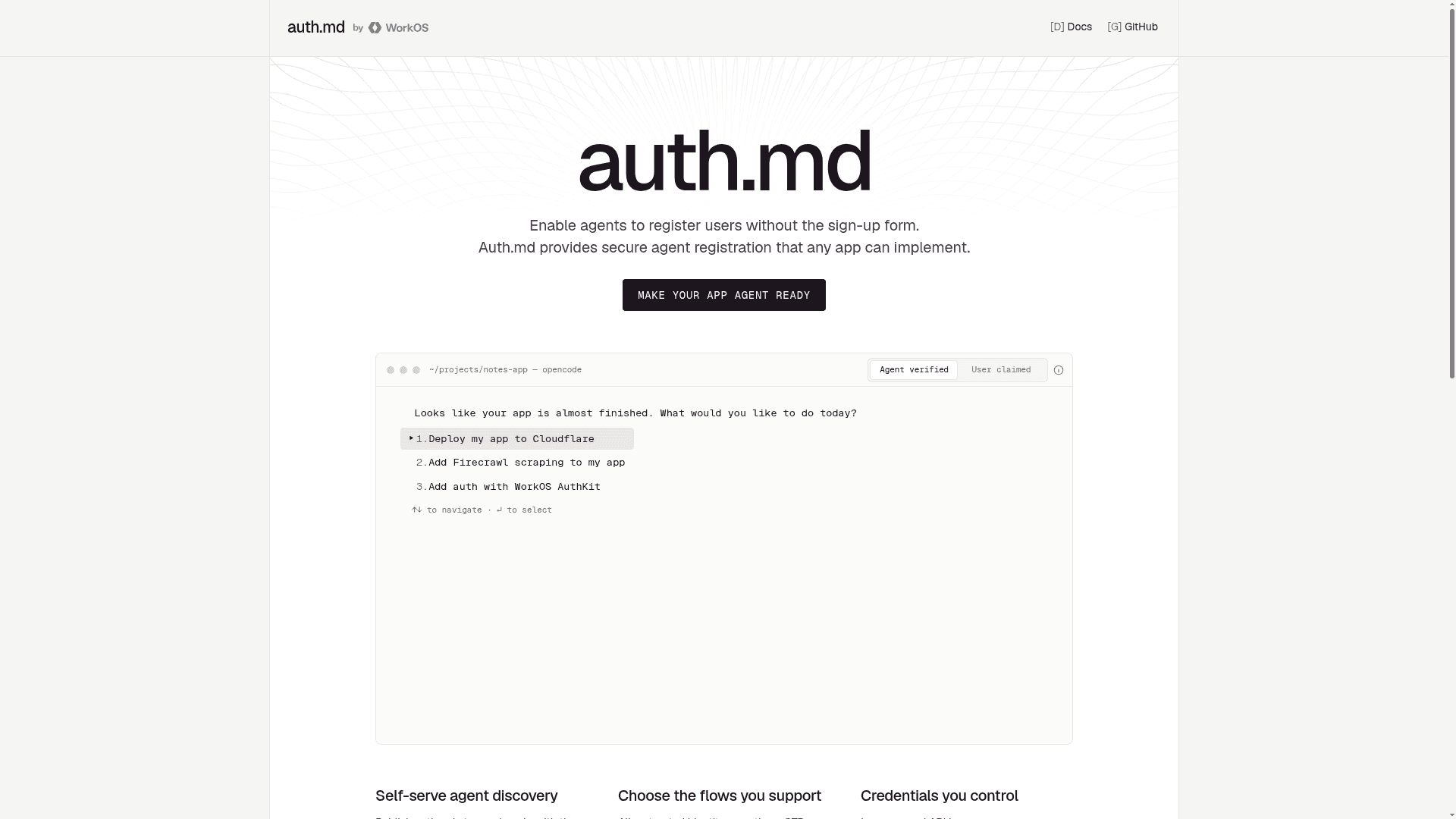
An open MIT-licensed protocol from WorkOS that lets AI agents register and authenticate to services on behalf of users, discoverable through an AUTH.md file hosted at a service's domain.
At a Glance
About auth.md
auth.md is an open protocol and reference implementation that lets AI agents authenticate to services on behalf of the users they act for. It is published by WorkOS on GitHub at github.com/workos/auth.md under an MIT license. The mechanism centers on a Markdown file named AUTH.md that a service hosts at its domain, telling agents how to register and obtain credentials.
What It Is
The repository describes a protocol for what it calls agentic registration. It defines three roles: an agent acting on behalf of a user, an agent provider that mints identity assertions (called ID-JAGs), and a service that accepts those assertions and issues credentials in return. When an agent is not tied to a user identity, or the agent provider does not support ID-JAGs, the service falls back to an OTP-based claim flow to authenticate the agent instead.
The AUTH.md File
At the center of the protocol is a Markdown manifest the service hosts, typically at a path like service.com/auth.md. The README describes this file as a skill manifest that agents read, laying out a procedural recipe for the agent to follow: discover, register, claim, use, and handle revocation. Service metadata is published at a well-known discovery endpoint that points agents to the AUTH.md skill, the registration URI, the claim URI, and the revocation URI.
Registration Flows
The README documents three registration flows that share a single /agent/auth endpoint, each matched to what the agent already has available. The identity assertion flow has the agent obtain an audience-specific ID-JAG from its provider, which the service verifies against the provider's published JSON Web Key Set before issuing credentials. The verified-email flow sends a claim email and uses a six-digit one-time code that the user reads back to the agent. The anonymous flow issues a scoped API key up front and lets a user later take ownership through the same OTP claim step, at which point the service swaps the key's pre-claim permissions for post-claim ones.
What the Repository Includes
The repository ships sample implementations for both sides of the exchange. The README points implementers to agent-services for a sample resource server and authorization server, and to agent-providers for a sample identity provider that mints ID-JAGs and publishes its JWKS. A shared workspace package holds common ports and types. The project is written entirely in TypeScript and runs locally with pnpm, exposing a sample service and provider that walk through the three flows interactively.
Current Status
The repository is public and MIT-licensed, with no tagged releases published at the time of writing. The codebase is presented as a reference implementation rather than a packaged product, intended to demonstrate the protocol and give implementers a starting point for both the service and provider sides.
Community Discussions
Be the first to start a conversation about auth.md
Share your experience with auth.md, ask questions, or help others learn from your insights.
Pricing
Open Source
Capabilities
Key Features
- Agentic registration protocol for agents acting on behalf of users
- AUTH.md skill manifest hosted at a service's domain
- Discovery via well-known OAuth authorization server metadata
- Identity assertion flow using ID-JAGs
- JWKS-based signature and claim verification
- Verified-email identity assertion with one-time code
- Anonymous registration with OTP-based claim flow
- Scoped API key issuance with pre-claim and post-claim permissions
- Credential revocation handling
- Sample agent service implementation (resource + authorization server)
- Sample agent provider (IdP) implementation
- Shared workspace package with common ports and types
- Local development setup via pnpm