
auto-arch-tournament
An autonomous agent loop that proposes, implements and verifies microarchitectural improvements to a SystemVerilog RV32IM CPU using formal verification, cosim and FPGA place-and-route.
At a Glance
Self-hosted core released under the Apache License 2.0. Vendored third-party code keeps its own licenses.
Engagement
Available On
Alternatives
Listed Oct 2026
About auto-arch-tournament
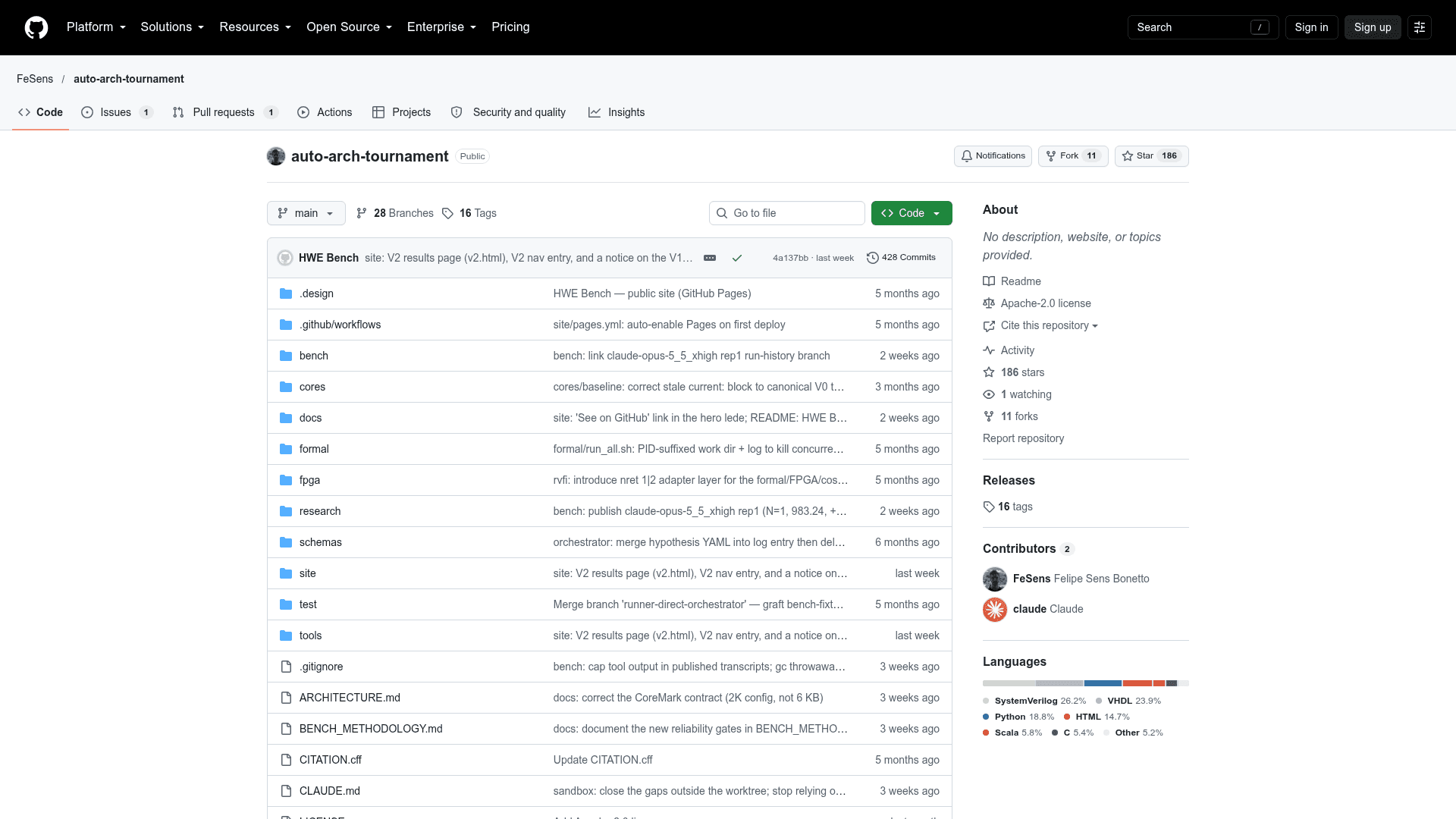
auto-arch-tournament is an open-source research loop, published by FeSens on GitHub, that points a coding agent at a SystemVerilog RV32IM CPU. Each round the agent proposes a microarchitectural hypothesis, implements it in an isolated git worktree, and runs it through a gated verification pipeline. Only hypotheses that beat the current champion on CoreMark/MHz are merged. It also underlies HWE Bench, a benchmark for LLM hardware development on RISC-V.
What It Is
It is an orchestrated, hardcoded evaluation-and-evolution framework for CPU design. Each core lives under cores/<name>/ with its own RTL, cocotb tests, experiment log, core.yaml, and LESSONS.md. make loop TARGET=<name> runs the loop for one core on a dedicated core-<name> branch in its own worktree, so several cores can evolve in parallel. The orchestrator never merges to main; each core's evolution is a single reviewable PR diff.
How a Round Works
A hypothesis agent writes a YAML hypothesis against a JSON schema, using the source RTL, recent log entries, lessons, and optional core philosophy. An implementation agent then edits only the core's rtl/ and cocotb tests. The eval pipeline runs Verilator lint, Yosys synthesis, a benchmark build, cosim build, riscv-formal, Verilator cosim against a Python ISS, and 3-seed FPGA place-and-route with CoreMark. The first failing step short-circuits the round. A scribe agent then records a lesson for later rounds. The highest-fitness slot above the champion merges.
Verification and Guardrails
- riscv-formal symbolic checks against RV32IM (about 105 checks at NRET=2).
- Verilator cosim with random bus stalls, comparing RVFI output to a Python ISS.
- Median Fmax across 3 seeds on a Gowin GW2A-LV18 (Tang Nano 20K) combined with CoreMark iterations per cycle for fitness.
- Independent CoreMark CRC validation.
- A path sandbox that rejects rounds where the agent touched anything outside its core's
rtl/andtest/test_*.py.
Reported Results
The README reports a run of 73 hypotheses over 9h 51m that produced cores/v1/ from cores/baseline/. In that run, 10 were accepted and 63 rejected. The champion went from 301 to 577 iter/s (2.23 to 2.91 CoreMark/MHz), which the author compares with VexRiscv's published 2.30 CoreMark/MHz.
Setup Path
Setup is macOS only for now. bash setup.sh installs Verilator, OSS CAD Suite, the RISC-V cross compiler, and Python dependencies into .toolchain/. A coding-agent CLI is also needed: Codex by default, or Claude Code via AGENT=claude. The repository is licensed under Apache 2.0.
Community Discussions
Be the first to start a conversation about auto-arch-tournament
Share your experience with auto-arch-tournament, ask questions, or help others learn from your insights.
Pricing
Open Source (Apache 2.0)
Self-hosted core released under the Apache License 2.0. Vendored third-party code keeps its own licenses.
- Apache License 2.0 core
- Vendored third-party code keeps its own license: formal/riscv-formal/ (ISC) and bench/programs/coremark/ (see its LICENSE.md)
- Requires a coding-agent CLI (Codex default, Claude Code supported), which is an external cost
- macOS only for now
Capabilities
Key Features
- Autonomous hypothesis-implement-verify loop for CPU microarchitecture
- Multi-core layout with per-core git worktrees and branches
- Parallel slots per round
- riscv-formal symbolic verification
- Verilator cosim against a Python ISS
- 3-seed FPGA place-and-route fitness on Tang Nano 20K (GW2A-LV18)
- CoreMark CRC validation
- Path sandbox restricting agent edits
- Scribe-maintained LESSONS.md and experiment log
- Progress reports and charts
- Selectable coding agent (Codex or Claude Code)