
Babysitter
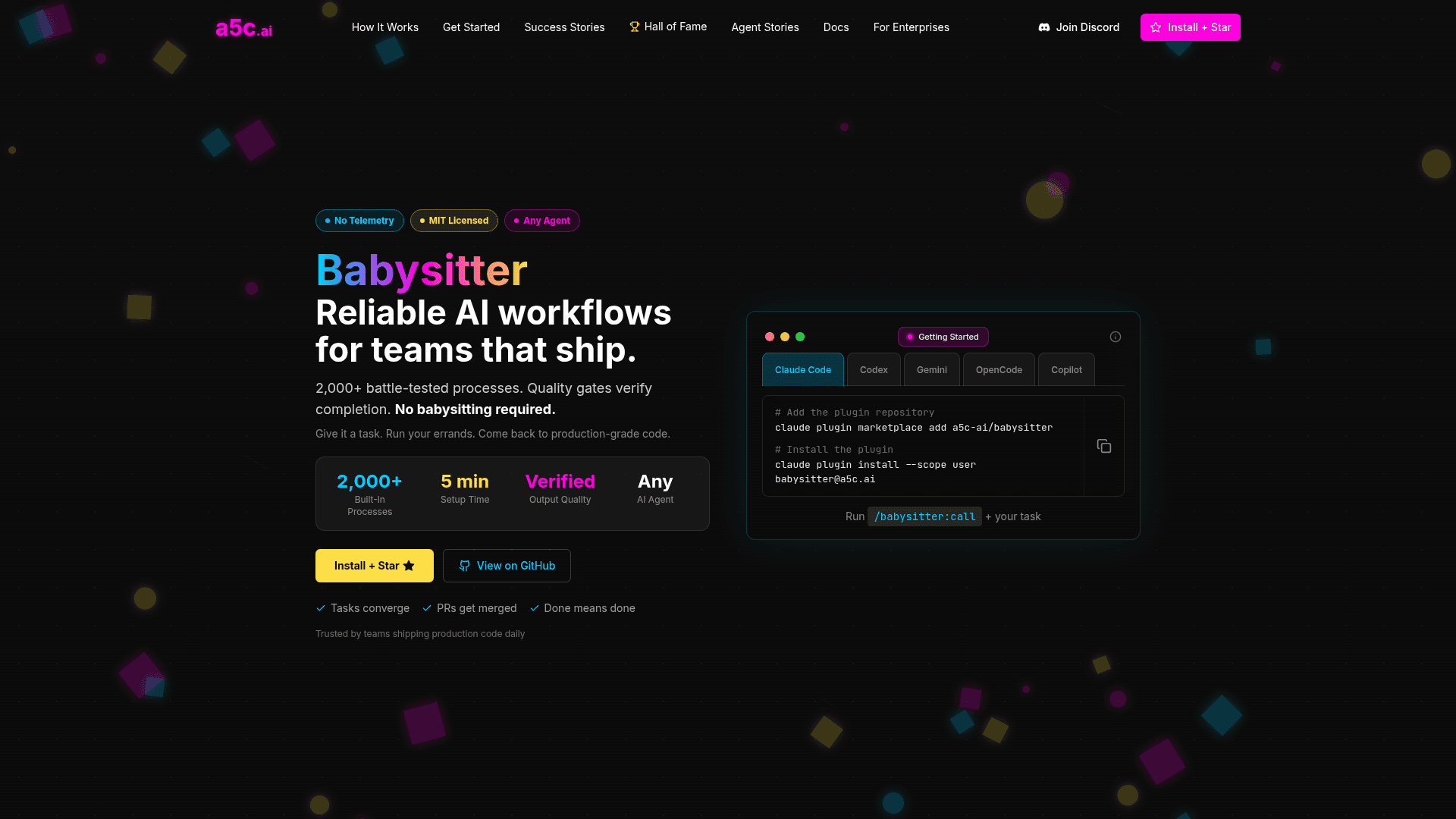
An open-source orchestration layer that wraps AI coding agents in quality gates, convergent loops, and deterministic workflows to ensure reliable, verified task completion.
At a Glance
Fully free and open-source under the MIT License. Self-hosted, no telemetry, no licensing fees.
Engagement
Available On
Alternatives
Listed Jun 2026
About Babysitter
Babysitter is an open-source orchestration layer built by a5c.ai that wraps AI coding agents in quality gates, convergent loops, and an immutable event-sourced journal. Licensed under MIT and available on GitHub, it enforces deterministic, hallucination-free self-orchestration so that "done" means gates passed — not just agent confidence. The project was created in January 2026 and has accumulated over 1,100 GitHub stars.
What It Is
Babysitter sits between a developer and their AI coding agent, acting as a process enforcement layer rather than a simple prompt wrapper. Workflows are defined as JavaScript code; the agent can only execute what the process permits. Every task, gate, and decision is recorded in an immutable journal stored in .a5c/runs/, enabling deterministic replay and resumption from any point. The homepage describes it as "CI/CD for AI agents" — your agent codes, Babysitter verifies.
How the Enforcement Architecture Works
The core mechanism is a mandatory stop-and-check loop. After every step, the agent is forced to halt; the process code then decides what is permitted next. Quality gates are real code logic — tests, lints, validators — not configuration suggestions. If a gate fails, the agent cannot progress until it passes. Key architectural properties include:
- Process as Code: Workflows are JavaScript functions, not YAML config
- Mandatory Stop Hook: Claude (or any harness) cannot "keep running" past a gate
- Event-Sourced Journal: All state is persisted, enabling resume from any checkpoint
- Cryptographic Completion Proof: A secret emits only when all gates have passed
- 4-Layer Token Compression: Built-in subsystem the project claims reduces context window usage by 50–67% while maintaining 99% fact retention
Supported Harnesses and Platforms
Babysitter ships plugins for multiple AI coding agents. Claude Code is the recommended and natively supported harness. Additional harness plugins — some labeled experimental — cover Codex CLI, Cursor IDE, Gemini CLI, GitHub Copilot, Pi, Oh-My-Pi, and OpenCode. An internal harness (--harness internal) runs processes programmatically without any external AI agent, making it suitable for CI/CD pipelines and headless automation. The SDK is published to npm as @a5c-ai/babysitter-sdk.
The Process Library and Plugin System
The project ships with what it describes as 2,000+ built-in processes — executable blueprints covering development (TDD, refactoring, code review), security (pentesting, compliance audits), research (scientific discovery pipelines), and operations (CI/CD, incident response). Community methodologies such as BMAD, CC10X, and Gas Town can be integrated via /babysitter:assimilate. The plugin system distributes natural language instruction sets (markdown) and deterministic coded processes (JS) that an AI agent reads and executes at install time, including setup for security tooling, testing frameworks, deployment configs, and CI/CD pipelines.
Operating Modes
Four primary modes give teams control over autonomy level:
- Interactive (
/babysitter:call): Pauses at breakpoints for human approval - Plan First (
/babysitter:plan): Research and architect before executing - YOLO (
/babysitter:yolo): Full autonomy, no interruptions - Forever (
/babysitter:forever): Continuous operation for monitoring or periodic tasks
Update: v0.0.187
The latest release is v0.0.187, published April 4, 2026. The repository was last pushed to on June 1, 2026, indicating active development. The project was created in January 2026 and has grown to 1,133 stars and 71 forks. The enterprise page at a5c.ai/enterprise describes an "Org AI Transformation" offering focused on autonomous workflow orchestration, governance, and an internal AI Task Force engagement model.
Community Discussions
Be the first to start a conversation about Babysitter
Share your experience with Babysitter, ask questions, or help others learn from your insights.
Pricing
Open Source
Fully free and open-source under the MIT License. Self-hosted, no telemetry, no licensing fees.
- Full orchestration layer with quality gates
- 2,000+ built-in processes
- Multi-harness support (Claude Code, Codex, Cursor, Gemini, Copilot)
- Internal harness for CI/CD automation
- 4-layer token compression
Capabilities
Key Features
- Quality gates that block agent progression until tests/lints/validators pass
- Convergent loops that retry until gates are satisfied
- Immutable event-sourced journal for deterministic replay and resume
- Cryptographic completion proof (secret emits only when truly done)
- 2,000+ built-in battle-tested processes
- Four operating modes: Interactive, Plan First, YOLO, Forever
- 4-layer token compression subsystem (50-67% context reduction claimed)
- Plugin system for security, testing, deployment, CI/CD, and themes
- Internal harness for headless CI/CD automation without external AI agent
- Multi-harness support: Claude Code, Codex, Cursor, Gemini CLI, GitHub Copilot
- Real-time monitoring via /babysitter:observe
- Human-in-the-loop breakpoints with structured approval context
- Parallel task execution with dependency management
- Run resumption from any checkpoint
- Zero telemetry — no data sent home