
BambooAI
An open-source Python library that enables natural language-based conversational data analysis using Large Language Models, supporting both local datasets and external data sources.
At a Glance
Fully free and open-source under the MIT License. Self-hosted; users supply their own LLM API keys.
Engagement
Available On
Alternatives
Listed Jul 2026
About BambooAI
BambooAI is an open-source Python library created by pgalko that lets users interact with their data through natural language conversations powered by Large Language Models. Released under the MIT License and available on PyPI, it supports both Jupyter notebook and web UI workflows, making data analysis accessible without requiring deep coding expertise.
What It Is
BambooAI is a conversational data analysis tool that sits between a user's natural language questions and Python-based data analysis code. It classifies incoming queries, routes them to specialized LLM agents, generates and executes Python code, self-corrects errors, and returns formatted results or visualizations — all within a conversation loop. The project describes itself as experimental and designed to augment data analysts at all skill levels.
Multi-Agent Architecture
BambooAI uses a multi-agent system where each agent handles a specific part of the analysis pipeline. The agents and their roles include:
- Expert Selector – determines the best expert type for the query
- Analyst Selector – selects the specific analysis approach
- Theorist – provides theoretical background and methodology
- Dataframe Inspector – analyzes data structure (requires ontology file)
- Planner – breaks complex tasks into step-by-step plans
- Code Generator – writes Python code for analysis
- Error Corrector – debugs and fixes generated code
- Reviewer – evaluates solution quality and adjusts plans
- Solution Summarizer – creates concise result summaries
- Google Search Executor / Summarizer – handles web search queries
Each agent is independently configurable via LLM_CONFIG.json, allowing users to mix and match models from OpenAI, Anthropic, Google Gemini, Mistral, DeepSeek, Groq, MiniMax, Ollama, and VLLM.
Memory and Knowledge Systems
BambooAI implements two memory layers to improve analysis quality over time:
- Semantic Memory (Dataframe Ontology): Users can supply an OWL ontology as a
.ttlfile to ground agents in domain-specific knowledge, improving code accuracy for complex data relationships. - Episodic Memory (Vector DB): High-quality solutions (user-ranked above 6/10) are vectorized and stored in Pinecone or Qdrant. When a new query arrives, the system retrieves the closest matching past solution above a 0.8 similarity threshold to guide agents.
Deployment Options
BambooAI supports three deployment paths:
- pip install – install
bambooaiand run interactively in Jupyter or CLI - Docker (recommended) – provides sandboxed code execution, consistent environment, and easy configuration via volume mounting
- Full repository clone – for contributors or users who want to modify the source
The web application runs on Flask and is accessible at http://localhost:5000 (or port 5001 via Docker). An interactive Workflow Map is available in the web UI.
Model Support and Configuration
The library supports a broad range of LLM providers via API and local inference:
- API-based: OpenAI, Google Gemini, Anthropic, Groq, Mistral, DeepSeek, OpenRouter, MiniMax
- Local inference: Ollama (all models), VLLM (all models)
The README notes that as of April 22, 2025, the most performant agent/model combination for sports and performance datasets uses GPT-4.1, Claude 3.7 Sonnet, Claude 3.5 Sonnet, and Gemini 2.5 Pro across different agents.
Update: v0.4.26
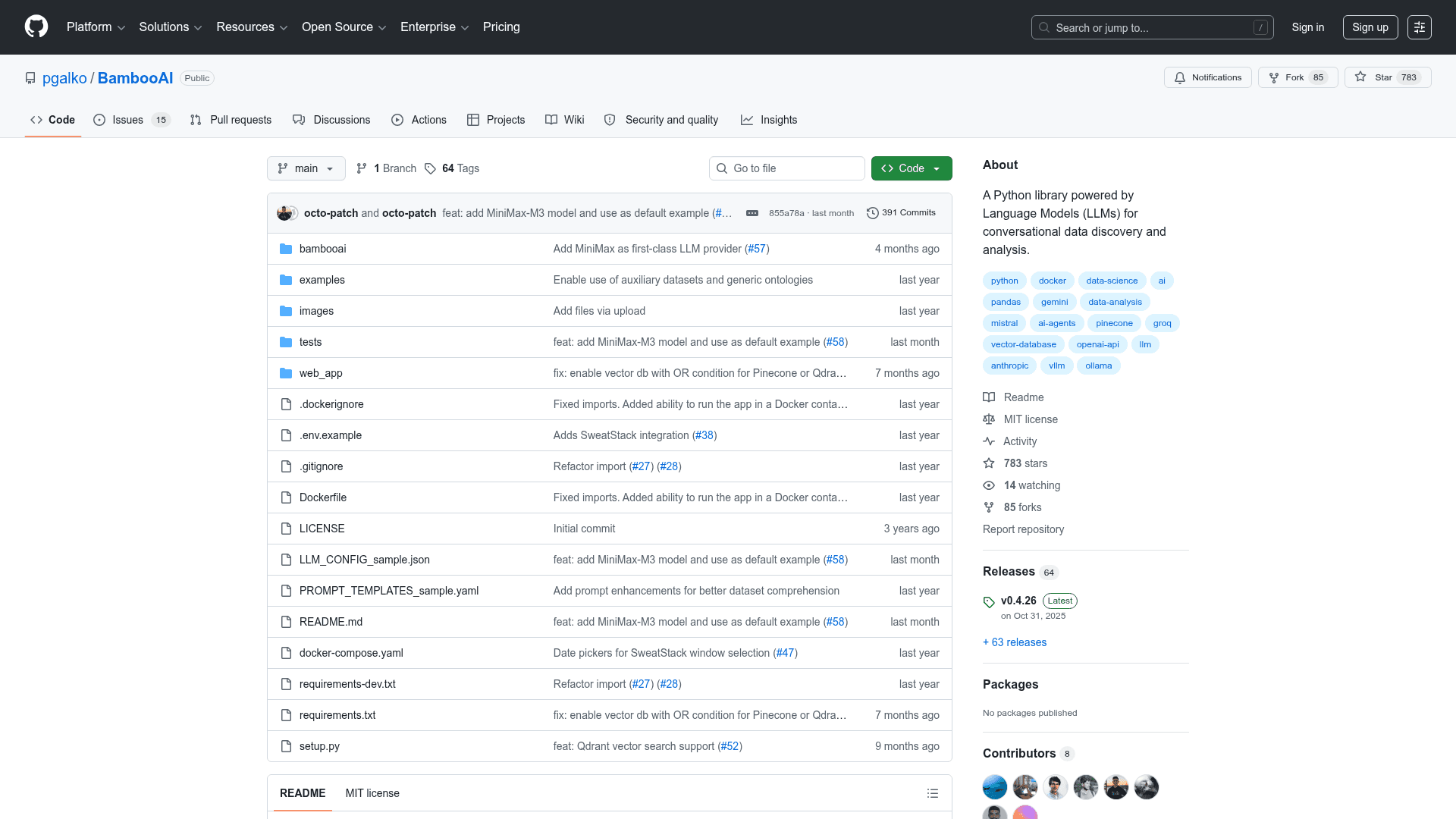
The latest release is v0.4.26, published on October 31, 2025. The repository was last pushed on June 3, 2026, and last updated July 18, 2026, indicating active ongoing development. The project has accumulated 783 GitHub stars and 85 forks since its creation in May 2023. It is indexed with DeepWiki by Cognition Labs for interactive documentation and code exploration.
Community Discussions
Be the first to start a conversation about BambooAI
Share your experience with BambooAI, ask questions, or help others learn from your insights.
Pricing
Open Source
Fully free and open-source under the MIT License. Self-hosted; users supply their own LLM API keys.
- Full source code access under MIT License
- pip install or Docker deployment
- Multi-agent LLM system
- Web UI and Jupyter notebook support
- Vector database integration (Pinecone/Qdrant)
Capabilities
Key Features
- Natural language interface for data analysis
- Multi-agent LLM system with specialized roles
- Web UI and Jupyter notebook support
- Support for local and external datasets
- Internet search integration
- Optional planning agent for complex tasks
- Custom OWL ontology integration (semantic memory)
- Vector database knowledge base (Pinecone and Qdrant)
- Self-healing code execution with error correction
- Multi-dataset (auxiliary datasets) support
- Multimodal query support
- Docker deployment with sandboxed code execution
- Configurable per-agent LLM model selection
- Workflow saving and follow-ups
- Logging with token usage and cost tracking