
Beacon
Open-source, cross-harness memory layer that captures coding agent sessions and turns them into reusable skills for future agents.
At a Glance
About Beacon
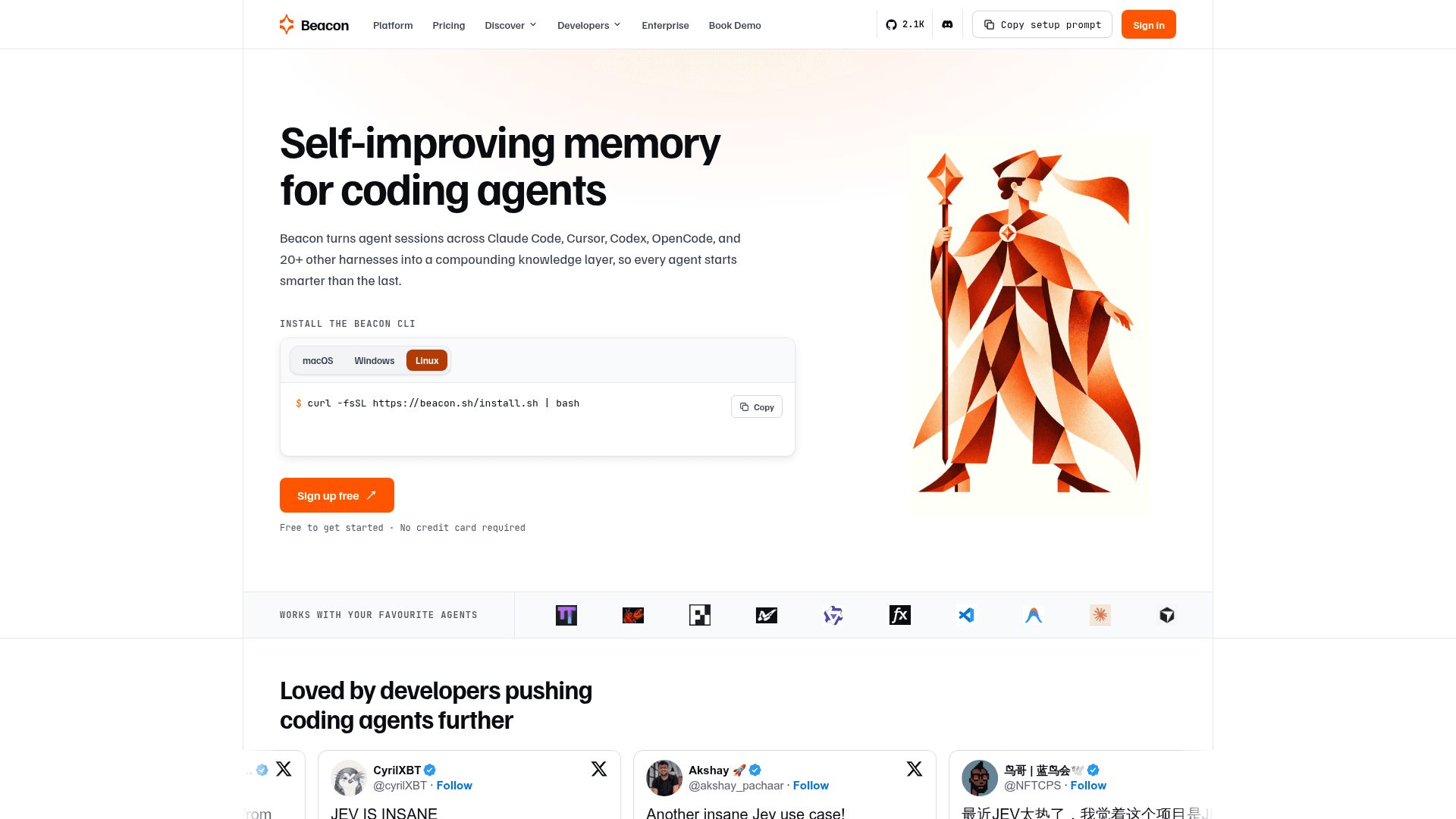
Beacon is an open-source memory layer for AI coding agents from Asymptote Labs. It captures session history across Claude Code, Cursor, Codex, OpenCode, and 20+ other harnesses, then turns useful workflows, corrections, and debugging patterns into reusable knowledge for future agents. The project is MIT-licensed, and the latest release listed on GitHub is v1.3.45.
What It Is
Beacon sits across the agent harness layer rather than inside any single tool. It records prompts, responses, tool calls, commands, file activity, approvals, MCP interactions and token usage, and normalizes them into a common OpenTelemetry-based event model. The result is one session history that can be inspected, searched and learned from, instead of a separate proprietary history per coding tool.
How the Memory Loop Works
The documented loop is: run agents, capture session history, evaluate what worked, extract useful knowledge, review and approve it, then reuse it across future agents. The website describes a "dreaming" process that reviews successful sessions, identifies the correction that mattered, and turns it into a concrete skill, for example a skill for debugging failed webhook deliveries. Once a skill is reviewed, future agents can retrieve it through MCP or Agent Skills.
Local-First Setup and Inspection
Beacon installs through Homebrew on macOS, a package installer on Linux (.deb or .rpm), and an MSI on Windows. Telemetry is written to local JSONL by default. beacon traces opens a terminal browser for traces, event timelines and token usage, and beacon endpoint dashboard opens a local read-only web dashboard. Dashboard sessions can show custom "lenses", sandboxed single-file views such as file diffs or token breakdowns. Interactive setup can instead connect the machine to Beacon Cloud, and beacon endpoint disconnect reverses that.
Coverage and Destinations
The README lists support for local agents, browser chat (Claude.ai and ChatGPT via extension), cloud agents, CI jobs, and SDK instrumentation for Anthropic, OpenAI, the Claude Agent SDK and the Vercel AI SDK. Normalized session history can be forwarded to destinations including Splunk, Datadog, Elastic, Microsoft Sentinel, CrowdStrike Falcon LogScale, Sumo Logic, Wazuh, AWS S3, GCS and CloudWatch.
Community Discussions
Be the first to start a conversation about Beacon
Share your experience with Beacon, ask questions, or help others learn from your insights.
Pricing
Open Source
Self-hosted agent telemetry for your own stack, MIT licensed
- 20+ agents, including Claude Code, Codex and Cursor
- Prompts, commands, diffs and token usage
- Export to Elastic, S3 or any OTel collector
- Offline threat detection
- Local dashboard for sessions and costs
Beacon Cloud
Managed cloud with free forever tier
- Everything in Open Source
- Every agent and machine in one timeline
- See where your token spend goes
- 50 findings for risks, reusable skills and habits
- One-click skills and fix prompts
Beacon Cloud Pro
Unlimited findings, and agents that learn from your history
- Everything in Beacon Cloud
- Unlimited findings
- Full MCP access for your agents: sessions, findings and feedback
- Memories your agents can save and recall over MCP
- Skills your agents can pull straight from your sessions
- Full evidence trail on every finding
- Real-time alerts and priority support
Enterprise
Govern AI agents across your organization
- Everything in Pro
- Block or require approval for risky actions
- Findings across your whole org
- Agents on endpoints, in CI and in the cloud
- Fleet rollout through Jamf, Intune or Fleet
- SSO, RBAC and audit logs
- Your own bucket and region
- Dedicated SLA and support channel
Capabilities
Key Features
- Cross-harness session history capture across 20+ coding agents
- Reusable skills generated from workflows, corrections and debugging patterns
- Shared memory retrievable through MCP or Agent Skills
- Exact session replay of prompts, tools, commands, edits, approvals and tokens
- Local-first JSONL storage
- Local terminal and web dashboard with custom lenses
- Forwarding to SIEM, log aggregation and object storage destinations
- Browser chat, cloud agent, CI and SDK instrumentation