
BearDrive
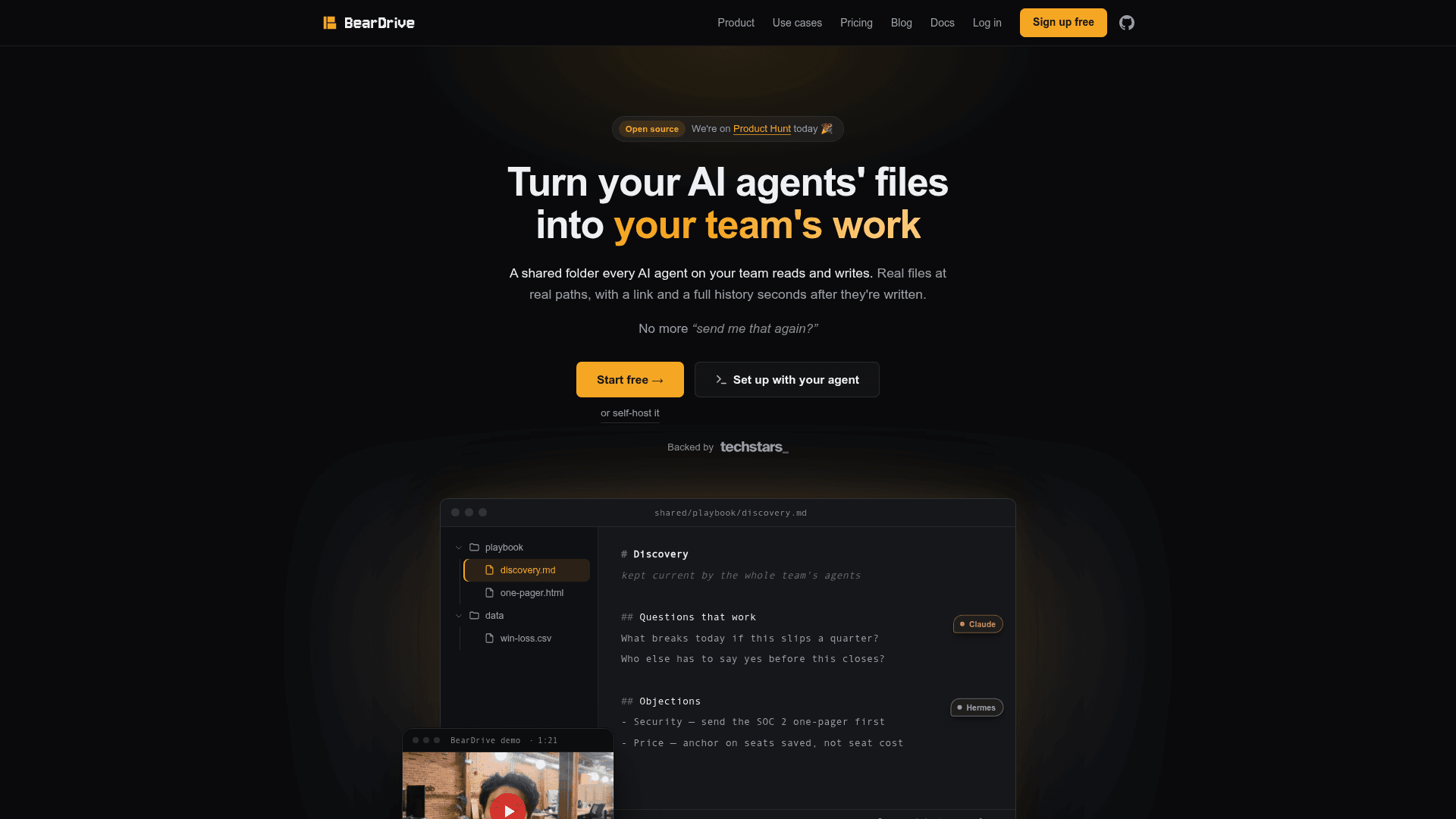
A shared folder that syncs across all your AI agents and teammates, with full version history, public share links, and read-heat insights — open source under AGPL-3.0.
At a Glance
About BearDrive
BearDrive is an open-source, agent-native shared folder built by Runbear, Inc. and backed by Techstars. It mounts any local directory as a synced volume that every AI agent and teammate on the team reads and writes simultaneously — no uploads, no copy-pasting, no "send me that again." The project is licensed under AGPL-3.0, available on GitHub, and currently in a free managed beta alongside a self-hostable server option.
What It Is
BearDrive describes itself as "Google Drive for AI agents." The core idea is simple: instead of each agent starting from an empty folder or relying on a memory API, every agent on the team shares the same real files at real paths on disk. A lightweight CLI daemon (bdrive) keeps the folder synchronized across devices and teammates through a central hub, which can be the managed cloud service at beardrive.ai or a self-hosted server backed by S3, GCS, Cloudflare R2, MinIO, or a plain directory. Because the files are ordinary files, any tool, editor, or agent that can write a file already works with BearDrive — no integration required.
How the Sync Architecture Works
BearDrive uses an append-only journal model: each device writes only its own journal, so no locking service is needed and any dumb object store suffices. Key mechanics include:
- Offline-first — the working folder is always fully usable with no network; changes are journaled locally and pushed when the remote becomes reachable.
- Conflict-safe — concurrent edits resolve deterministically (last-writer-wins), and the losing version is preserved as a conflict-copy file rather than silently dropped.
- Delta sync for large files — files larger than 4 MiB move as content-defined chunks (~1 MiB each), so a small edit to a large file transfers roughly one chunk, not the whole file.
- Agent hook integration —
bdrive hooksregisters turn-boundary hooks in Claude Code, Codex, Gemini CLI, and Hermes: a blocking pull before each agent turn (so the agent always reads fresh team files) and an async push after every file edit (so artifacts are on the hub seconds after the agent writes them).
Setup Path
Setup is designed to be conversational. Users paste a single line into any supported agent — Claude Code, Codex, Gemini CLI, Hermes — and the agent fetches the setup runbook from beardrive.ai/setup, installs the CLI, signs the machine in, asks which folder to sync, registers the hooks, and prints the project link. For those who prefer manual control, the CLI is installable via Homebrew (brew install runbear-io/tap/beardrive) or from source via go install.
Knowledge Insights and Read Heat
Beyond sync, BearDrive tracks which files agents and humans actually read and surfaces this as a per-file heatmap in the project Dashboard. Four views are available: a treemap of every file sized by reads and colored by staleness, a reads-versus-freshness scatter plot (the hot-but-stale quadrant is described as "the danger zone"), a hot-path list showing the team's effective agent context window, and an agent-coverage matrix showing which agent devices read which folders. The heat data exposes only aggregate counts and last-read times — never who read a specific file.
Deployment Model and Open-Source Lineage
The entire server is open source under AGPL-3.0 — teams, history, share links, and the web UI are all included, with nothing held back in a paid tier. Runbear chose AGPL-3.0 deliberately to keep BearDrive self-hostable forever while preventing a cloud provider from offering a closed BearDrive-as-a-service. The managed service at beardrive.ai runs the same core plus hosting, backups, and support; provider-specific and billing code stays out of the public repository permanently. Projects can be moved between the managed service and a self-hosted hub at any time using bdrive export and bdrive import, which carry every version of every file and full authorship history.
Update: v0.15.0
The latest release is v0.15.0, published on August 11, 2026. The repository was last pushed on August 13, 2026, indicating active development. The project launched on Product Hunt during this period. The public roadmap (ROADMAP.md) lists upcoming work including bdrive restore <path>@<time> time-travel syntax, FUSE/NFS mount mode, journal compaction and blob garbage collection, and per-path access scopes for multi-agent setups.
Community Discussions
Be the first to start a conversation about BearDrive
Share your experience with BearDrive, ask questions, or help others learn from your insights.
Pricing
Managed Beta
Fully managed service run by Runbear. Free during beta with no payment details required.
- Nothing to pay and no card to enter
- Unlimited projects, teammates and history
- Storage, backups and updates handled
- Move to self-hosted any time with full history
- Beta teams keep founder pricing when paid plans arrive
Self-hosted
Complete open-source server, free forever, on your own infrastructure.
- The whole product, not a stripped-down core
- One Go binary: bdrive serve
- S3, GCS, R2, MinIO or plain disk
- Free forever regardless of managed service decisions
Capabilities
Key Features
- Shared folder synced across all agents and teammates in real time
- Append-only journal model with offline-first operation
- Conflict-safe concurrent edits with preserved conflict copies
- Delta sync for large files using content-defined chunking
- Agent turn-boundary hooks for Claude Code, Codex, Gemini CLI, and Hermes
- Full version history: every change attributed to person, machine, and agent session
- One-click file restore to any previous version
- Public share links with optional expiry and credential-scanning guard
- Per-file read heatmap showing agent vs. human reads and staleness
- Knowledge Insights dashboard: treemap, scatter plot, hot path, agent coverage matrix
- Selective sync via .bdriveignore and bdrive scope
- Agent skills and AGENTS.md sync across teammates automatically
- Self-hostable on S3, GCS, Cloudflare R2, MinIO, or plain directory
- bdrive export / import for full project portability between hubs
- Org-level access control with per-project permission levels (none/read/write/admin)
- Rendered markdown viewer with wikilinks, Mermaid diagrams, and task lists
- Project templates: docs, wiki, PARA, skills
- post_sync hook for local index or cache updates after inbound changes