
BOTROSTER
Open-source, self-hostable platform of persistent, named AI agents that share one durable computer with a browser, shell and filesystem, with approvals for consequential actions.
At a Glance
Self-hostable BOTROSTER core under Apache-2.0; free to use, modify and distribute.
Engagement
Available On
Alternatives
Listed Oct 2026
About BOTROSTER
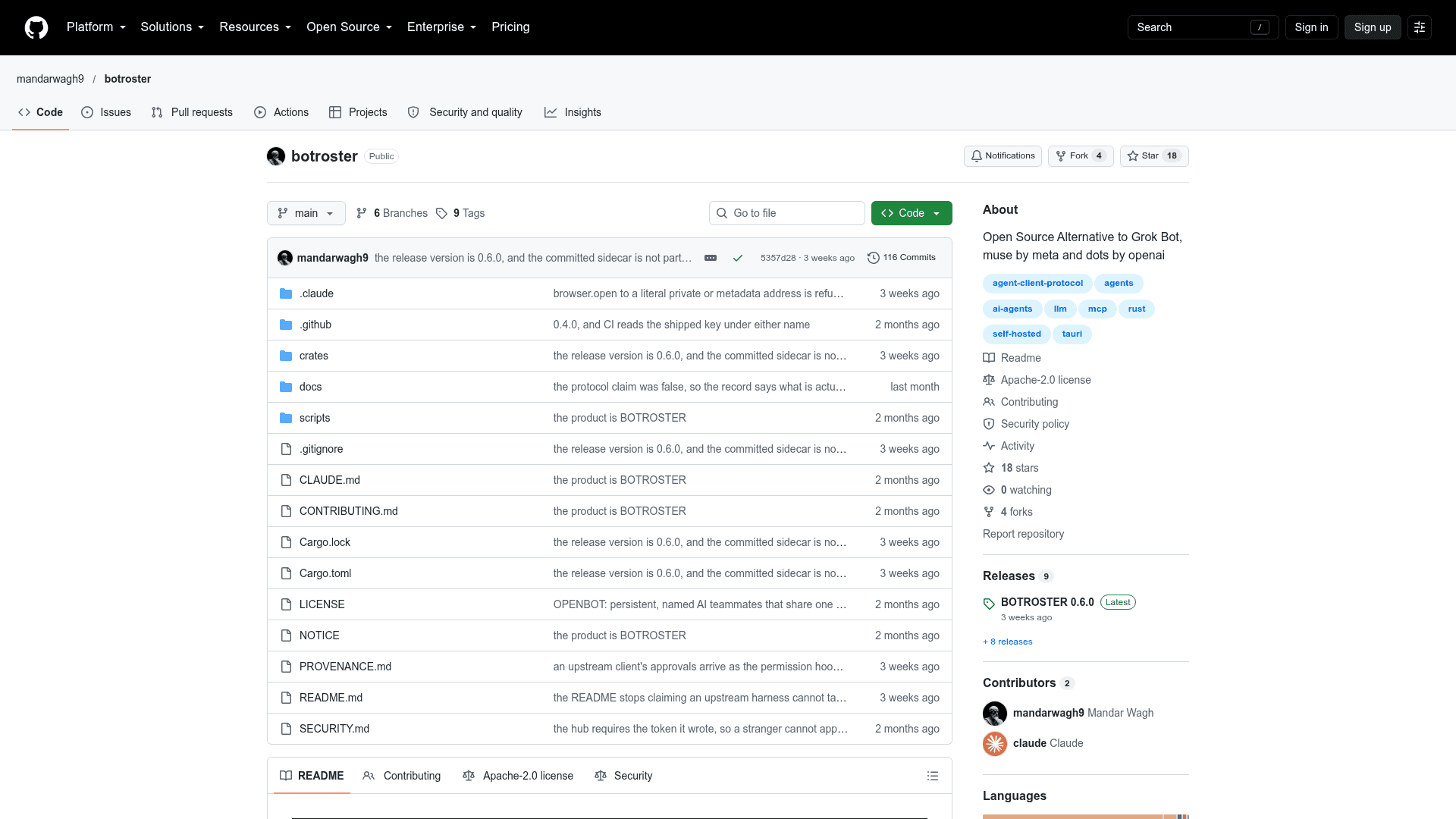
BOTROSTER is an open-source, self-hostable runtime and desktop client from mandarwagh9 for running persistent, named AI teammates called Bots. Each Bot has its own conversation, memory and schedule, and all Bots share one durable computer with a browser, a shell and a filesystem. The README describes it as pre-alpha, with the latest release listed as v0.6.0.
What It Is
BOTROSTER is an agent platform in which you message a Bot like a colleague and it does the work in real tools. It uses MCP connectors where one exists and drives the browser where one does not, then returns when it needs approval. The README presents it as an independent implementation of the shape xAI shipped as Grok Bot, not affiliated with xAI and containing none of its code.
How the workflow runs
Bots are created through the botroster CLI or the desktop client, given a standing brief, and can hand work to each other or post in group threads. Routines fire on cron or event triggers, with an inactivity brake that pauses them when nobody has looked at the account for a while. The botroster up command runs the hub and one guest in a single process and checks for due routines every minute. Everything is stored in ~/.botroster by default, and the window and the command line read the same home.
Approvals, credentials and the computer
The policy gate runs in the hub's control plane rather than in the agent. Users can allow a call once, allow it for the session, or refuse it, and approvals fail closed when a hook times out or errors. A credential broker holds connector tokens and attaches them at call time inside the hub, so the guest never sees them. The hub records every tool call with its arguments, how it was allowed and how it ended. The shared computer offers content-addressed snapshots and restore, a CDP-driven browser, a shell, and a filesystem confined to the workspace root. A live viewer lets a person take over control and locks the Bot out while they drive.
Models, editors and setup
Model providers can use the Anthropic or OpenAI dialects, including xAI, Groq, Ollama and most gateways. A local Ollama or LM Studio model on loopback is detected automatically. Official installers ship with a built-in OpenRouter model whose credential is recoverable from the installer, and whose provider retains prompts. botroster acp speaks the Agent Client Protocol so ACP-capable editors can drive a Bot. Installers are available for Windows, macOS and Linux but are unsigned, and the project can also be built from source with Rust 1.89 or newer.
Tradeoffs to know
The shipped guest is an ordinary process running as the user, not a VM or container, and a hypervisor backend is not yet built. Bots share files, browser sessions and shell credentials, so they organise work but are not a security boundary. The README also flags prompt injection from visited pages as a live risk, mitigated by approvals.
Community Discussions
Be the first to start a conversation about BOTROSTER
Share your experience with BOTROSTER, ask questions, or help others learn from your insights.
Pricing
Open Source
Self-hostable BOTROSTER core under Apache-2.0; free to use, modify and distribute.
- Apache License 2.0
- Self-hostable
- Desktop client for Windows, macOS and Linux
- Demo needs no API key
- Release builds default to stealth/ox-alpha on OpenRouter, free of token charges
Capabilities
Key Features
- Persistent named Bots with standing briefs, conversations and schedules
- Shared durable computer with browser, shell and filesystem
- Hub-enforced approvals that fail closed
- Credential broker keeping tokens out of the guest
- MCP connectors to remote servers with namespaced tools
- Cron and event routines with inactivity brake
- Bot handoff and group threads
- Audit record of every tool call
- Content-addressed snapshots and restore
- Live computer viewer with takeover
- Agent Client Protocol adapter for editors
- Local model detection for Ollama and LM Studio
- Desktop client built with Tauri