
AgenticOS
A self-hosted, open-source platform for building, running, and governing company AI agents with budgets, approvals, MCP integrations, and multi-surface deployment.
At a Glance
Fully open-source self-hosted platform under Apache 2.0. Free to use, modify, and deploy on your own infrastructure.
Engagement
Available On
Alternatives
Listed Sep 2026
About AgenticOS
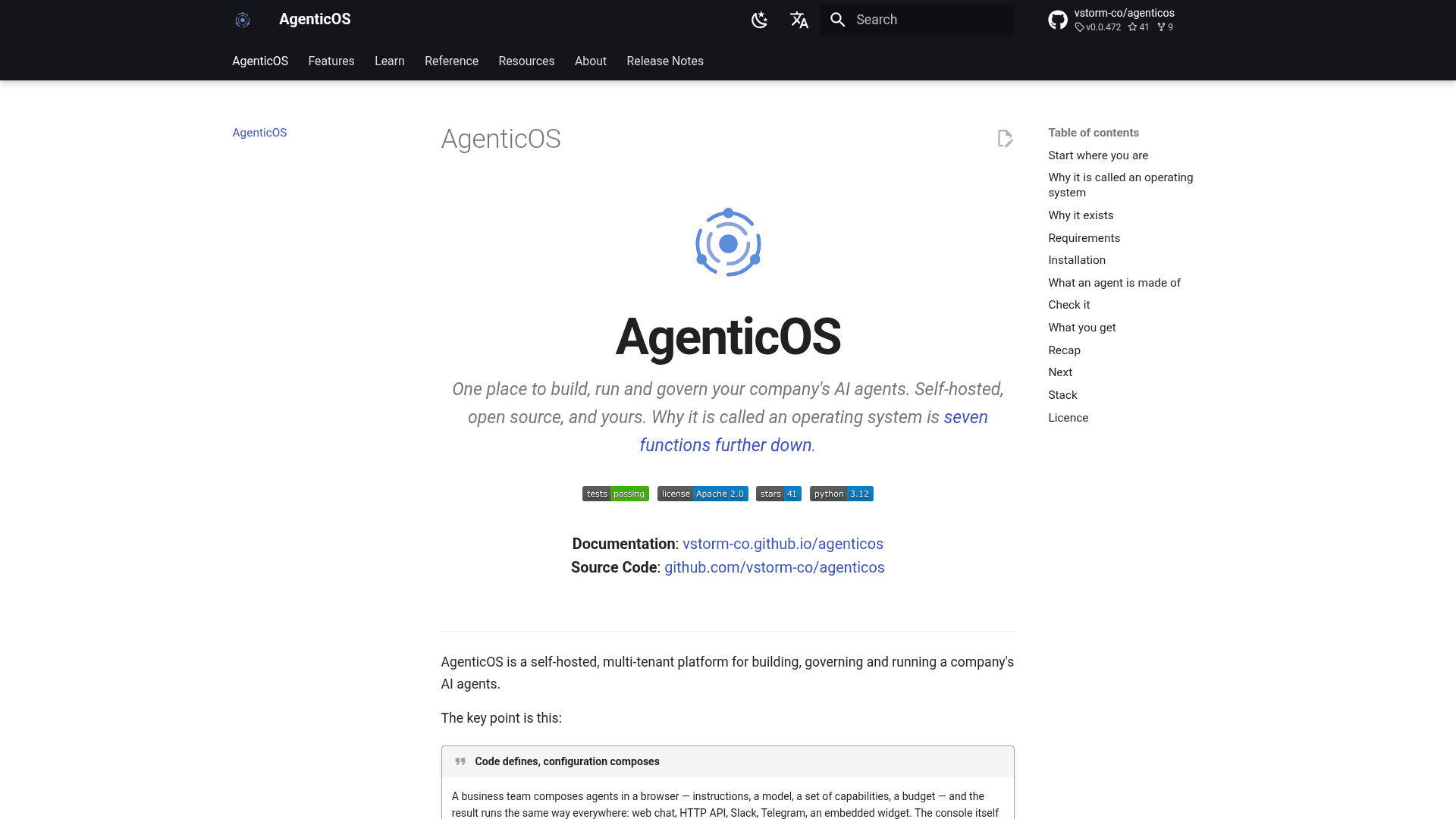
AgenticOS is a self-hosted, open-source platform built by Vstorm for companies that want to build, run, and govern AI agents without giving up control of their infrastructure. Licensed under Apache 2.0, it runs on ordinary Docker infrastructure — Postgres with pgvector, Redis, and a Next.js console — and nothing phones home. The project reached v0.0.472 as of September 2026 and is actively developed on GitHub.
What It Is
AgenticOS is a multi-tenant agent control plane that separates the concerns of engineering and business operation. Engineers register capabilities in typed Python; business teams compose agents in a browser by choosing instructions, a model profile, capabilities, knowledge collections, approval rules, and a budget. The result is a versioned YAML spec that runs identically across every surface — web chat, HTTP API, Slack, Telegram, Mattermost, an embeddable widget, or a hosted page — through a single shared runner. The project describes itself as an "operating system for agents" and maps seven OS-level functions (process isolation, resource limits, access control, driver abstraction, filesystem, unified shell, and audit log) to concrete mechanisms in the codebase.
Architecture and Stack
The platform is built on FastAPI and Pydantic v2 for the API layer, Pydantic AI for the agent runtime, PostgreSQL with pgvector for storage and retrieval, Redis for queuing, Prefect for background work, and Next.js 15 for the console frontend. Tenant isolation is enforced at the schema level, not just in service code — a ciphertext from one organization cannot be decrypted for another. The platform layer is held at 100% test coverage and CI fails below it.
Key architectural decisions:
- Code defines, configuration composes — capabilities are registered in Python; agents are assembled from what is registered, so a no-code builder cannot exceed what engineers have sanctioned
- One runner, eight surfaces — the same budget, approval gate, and audit trail apply regardless of where a question arrives
- Budgets checked before the model call — a run that fails still records what it spent; a runaway stops mid-sentence rather than arriving as an invoice
Capabilities and Integrations
Each capability is switched on per agent in the Builder and carries its own settings and optional approval gate:
- Retrieval over documents in your own Postgres, with three PDF parsers (PyMuPDF, LlamaParse, self-hosted LiteParse OCR), configurable chunking, and OCR language selection
- Web search, page fetch, and a real browser for sites that require interaction
- Python execution in a sandboxed environment with files and a shell
- Charts and image generation
- Delegation and planning for tasks too large for a single answer
- Guardrails for redaction, blocking, and output caps
- MCP integration — the project states 5,802 servers in the catalogue, 99 of them verified with OAuth flows wired, plus any server by URL with no connector to write
- 27 model providers with per-organization keys, fallbacks, and support for self-hosted Ollama or a LiteLLM proxy
- Google Drive and S3 sync for knowledge collections
- Skills — written procedures loaded on demand when the agent decides they are relevant
- Context files — standing instructions attached across agents, analogous to
AGENTS.md
Governance Model
AgenticOS frames governance as a first-class concern rather than an afterthought:
- Monthly budgets per agent, checked before each model request
- Human approval gates on any capability that acts on the outside world — the run parks and waits for a person
- Permission catalog in code, with roles composed from permissions and per-resource grants that widen access but never narrow it
- Audit trail written even when a run fails, recording who ran what, when, what it cost, and who approved it
- Per-organization secret vault — keys are encrypted and separated per tenant; no API response, log line, or audit entry ever carries a plaintext key
Update: v0.0.472
The latest release is v0.0.472, published on 2026-09-18. The project was created in July 2026 and has been releasing rapidly under a continuous versioning scheme. The GitHub repository shows 41 stars and 9 forks at time of indexing, with 49 open issues. The README includes a roadmap reference for features not yet available (ACL-aware SaaS connectors, evaluation harness, SAML/SCIM), and the project explicitly documents where it loses to alternatives in a comparison table. Vstorm, the company behind AgenticOS, describes itself as an applied agentic AI engineering consultancy with production agent deployments and offers commercial deployment services on top of the open-source platform.
Community Discussions
Be the first to start a conversation about AgenticOS
Share your experience with AgenticOS, ask questions, or help others learn from your insights.
Pricing
Open Source
Fully open-source self-hosted platform under Apache 2.0. Free to use, modify, and deploy on your own infrastructure.
- Self-hosted on your own Postgres and Docker
- Multi-tenant agent platform
- 27 model providers
- MCP integration with 5,802 servers
- Budget and approval governance
Capabilities
Key Features
- Self-hosted, open-source agent platform (Apache 2.0)
- Multi-tenant isolation enforced at the database schema level
- Agent builder UI — no code required for business teams
- Versioned agent specs exportable as YAML into git
- Monthly budgets checked before each model request
- Human approval gates on side-effecting tool calls
- Audit trail written even on failed runs
- 27 model providers with per-organization keys and fallbacks
- Self-hosted Ollama and LiteLLM proxy support
- MCP integration with 5,802 servers in the catalogue
- Three PDF parsers: PyMuPDF, LlamaParse, LiteParse OCR
- Google Drive and S3 knowledge sync
- Skills — on-demand written procedures
- Context files — standing instructions across agents
- Python sandbox with files and shell
- Real browser capability for interactive sites
- Web search and page fetch
- Charts and image generation
- Delegation and planning for multi-step tasks
- Guardrails for redaction, blocking, and output caps
- One runner behind web chat, API, Slack, Telegram, Mattermost, widget, hosted page
- Per-organization encrypted secret vault
- 35-card arrangeable dashboard
- Schedules and event triggers for automations
- Desktop app with screenshot shortcut and desktop pet
- HTTP API and raw WebSocket for custom frontends
- Embeddable widget with address-bar variables
- Agent templates for industry starting points
- Full version history with one-click rollback
- Permission catalog in code with role composition