
BoxHaven
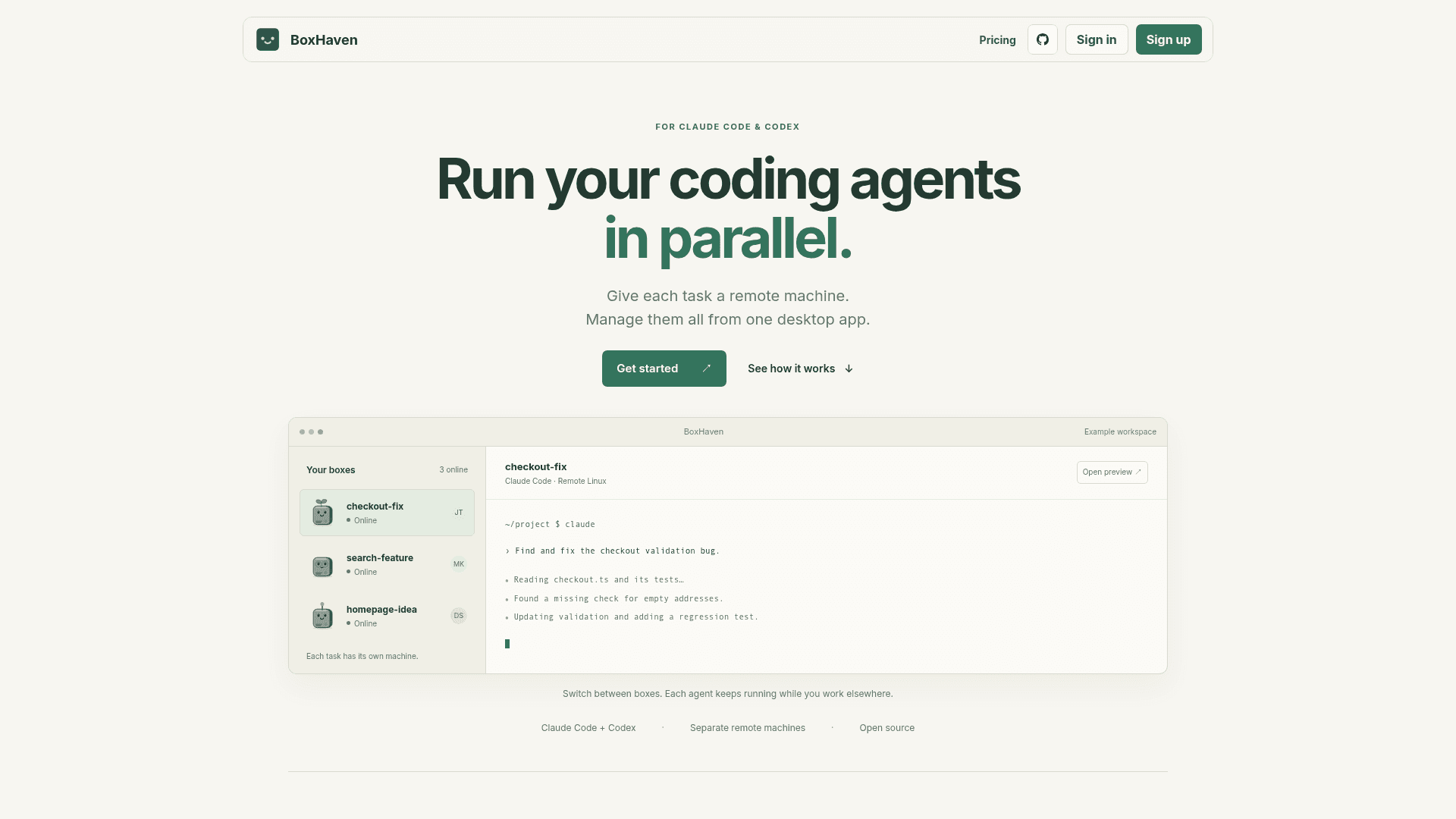
Persistent remote Linux dev machines that let Claude Code and Codex agents run tasks in parallel, managed from a desktop app, CLI, or agent skill.
At a Glance
About BoxHaven
BoxHaven, published by Default Alive LLC, gives coding agents separate remote Linux VMs so independent tasks can run in parallel without using up a laptop's resources. Each box gets its own copy of the project, compute, and a persistent session, so agents keep working after you disconnect. It is open source under AGPL-3.0 and can be used through BoxHaven's hosted cloud or self-hosted with your own cloud credentials.
What It Is
BoxHaven is a remote development-box manager built for Claude Code and Codex. From a project folder, the CLI (bh) creates a named box, copies the local project to it, and starts an agent in a managed tmux session. You can detach, close your laptop, and reattach later with bh connect.
The same account and boxes are available from three entry points: a macOS desktop app that lists boxes in a sidebar, the bh CLI for macOS and Linux, and an installable agent skill that lets a local Claude or Codex agent create and manage boxes itself.
How the Workflow Runs
bh createprovisions a machine and syncs the project once; afterward the box owns its copy, andbh sync upandbh sync downmove changes explicitly.- Common dependency and cache directories are excluded from sync, and a
.boxhavenignorefile adds more exclusions. - The CLI forwards GitHub access, the local Git author identity, and supported agent login files, plus recent Claude or Codex sessions so conversations can resume on the box.
bh ssh-config installadds SSH aliases that also work with tools such as VS Code Remote SSH.- Each box can have a public HTTPS preview URL when the backend is configured with a preview domain.
Teams, Images, and Providers
Boxes belong to teams with owner, admin, and member roles, and teammates are invited through shareable links. A configured box can be snapshotted into a team image so new boxes start with tools and dependencies already installed. A single backend can serve multiple providers, including DigitalOcean, Hetzner Cloud, exe.dev, and E2B, Daytona, and Blaxel sandboxes.
Self-Hosting
The backend is an open-source Fastify and Better Auth service with a web console, and a deployment bundle is provided in the repository. Self-hosters supply their own provider credentials, and the cloud provider charges for the machines created.
Community Discussions
Be the first to start a conversation about BoxHaven
Share your experience with BoxHaven, ask questions, or help others learn from your insights.
Pricing
Self-hosted
Run the open-source backend, CLI, and VM runtime in your own cloud account under AGPL-3.0; you pay your cloud provider directly.
- Open-source under AGPL-3.0
- Pay your cloud provider directly
- Use DigitalOcean or Hetzner
- Operate and secure the control plane yourself
Hosted Pay as you go
Hosted compute starts at USD 0.09 per hour for Small boxes; Medium is USD 0.17 per hour. Charges accrue by the started minute until a box is destroyed. No monthly platform or seat fee. Agent subscriptions and API costs are separate.
- $0 monthly platform fee
- Small: 2 vCPU, 4 GB, 80 GB disk, $0.09/hr
- Medium: 4 vCPU, 8 GB, 160 GB disk, $0.17/hr
- $5 of compute credit for new users, valid for 14 days
- Persistent boxes with no fixed session lifetime
- Teams and public preview URLs included
- No per-seat charge
- Claude, Codex, model API and other third-party charges are separate
Capabilities
Key Features
- Separate remote Linux VM per agent task
- Persistent tmux sessions that survive disconnects
- One-time project sync with explicit sync up/down and .boxhavenignore
- Forwarding of GitHub credentials, Git identity, and agent login files
- Public HTTPS preview URL per box
- Desktop app for macOS with sidebar of boxes
- CLI (bh) with SSH config aliases
- Agent skill for Codex and Claude Code
- Team workspaces with roles and invite links
- Team images from snapshotted boxes
- Multiple cloud providers
- Self-hostable open-source backend