
Browserless
Managed and self-hostable headless browser platform with REST APIs, an MCP server and stealth features for scraping, automation, testing and AI agents.
At a Glance
About Browserless
Browserless provides managed headless browsers that teams drive from existing Puppeteer or Playwright scripts, REST APIs, a typed SDK or an MCP server. It is built by Browserless, which says its founder started it after spending much of his time maintaining headless Chrome in a previous job. It runs as a managed cloud, a private deployment or a self-hosted Docker image.
What It Is
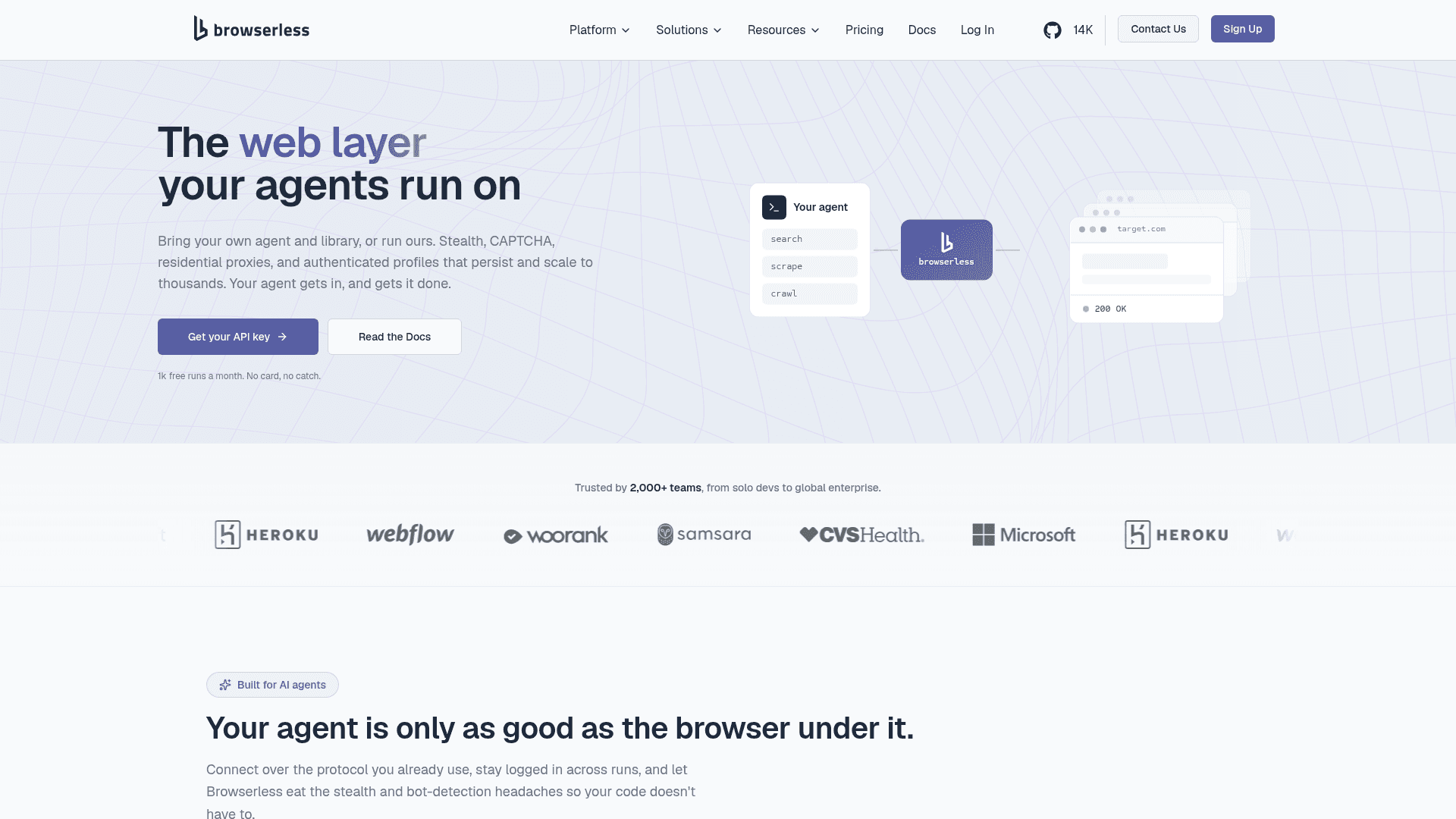
Browserless is browser infrastructure for web scraping, browser automation, testing, screenshot and PDF generation, and AI agents. Users point existing Puppeteer or Playwright scripts at Browserless by changing the connection URL, or call REST endpoints that return screenshots, PDFs, HTML or structured data from a URL. The platform handles Chrome installation, fonts, crashes, scaling and patching so users keep ownership of their own scripts.
Ways to Connect
- Browser Automation Protocol (BAP): a typed TypeScript SDK shaped like Puppeteer, with stealth, proxies and CAPTCHA solving included.
- Browsers as a Service: existing Puppeteer or Playwright code connects over WebSocket, with stealth and proxy options as URL flags, persistent sessions and live human handoff.
- REST APIs: the platform page lists 13 endpoints, including /smart-scrape, /pdf and /crawl. The README also documents /map and /search.
- Hosted MCP server: lets Claude, Cursor or other MCP clients use search, scrape and crawl tools plus a stateful browser agent, according to the site.
Built-In Capabilities
On Browserless Cloud the site lists stealth and CAPTCHA solving, residential proxies, persistent sessions, saved logins (Authenticated Profiles), live human handoff and three regions. The README lists a debug viewer, session replay, Chrome extension support, queueing with configurable concurrency and webhook integrations. Some of these are documented as premium features rather than part of the open-source image.
Deployment and Licensing
The open-source repository ships Docker images that expose a WebSocket endpoint and a docs page locally. Firefox and WebKit require the firefox or multi images. The code is dual-licensed under SSPL-1.0 or a Browserless Commercial License, and closed-source commercial or CI use requires a commercial license. Managed cloud is hosted in San Francisco, London and Amsterdam, and enterprise private deployments are also offered.
Security and Compliance
The site lists SOC 2 Type II, GDPR compliance, HIPAA BAA availability and DPA availability, with details in its Trust Center.
Community Discussions
Be the first to start a conversation about Browserless
Share your experience with Browserless, ask questions, or help others learn from your insights.
Pricing
Free
Permanent free plan with 1k units/month and 2 concurrent browsers; no credit card required.
- BrowserQL language and editor
- 1k units/month
- 2 max concurrent browsers
- 2 min. max session time
- Session reconnects
Prototyping
20k units per month, 10 concurrent browsers.
- Everything on Free
- 20k units per month
- 10 max concurrent browsers
- 15 min. max session time
- $0.0020 per unit overages
- 7 day persisted sessions and replays storage
- 24 hours log search window
- External proxies (bring your own)
- Access to screen recording
- Basic email and chat support
Starter
180k units per month, 40 concurrent browsers.
- Everything on Prototyping
- 180k units per month
- 40 max concurrent browsers
- 30 min. max session time
- $0.0017 per unit overages
- 30 day persisted sessions and replays storage
- 3 days log search window
- Email, chat & video support
Scale
500k units per month, 100 concurrent browsers.
- Everything on Starter
- 500k units per month
- 100 max concurrent browsers
- 60 min. max session time
- $0.0015 per unit overages
- 90 day persisted sessions and replays storage
- 7 days log search window
Enterprise
Custom pricing for large-scale deployments, private deployments or licensed self-hosting.
- Private deployments or licensed self-hosting
- Hundreds or thousands of concurrent browsers
- Commercial license for self-hosting
- SSO
- Dedicated technical account manager
- Private Slack support
- GPU enabled infrastructure
Capabilities
Key Features
- Managed headless Chrome browsers via Puppeteer and Playwright
- Browser Automation Protocol typed TypeScript SDK
- REST APIs for screenshots, PDFs, scraping, crawling, mapping and search
- Hosted MCP server with stateful browser agent
- Stealth fingerprints and built-in CAPTCHA solving
- Residential proxies
- Persistent sessions and authenticated profiles
- Live debugger and human handoff
- Session replay
- Chrome extension support
- Parallelism and queueing with configurable concurrency
- Webhook integrations
- Cloud, private deployment and self-hosted Docker options