Calibra
Dataset observability and coreset selection tool for robotics imitation learning that audits integrity, measures quality and coverage, and builds quality-aware training sets to reduce GPU compute costs.
At a Glance
Free for research and internal use under Business Source License 1.1. Converts to Apache 2.0 on 2030-06-30. Commercial hosting requires a separate license.
Engagement
Available On
Alternatives
Listed Aug 2026
About Calibra
Calibra is a Python CLI and library for robotics teams that need to audit and curate robot demonstration datasets before training imitation learning policies. Built by omerTT and published under a Business Source License 1.1 (converting to Apache 2.0 on 2030-06-30), it runs entirely locally with no upload, account, or API key required, and produces deterministic, CI-friendly results.
What It Is
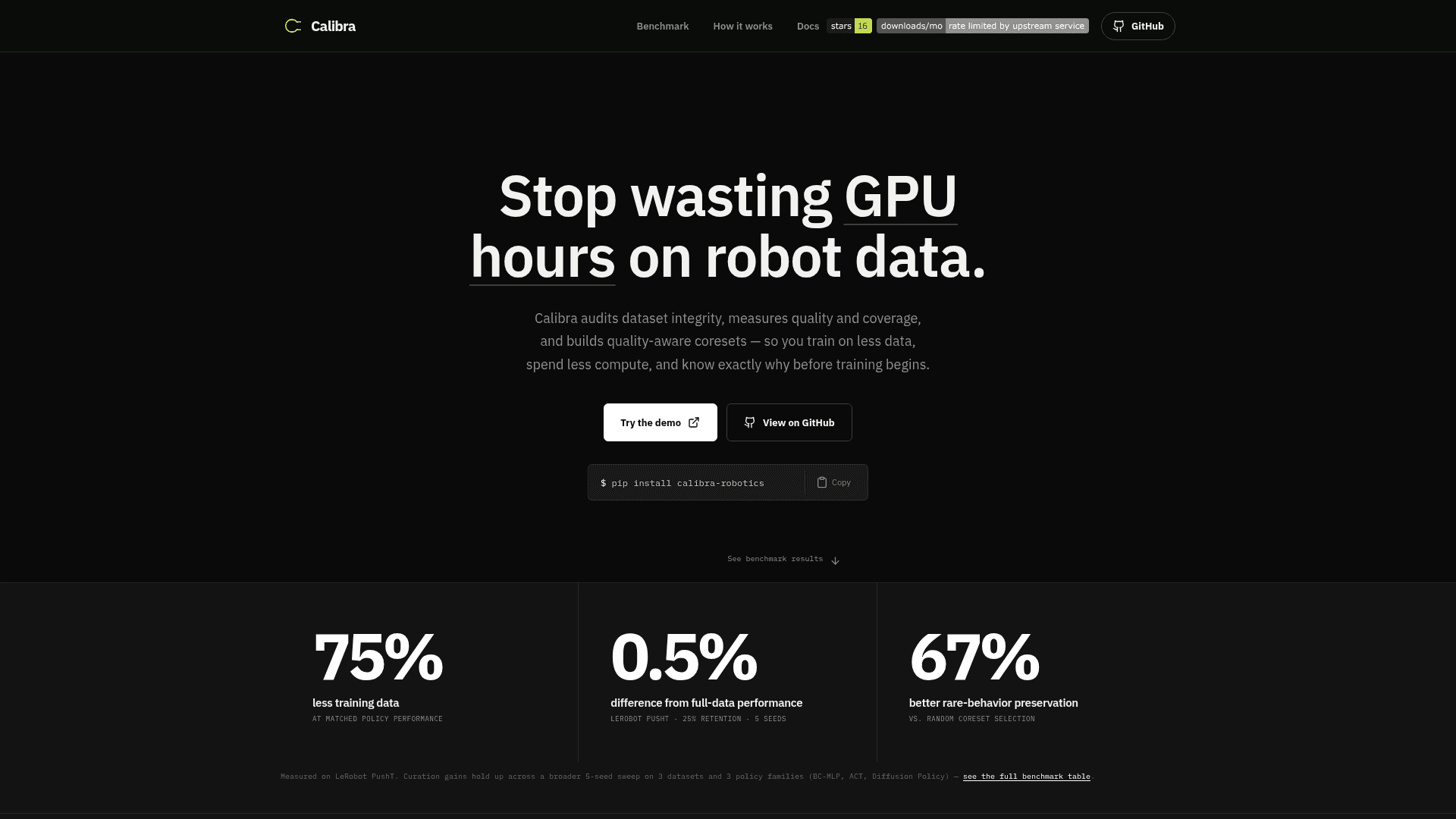
Calibra addresses a specific problem in robot learning: most robotics datasets contain two distinct failure modes — bad episodes (jerk spikes, dropped frames, sync errors) and redundant episodes (near-duplicate demonstrations of the same behavior). The tool runs a four-step pipeline — Integrity, Quality, Coverage, and Optimization — to identify and remove both categories, then selects a quality-aware coreset of episodes for training. The result, according to the project's own benchmark data, is a dramatically smaller training set that matches or exceeds full-dataset policy performance.
Benchmark Results
The project publishes benchmark results across multiple public robotics datasets and policy families:
- On LeRobot PushT (
lerobot/pusht): retaining 25% of episodes (41 of 165) produced a test MSE of 422.77 vs. 420.93 for the full 165-episode baseline — a 0.5% difference — while achieving 56.0% tail-behavior coverage vs. 33.6% for random coreset selection at the same retention level. - On DROID-100 (
lerobot/droid_100): the project reports outperforming the full-data baseline by +3% at 75% retention. - Across three datasets and three policy families (BC-MLP, ACT, Diffusion Policy) at 30% retention, Calibra's full pipeline improves over random selection by a mean of +24.5%.
- Method rankings are reported as stable across all three policy families (Spearman ρ ≥ 0.86).
All benchmark claims are sourced from the project's own published benchmark tables and should be verified against the full benchmark documentation before production use.
Four-Step Pipeline
The core workflow maps to four explicit CLI commands:
calibra integrity— checks timestamps, sync, episode completeness, duplicate/frozen/blurry camera frames, and jittery motion; outputs a scored integrity report with per-episode root causes and CI-friendly exit codes.calibra audit— full diagnostic report with bootstrap confidence intervals and per-episode outlier detection.calibra review— ranked episode review queue separating anomaly, quality-risk, and coverage-value signals.calibra prune— two-stage coreset: quality filter followed by greedy max-coverage selection.calibra analyze— one-command report composing all four steps into a single integrity, Calibra Score, redundancy estimate, and training-set recommendation.
Additional commands include calibra certify, calibra predict, calibra watch (real-time feedback during teleoperation), calibra sim2real, calibra transfer, calibra cure (automatic remediation), and calibra serve (local REST API and web dashboard).
Dataset Format Support
Calibra supports a broad range of robotics dataset formats via optional install extras:
- LeRobot v1 / v2 / v3 (Parquet and HuggingFace Hub IDs)
- HDF5 (Isaac Lab, Robomimic)
- RLDS / TF Datasets
- MCAP / ROS2 bags
Camera-frame integrity checks work out of the box on HDF5 datasets and LeRobot v1 (with --decode-images); LeRobot v2/v3 video-encoded support is listed on the roadmap.
Update: v0.8.0 — Measured Training Results
The current release is v0.8.0, published on 2026-08-12. This release introduced calibra experiment record/list/report for logging real training-run outcomes (GPU-hours, evaluation success rates), and extended calibra benchmark --sweep to fold measured numbers into benchmark reports, tagging every value as (measured) or (simulated). The calibra analyze one-command report and calibra case-study partner-facing report renderer were also added in this cycle. The next planned milestone is Vision Integrity support for video-backed LeRobot v2/v3 datasets. A research paper describing the coreset selection methodology is listed as coming soon.
Community Discussions
Be the first to start a conversation about Calibra
Share your experience with Calibra, ask questions, or help others learn from your insights.
Pricing
Open Source
Free for research and internal use under Business Source License 1.1. Converts to Apache 2.0 on 2030-06-30. Commercial hosting requires a separate license.
- Full CLI access (calibra integrity, audit, review, prune, analyze, etc.)
- Python API
- LeRobot, HDF5, RLDS, MCAP format support
- Local execution, no upload or account required
- CI-friendly exit codes
Capabilities
Key Features
- Dataset integrity auditing (timestamps, sync, duplicate/frozen/blurry frames, jitter)
- Quality scoring with bootstrap confidence intervals and per-episode outlier detection
- Coverage and diversity analysis across behavioral space
- Quality-aware coreset selection via two-stage quality filter + greedy max-coverage
- One-command pipeline report (calibra analyze)
- CI-friendly exit codes and deterministic local execution
- Real-time quality feedback during teleoperation (calibra watch)
- Sim-to-real distribution gap quantification (calibra sim2real)
- Cross-embodiment compatibility scoring (calibra transfer)
- Automatic data remediation: smoothing, resampling, trimming (calibra cure)
- Measured training result logging and reporting (calibra experiment)
- Partner-facing case-study report generation (calibra case-study)
- Static leaderboard website generation (calibra site)
- Local REST API server and web dashboard (calibra serve)
- HuggingFace dataset quality card generation (calibra card)
- Synthetic corruption injection for metric validation (calibra corrupt)
- Bulk org-wide audit (calibra audit-all)
- HTML report output
- Python API for programmatic pipeline access