
Cerulion
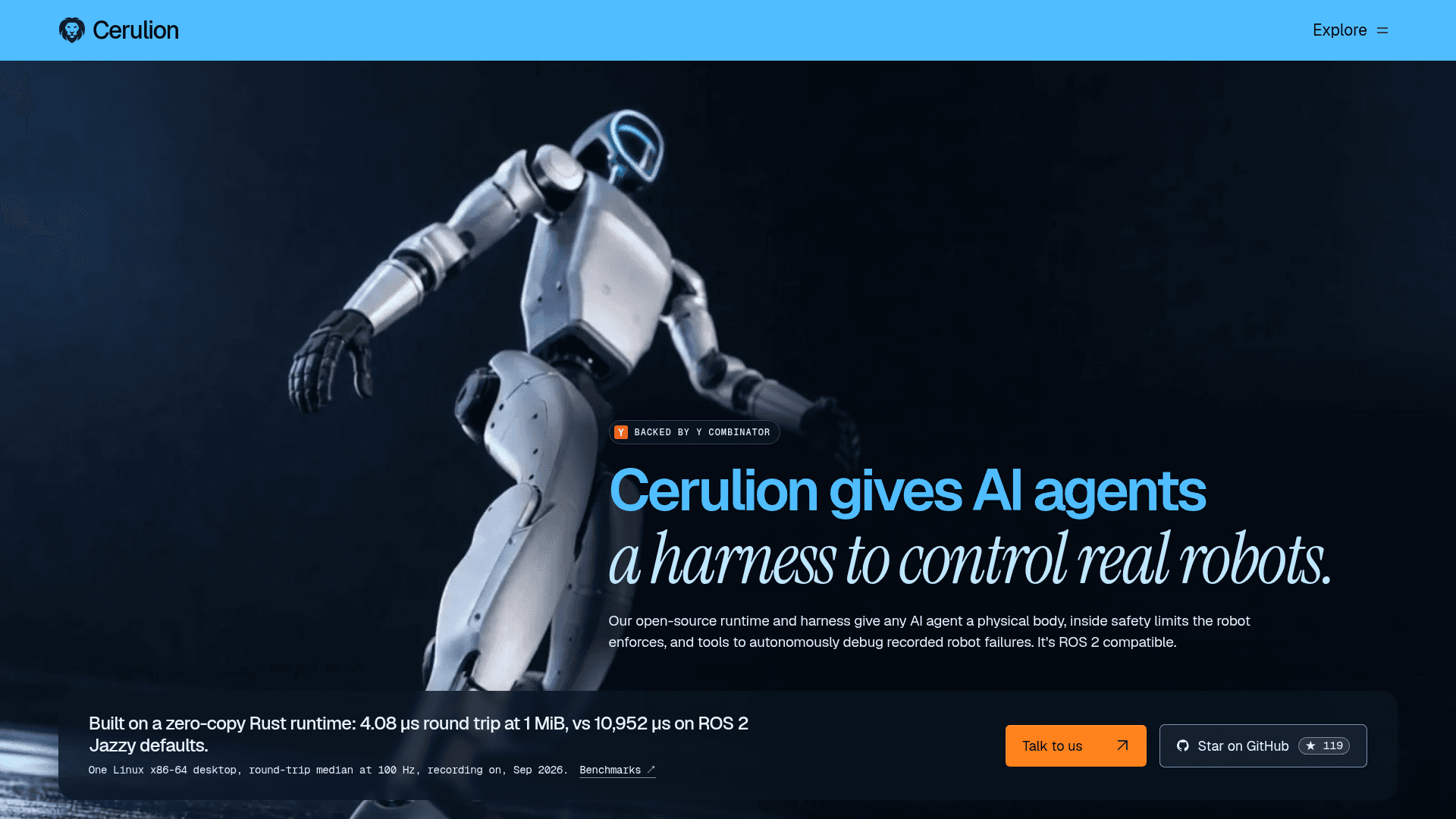
Open-source, ROS 2-compatible zero-copy Rust robot runtime and harness that lets AI agents control robots and debug recorded failures.
At a Glance
Open-source zero-copy robot runtime and CLI under AGPL-3.0-only. Commands run under a free Cerulion account used for robot pairing. Hindsight and the hosted MCP server are closed-source early access and not covered by this license.
Engagement
Available On
Alternatives
Listed Nov 2026
About Cerulion
Cerulion Inc., a Y Combinator company, makes Cerulion, an open-source, zero-copy robot runtime and harness for physical AI. It records robot runs, replays them against new code, and exposes robots to AI agents through MCP. It is ROS 2 compatible and runs on Linux (x86_64, aarch64) and macOS. The latest release listed is v2.0.0.
What It Is
Cerulion is a robotics runtime written in Rust. Developers write typed nodes, declare the wiring in a graph file, and the runtime handles scheduling, shared-memory transport, recording and observability, with no executor or spin loop to configure. Nodes can be written in Rust, and Python nodes are also supported via a Cerulion source checkout. The CLI covers workspace creation, node builds, graph validation and runs, topic inspection and bag playback.
Agent control and safety limits
cerulion-rcpd is an MCP server on the robot. The agent calls only the tools declared in rcp.yaml, and the robot checks argument limits, safety classes and an e-stop latch and keeps a receipt for every call. The site notes this ships in the next release rather than v1.0.0 and is shown today on a simulated arm.
Recording, Flashback and replay verification
Runs are recorded as standard MCAP. Flashback keeps a memory-bounded rolling window of recent activity and writes it to a recording when a runtime fault occurs or on demand with cerulion flashback. Re-running a supported native recording with cerulion bag play --resim all --verify compares outputs against the recording. Exit 0 means a match, exit 1 means output data diverged and names the topic and field, and exit 6 means the schedule diverged. Comparisons are byte-exact by default, with optional per-field tolerances and machine-readable reports for CI.
Debugging with coding agents
Hosted Cerulion MCP and Hindsight endpoints, both in early access and closed source, give Claude Code, Codex, Cursor and other MCP clients tools for MCAP recordings, Cerulion Cloud instances and the robots on an account. Hindsight answers are tied to topics and timestamps, and Cerulion Studio is also listed as early access.
ROS 2 path and performance
Existing stacks can run through rmw_cerulion with cerulion ros2 run and launch, or attach to a running DDS stack with cerulion ros2 attach. Cerulion reports a 4.08 µs median round trip at 1 MiB against 10,952 µs for ROS 2 Jazzy defaults, measured on one Linux x86-64 desktop with recording on, and notes it is one machine and not a guarantee.
Licensing
The project is AGPL-3.0-only with a commercial license available. Some client-side crates are MIT OR Apache-2.0.
Community Discussions
Be the first to start a conversation about Cerulion
Share your experience with Cerulion, ask questions, or help others learn from your insights.
Pricing
Open Source (AGPL-3.0)
Open-source zero-copy robot runtime and CLI under AGPL-3.0-only. Commands run under a free Cerulion account used for robot pairing. Hindsight and the hosted MCP server are closed-source early access and not covered by this license.
- AGPL-3.0-only licensed core runtime and CLI
- Requires a free Cerulion account (cerulion login) for robot pairing
- Flashback, MCAP recording, replay and verification
- ROS 2 compatibility via rmw_cerulion
- Hindsight and hosted MCP server are closed source (early access, request access)
Capabilities
Key Features
- Zero-copy shared-memory Rust runtime
- Graph-based node scheduling with deadlines and backpressure
- MCAP recording of runs
- Replay verification with byte-exact or tolerance-based comparison for CI
- Flashback rolling-window failure capture
- MCP server on the robot with declared tools and safety checks
- Hosted MCP and Hindsight endpoints for coding agents (early access)
- ROS 2 compatibility via rmw_cerulion, launch, run and attach
- Account-based remote robot discovery over LAN and WAN
- Rust and Python node authoring