
Claude How To
A structured, visual, example-driven guide to mastering Claude Code — from slash commands to advanced multi-agent orchestration, with copy-paste templates and a guided learning path.
At a Glance
Completely free to use, modify, and distribute under the MIT License.
Engagement
Available On
Alternatives
Listed Apr 2026
About Claude How To
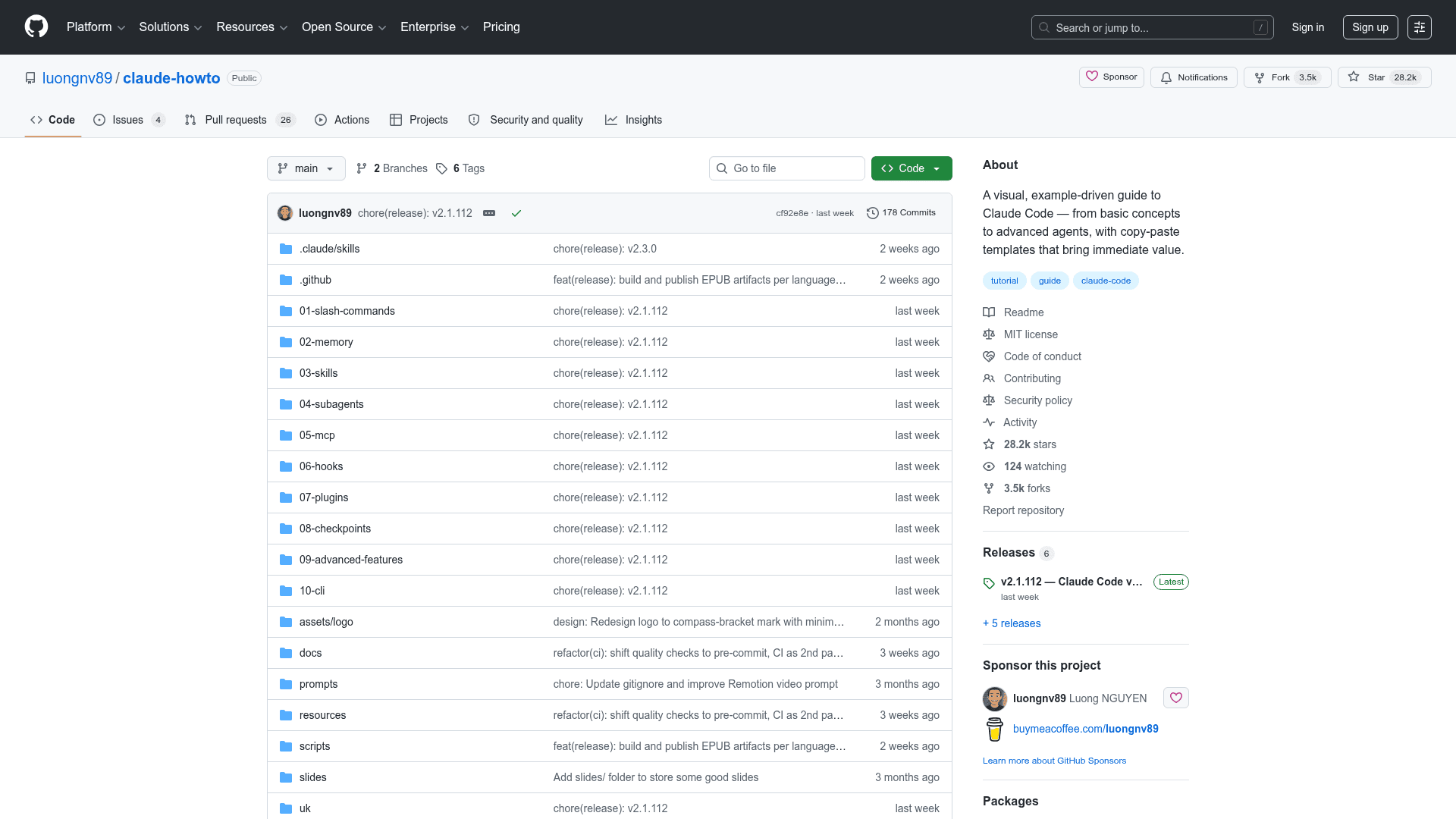
Claude How To is an open-source, MIT-licensed guide that takes developers from basic Claude Code usage to advanced agent orchestration in 11–13 hours. It provides 10 progressive tutorial modules, Mermaid diagrams, production-ready copy-paste templates, and built-in self-assessment quizzes — filling the gap left by official feature-reference documentation. The guide covers every major Claude Code capability including slash commands, memory, skills, subagents, MCP servers, hooks, plugins, checkpoints, and CLI automation.
- 10 tutorial modules covering every Claude Code feature from beginner slash commands to advanced plugin bundles, organized in a progressive learning path with time estimates
- Copy-paste templates for slash commands, CLAUDE.md memory files, hook scripts, MCP configs, subagent definitions, and full plugin bundles ready to drop into any project
- Mermaid diagrams visually explaining how each feature works internally so you understand the why, not just the how
- Built-in self-assessment — run
/self-assessmentor/lesson-quiz [topic]directly in Claude Code to identify knowledge gaps and get a personalized roadmap - Guided learning path with three entry levels (Beginner, Intermediate, Advanced) and estimated completion times per module
- Real-world workflow examples showing how to combine features into automated code review pipelines, CI/CD automation, documentation generation, security audits, and DevOps deployments
- EPUB generation via
uv run scripts/build_epub.pyfor offline reading with all content and rendered diagrams - Automated testing suite using pytest, Ruff, Bandit, and mypy to ensure all scripts and templates remain reliable across Python 3.10–3.12
- Multi-language support with README translations in English, Vietnamese, Chinese, and Ukrainian
- Actively maintained and synced with every Claude Code release; current version targets Claude Code 2.1+ and is compatible with Claude Sonnet 4.6, Opus 4.7, and Haiku 4.5
To get started: clone the repository, copy a slash command template into your project's .claude/commands/ directory, and type /optimize in Claude Code. Follow the learning roadmap for the full structured path.
Community Discussions
Be the first to start a conversation about Claude How To
Share your experience with Claude How To, ask questions, or help others learn from your insights.
Pricing
Open Source (MIT)
Completely free to use, modify, and distribute under the MIT License.
- All 10 tutorial modules
- Copy-paste templates for slash commands, memory, hooks, MCP, subagents, plugins
- Mermaid diagrams
- Self-assessment quizzes
- EPUB offline generation
Capabilities
Key Features
- 10 progressive tutorial modules
- Copy-paste slash command templates
- CLAUDE.md memory file templates
- Hook scripts for event-driven automation
- MCP server configuration examples
- Subagent definition templates
- Plugin bundles
- Checkpoint and rewind examples
- CLI reference and automation scripts
- Mermaid diagrams for visual learning
- Built-in self-assessment quizzes (/self-assessment)
- Per-lesson quizzes (/lesson-quiz)
- Guided learning roadmap with time estimates
- EPUB offline generation
- Multi-language README (EN, VI, ZH, UK)
- Automated testing with pytest, Ruff, Bandit, mypy