
Clawboo
Open-source, local-first studio that lets a team of AI agents on different runtimes split a brief into tasks on a shared board.
At a Glance
MIT-licensed, self-hosted Clawboo that runs on your own computer; model usage is billed separately by the provider you connect.
Engagement
Available On
Alternatives
Listed Nov 2026
About Clawboo
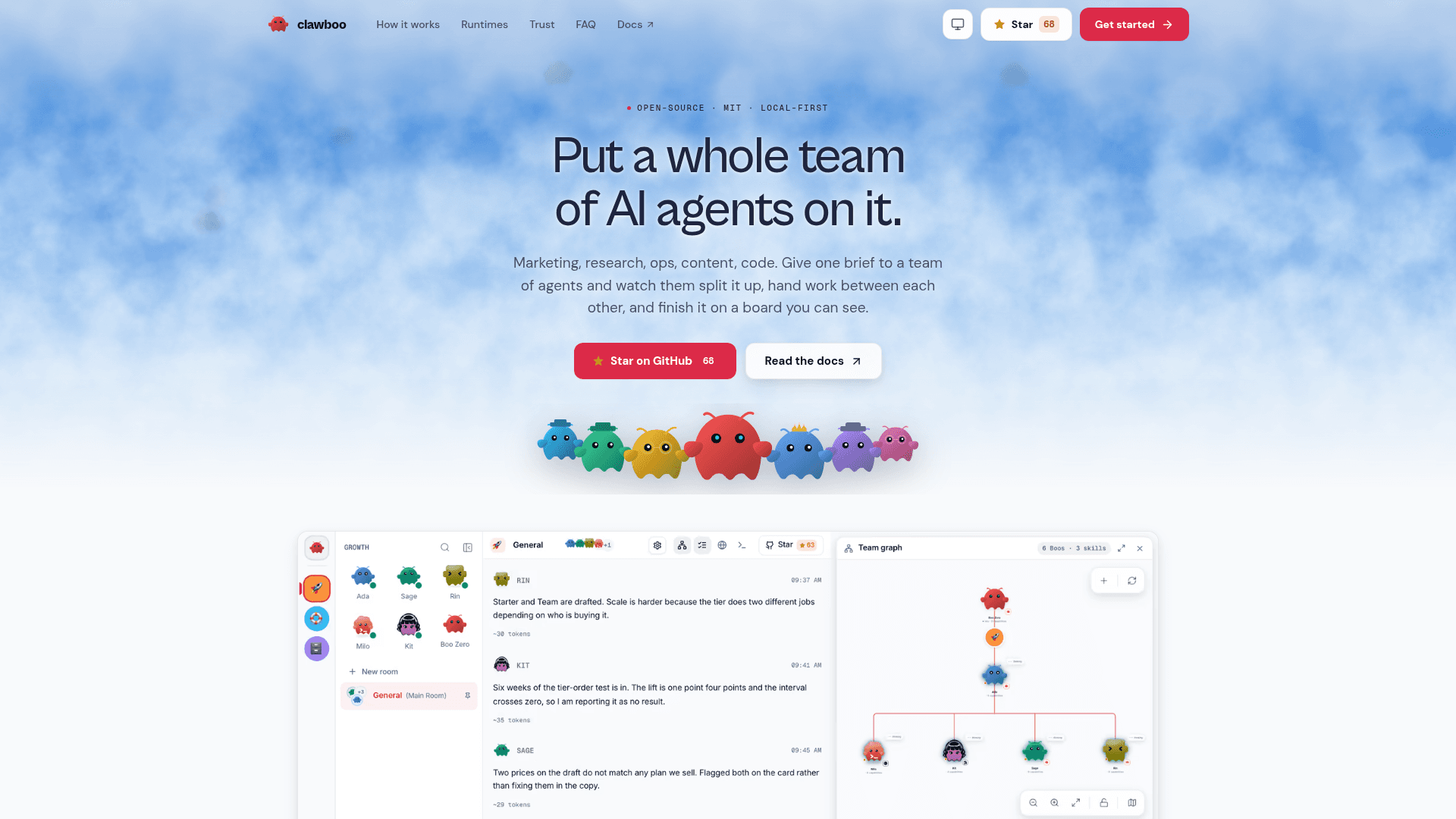
Clawboo is an open-source, MIT-licensed studio for running teams of AI agents on your own computer. You give one request to a team lead called Boo Zero, which splits it into jobs on a shared board and hands them to teammates running on Claude Code, Codex, Hermes, OpenClaw or Clawboo's built-in agents. Progress is followed live on the board, in a group chat and on a team graph.
What It Is
Clawboo is a TypeScript control plane that coordinates agents from different runtimes as peers. It provides one durable board, one group chat and one shared memory, so agents that would otherwise be isolated in their own terminals can hand work to each other. Agents coordinate through the board and structured messages, not by reading each other's output. Teams can be deployed from a marketplace of ready-made agents and teams, and each teammate's runtime is chosen at deploy time.
How the workflow runs
You start with npx clawboo@latest or a global npm install, and a setup wizard opens in the browser. You connect a model (an API key from one of eleven providers, a local Ollama model, or a ChatGPT sign-in through the Codex CLI), optionally connect other runtimes, then pick and deploy a team. You ask once in the group chat; Boo Zero creates task cards, delegates them, and returns the pulled-together results in chat.
Oversight and local storage
Tasks survive restarts, and a task is claimed by a single conditional write so two agents cannot take the same one. Code tasks run in their own git worktree and must pass the repository's verify command, with delegated or large diffs also getting an independent read-only review. Budgets can be set per agent, team or mission, with warnings by default or a hard cap that auto-pauses. Delegation depth, fan-out and task creation limits are enforced in code. The board and history are stored in SQLite at ~/.clawboo/clawboo.db and API keys in an AES-256-GCM vault. Clawboo has no account and no telemetry, and prompts go only to the providers you connect.
Current Status
The project site describes it as early and fast-moving, with possible rough edges. The latest listed release is clawboo@0.5.0. It requires Node.js 22.12 or newer on macOS, Linux or Windows; Hermes also needs Python 3.11 to 3.13.
Community Discussions
Be the first to start a conversation about Clawboo
Share your experience with Clawboo, ask questions, or help others learn from your insights.
Pricing
Open Source
MIT-licensed, self-hosted Clawboo that runs on your own computer; model usage is billed separately by the provider you connect.
- MIT licensed, free to use or fork
- Runs locally on your computer, no Clawboo account
- No product analytics or telemetry
- Model usage billed by the provider you connect (external cost)
Capabilities
Key Features
- Team lead agent (Boo Zero) that splits requests into delegated jobs
- Durable shared task board that survives restarts
- Group chat narrating team work
- Mixed runtimes: Claude Code, Codex, Hermes, OpenClaw and built-in agents
- Shared team memory graph across runtimes
- Org chart and team graph views
- Budgets per agent, team and mission with optional hard cap
- Verified code tasks with git worktrees and independent review
- Routines for scheduled team and agent work
- Connectors for MCP servers and Composio apps
- Marketplace of ready-made agents and teams
- Local-first storage with AES-256-GCM encrypted secrets vault
- CLI commands for stop, restart and backup