
PenguinHarness
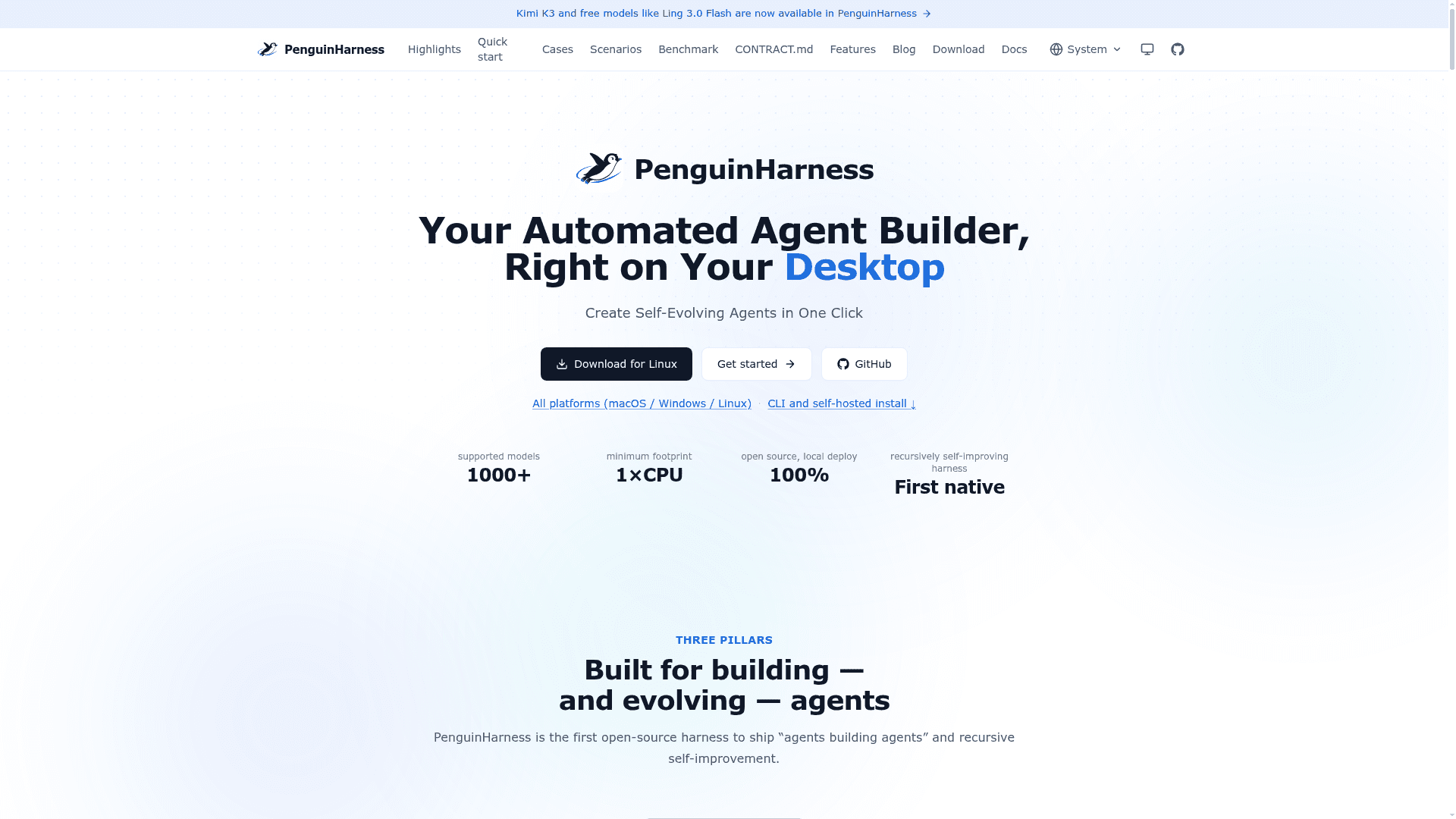
An open-source, locally deployed AI agent harness that lets agents autonomously build and recursively self-improve other agents, supporting 1000+ models on desktop or server.
At a Glance
About PenguinHarness
PenguinHarness is an open-source AI agent harness built by the PrismShadow AI Team, led by Yaowei Zheng (author of LlamaFactory). It runs fully locally — all data stays in ~/.penguin/data — and reaches 1000+ online and local models through a unified model gateway. The project is licensed under Apache-2.0 and available on GitHub.
What It Is
PenguinHarness is a complete TypeScript stack for constructing and evolving AI agents. It ships four tightly integrated layers — an SDK (@prismshadow/penguin-core), a CLI (@prismshadow/penguin-cli), a server (@prismshadow/penguin-server), and a browser web app (@prismshadow/penguin-web) — all sharing a single data directory and a unified message protocol called OmniMessage. The project describes itself as "the first open-source harness to ship 'agents building agents' and recursive self-improvement."
Three Core Pillars
The harness is organized around three design principles:
- Simplest Is the Best — A deliberately minimal toolset over clean low-level interfaces: dedicated file tools (
read_file,edit_file,write_file) and a shell fallback (exec_command), tuned to minimize token usage on open models like DeepSeek. - Harness for Building Agents — With the PenguinHarness SDK, an agent builds complete agent applications autonomously from a single sentence of input, delivering scaffold, code, and run instructions end to end.
- Harness for Recursive Self-Improvement — With PenguinHarness Skills, an Optimizer orchestrates multiple Evaluators to score a Target Agent in parallel, uses scores and run traces to find where points were lost, and upgrades the agent from version N to N+1 — with a snapshot before every round.
Architecture and Design Tenets
The harness enforces a CONTRACT.md that defines the boundary of evolution: self-improvement is strictly confined to Workspace and Skills, while the harness kernel and its safety mechanisms never change. Key design tenets include:
- Full tracing — Every model request and tool call is written to the Trace in full, including token count, latency, and failure reason; sessions are fully restorable from the Trace.
- Approvals and audit — Every tool call requires user approval before it runs, and every decision leaves an audit record.
- Credential isolation — API keys land as hidden 0600 files, are barred from the system prompt, and stay masked throughout the UI.
- Model decoupling — Models are not bound to agents; you pick one per session and can switch without rewriting the agent.
- Progressive loading — Content is indexed first and read on demand, never dumped wholesale into context.
- Error convergence — Errors split into retryable and fatal; retryable ones retry automatically, fatal ones become messages the model can react to.
Built-in Skill Library
Four skill groups ship out of the box, and agents can write and optimize their own:
- Office Productivity:
data-analysis,firecrawl - Software Development:
web-design,software-engineering - AI App Development:
penguin-sdk,penguin-cli,agenthub-models,vllm,ollama,llamafactory - Agent Tuning:
agent-creation,benchmark-design,agent-evaluation,agent-optimization
Deployment and Platform Support
PenguinHarness supports two installation paths that share the same local data root:
- Desktop app — A double-click installer for macOS 11+, Windows 10+, and Linux (AppImage/deb) that embeds the server and opens already signed in.
- CLI — A one-line installer (
curl | shon Linux/macOS, PowerShell on Windows) ornpm install -g @prismshadow/penguin-cli;penguin webthen serves the full web UI athttp://127.0.0.1:7364. Offline/air-gapped installs are also supported via GitHub Release packages.
The system requires only a single CPU at minimum and supports x64 and arm64 architectures. Node >= 24 is required for npm installs; the one-line installer bundles its own runtime.
Update: v0.2.1
The latest release is v0.2.1, published on 2026-08-04. The repository was created on 2026-07-19 and last pushed on 2026-08-07, indicating rapid early development. Recent blog posts announce availability of Kimi K3 and free models like Ling 3.0 Flash in PenguinHarness, as well as a Fireworks AI AMD Developer Program credit offer. The roadmap lists upcoming items including a public benchmark suite release, agent company templates, company-level self-evolving, and OpenShell integration.
Community Discussions
Be the first to start a conversation about PenguinHarness
Share your experience with PenguinHarness, ask questions, or help others learn from your insights.
Pricing
Open Source
Fully free and open-source under Apache-2.0. Self-host locally on desktop or server.
- Full desktop app for macOS, Windows, Linux
- CLI and web UI included
- 1000+ model support via unified gateway
- Agents building agents
- Recursive self-improvement with Skills
Capabilities
Key Features
- Agents building agents autonomously from a single sentence
- Recursive self-improvement via Optimizer and Evaluator multi-agent loop
- 1000+ supported models via unified model gateway
- Fully local deployment — data never leaves the machine
- Desktop app for macOS, Windows, and Linux
- CLI with interactive REPL and one-shot task runs
- Web UI with multi-session chat, agent management, skill library, and Trace observability
- Built-in skill library (Office Productivity, Software Development, AI App Development, Agent Tuning)
- Full tracing of every model request and tool call
- Per-tool-call approval and audit records
- Credential isolation (hidden 0600 files, masked in UI)
- Model decoupling — switch models per session without rewriting agents
- Scheduled cron-style tasks
- Subagent delegation with parallel isolated execution
- Multi-user management with per-project data isolation
- Cost center with daily token, request, and cost trends
- Version snapshots before each optimization round
- Offline/air-gapped install support
- TypeScript SDK (@prismshadow/penguin-core) for programmatic agent control
- CONTRACT.md safety boundary — harness kernel never modified by self-improvement