
Clotr
Browser extension that warns you before you send passwords, keys or personal details to an AI chat, running entirely on your device.
At a Glance
Free and open source browser extension licensed under AGPL-3.0-or-later; runs on your device with no account.
Engagement
Available On
Listed Oct 2026
About Clotr
Clotr is a free, open-source browser extension that watches the message box on AI chat sites and warns you before a password, key or personal detail is sent. It checks on your device with readable pattern matching, with no AI inside, no server and no account. It runs on Chrome, Brave, Edge and Firefox on a computer, and the latest listed release is v1.3.0.
What It Is
Clotr is a data-loss-prevention and privacy tool for people who use AI chat services. It watches the text you type and the files you attach on 19 AI chat sites, with ChatGPT, Claude and Gemini among them. When it finds something sensitive, a warning appears in the corner and you choose whether to cover the detail or send it anyway. Email and chat sites such as Gmail and Discord stay off until you turn them on.
What It Detects
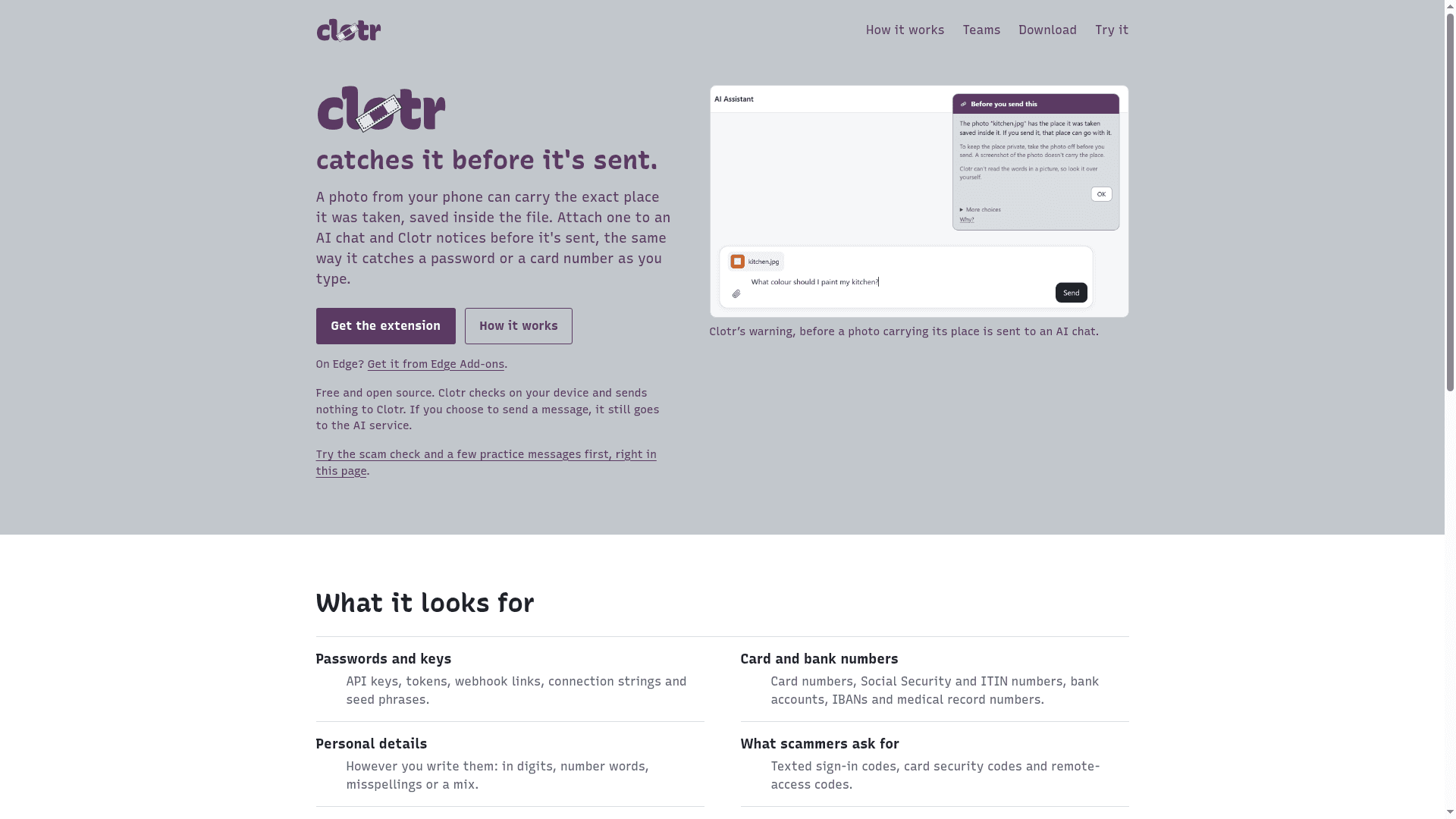
The patterns cover API keys, tokens, webhook links, connection strings and seed phrases. They also cover card numbers, Social Security and ITIN numbers, bank accounts, IBANs and medical record numbers, plus phone numbers and addresses, including details that are spelled out or misspelled. It reads text in attached text, PDF, Word, Excel and PowerPoint files, and it warns when a photo carries embedded location data. You can add your own names and details, which are stored only as a scrambled code. Clotr cannot read words inside images.
Scam Protection Features
When a message asks for something scammers go after, such as a sign-in code or a card security code, the warning explains who would really be asking. An "Is this a scam?" page marks known warning signs in pasted messages and never calls a message safe. Clotr also warns about copied "verify you're human, paste this" commands. Tourniquet applies stronger settings in one step, Bandage swaps details for cover names such as [Phone 1], and Practice offers made-up scam and AI chat messages to learn from.
Privacy and Verifiability
The project states that Clotr contains no network code and that a test fails the build if any is added. The patterns are in a readable file, and releases are reproducible: building a release tag yourself should match the published SHA256SUMS.txt. Clotr stores only a short local record of the kind of detail found, the site and the time, visible only in its own Settings.
Team Rollout
An administrator can set policy through supported browser management, using presets for developer credentials, client/matter details, clinics and tax offices, or custom formats. Clotr reports no prompts or findings to the organization and has no admin dashboard. Custom values are not encrypted from policy administrators.
Licensing
Clotr is released under AGPL-3.0-or-later, and a commercial license is available by email for closed-source use.
Community Discussions
Be the first to start a conversation about Clotr
Share your experience with Clotr, ask questions, or help others learn from your insights.
Pricing
Open Source
Free and open source browser extension licensed under AGPL-3.0-or-later; runs on your device with no account.
- Licensed under AGPL-3.0-or-later
- Runs on Chrome, Brave, Edge and Firefox
- On for 19 AI chat sites out of the box
- Checks on your device, no network code, no account
- Commercial license available for closed-source use (email contact)
Capabilities
Key Features
- Warns before sending passwords, API keys, tokens and seed phrases to AI chats
- Detects card, bank, ID and medical record numbers
- Catches personal details written in digits, words or misspellings
- Reads text in attached text, PDF, Word, Excel and PowerPoint files
- Warns when a photo carries embedded location data
- Works on 19 AI chat sites out of the box
- Optional email and chat site coverage
- Custom watch list stored as scrambled fingerprints
- Scam check page that marks known warning signs
- Warns about copy-paste 'verify you're human' commands
- Bandage cover names replace details before sending
- Tourniquet stronger settings for children or people you're helping
- Practice exercises with made-up scam messages
- Team policy via browser management with presets
- Fully local with no network code, no account and reproducible builds