
Codex First Customer Finder Skill
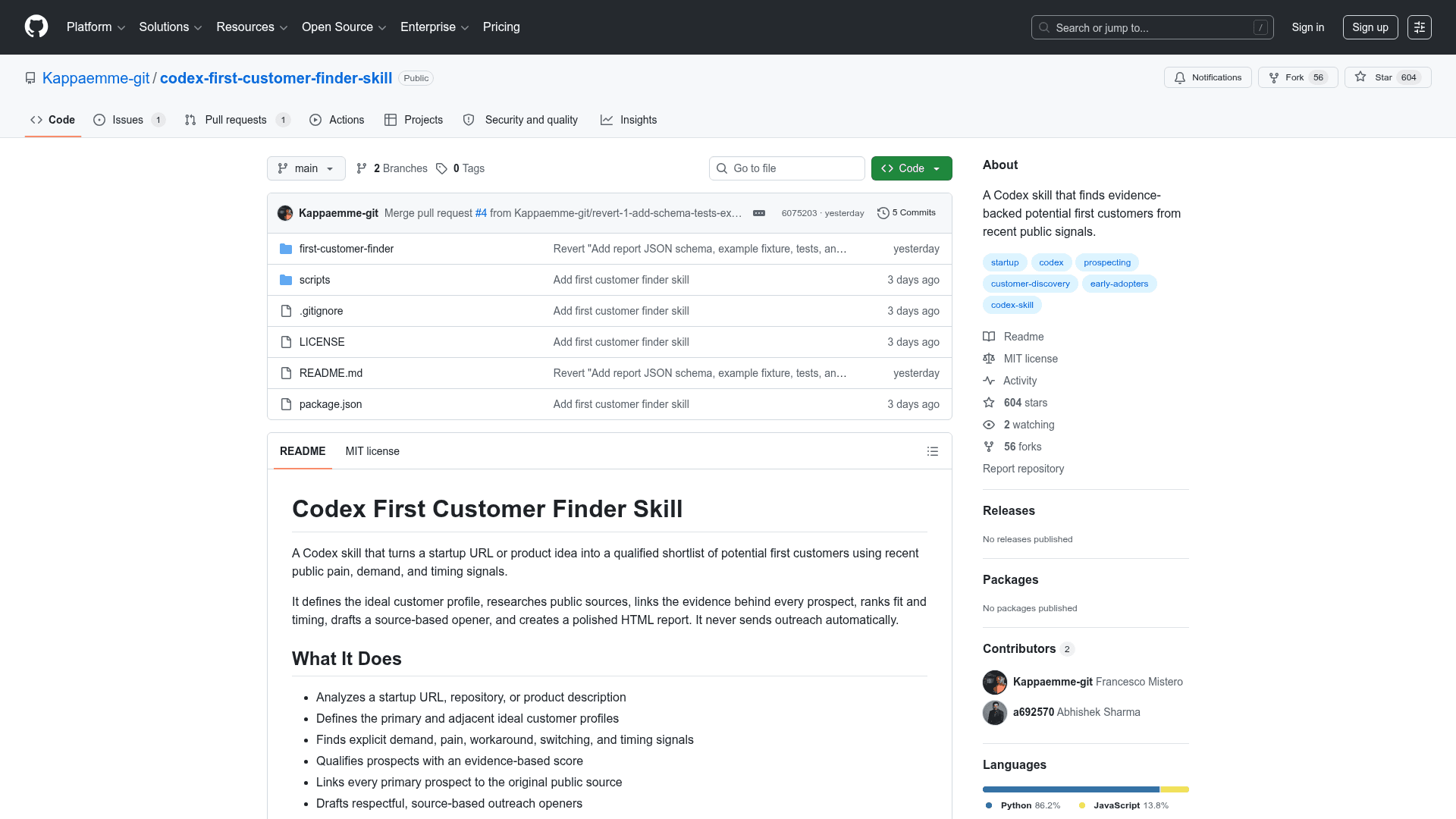
A Codex skill that turns a startup URL or product idea into an evidence-backed shortlist of potential first customers using recent public signals.
At a Glance
Fully free and open-source under the MIT License. Install via npx or git clone.
Engagement
Available On
Listed Jul 2026
About Codex First Customer Finder Skill
Codex First Customer Finder Skill is an open-source Codex skill built by Francesco Mistero (GitHub: Kappaemme-git) and released under the MIT License. It takes a startup URL, repository link, or product description and produces a qualified shortlist of potential first customers drawn entirely from recent public signals — no private contact enrichment, no automatic outreach. The project was created in July 2026 and has accumulated over 600 stars on GitHub.
What It Is
This is a plugin for OpenAI's Codex agent environment, installed as a local skill under ~/.codex/skills/. Once installed, it can be invoked by name inside a Codex session to run a structured customer-discovery research workflow. The skill defines an ideal customer profile (ICP), searches public sources for demand and pain signals, scores and ranks prospects, drafts outreach openers, and compiles everything into a standalone HTML report — all without sending any messages automatically.
How the Research Workflow Operates
The skill follows a deliberate, evidence-first pipeline:
- ICP definition: Identifies primary and adjacent ideal customer profiles from the product description or URL.
- Signal discovery: Finds explicit demand, pain, workaround, switching, and timing signals from public sources.
- Evidence-based scoring: Qualifies each prospect with a fit and timing score linked to the original public source.
- Outreach drafting: Writes respectful, source-grounded opener messages for each prospect.
- HTML report generation: Produces a responsive standalone report covering the early-customer verdict, prospect shortlist, repeated pain patterns, source links, signal dates, and a seven-day manual outreach plan.
All outreach remains manual by default, and the skill explicitly avoids sensitive personal data.
Research Modes
The skill ships with six configurable modes to match different discovery goals:
- quick — up to five strong prospects
- standard — up to ten prospects across several source types
- deep — up to twenty prospects with repeated-pattern analysis
- design-partners — feedback-oriented early adopters likely to give product input
- b2b — companies and public business triggers
- community — explicit requests and public discussion signals
Installation and Setup
The skill installs via a single npx command (npx --yes codex-first-customer-finder-skill@latest) or manually via git clone. After installation, restarting Codex makes the $first-customer-finder skill available in any session. The primary language is Python, and the repository is hosted publicly on GitHub.
Current Status
The repository was created on July 12, 2026, and last updated on July 15, 2026, indicating active early development. It carries 604 stars and 55 forks as reported by GitHub, with 2 open issues. The project is MIT-licensed and free to use, modify, and distribute.
Community Discussions
Be the first to start a conversation about Codex First Customer Finder Skill
Share your experience with Codex First Customer Finder Skill, ask questions, or help others learn from your insights.
Pricing
Open Source
Fully free and open-source under the MIT License. Install via npx or git clone.
- All research modes (quick, standard, deep, design-partners, b2b, community)
- ICP definition and prospect scoring
- HTML report generation
- Outreach opener drafting
- Source-linked evidence for every prospect
Capabilities
Key Features
- Analyzes startup URLs, repositories, or product descriptions
- Defines primary and adjacent ideal customer profiles (ICP)
- Finds demand, pain, workaround, switching, and timing signals from public sources
- Evidence-based prospect scoring with fit and timing scores
- Links every prospect to original public source
- Drafts respectful, source-based outreach openers
- Generates responsive standalone HTML report
- Multiple research modes: quick, standard, deep, design-partners, b2b, community
- Seven-day manual outreach plan included in report
- No automatic outreach — all actions remain manual
- Avoids private contact enrichment and sensitive personal data