
codex-lb
Open-source load balancer and proxy for multiple ChatGPT accounts with usage tracking, API key management, and an OpenAI-compatible dashboard.
At a Glance
Free to use, modify, and distribute under the MIT License.
Engagement
Available On
Alternatives
Listed Aug 2026
About codex-lb
codex-lb is an open-source Python project that lets you pool multiple ChatGPT accounts behind a single OpenAI-compatible proxy endpoint, distributing requests across accounts while tracking per-account token usage, costs, and 28-day trends. Built with FastAPI and SQLAlchemy, it ships with a web dashboard, API key management, and support for Docker and Kubernetes deployments. The project is maintained by Soju06 on GitHub under the MIT License and has attracted a large community of contributors.
What It Is
codex-lb sits between your AI coding tools and ChatGPT, acting as a load balancer and reverse proxy. Instead of hitting a single ChatGPT account and running into rate limits, you register multiple accounts and codex-lb routes requests across them automatically. It exposes an OpenAI-compatible API surface, so any client that speaks the OpenAI wire protocol — Codex CLI, OpenCode, OpenClaw, Hermes Agent, or the OpenAI Python SDK — can point at it without modification.
Core Features
- Account pooling — load balance across multiple ChatGPT accounts with configurable routing strategies
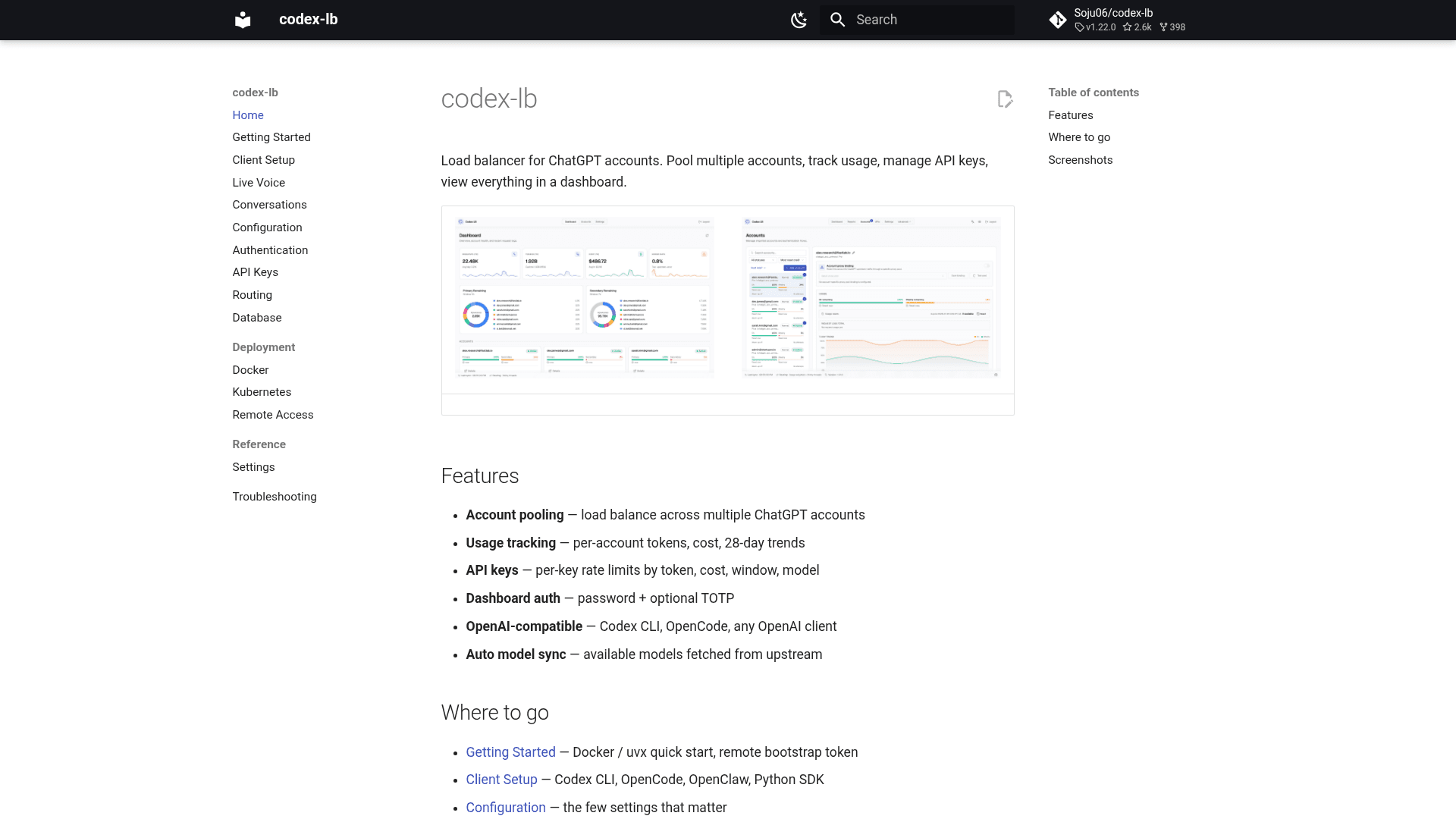
- Usage tracking — per-account token counts, cost estimates, and 28-day trend charts in the dashboard
- API key management — create per-key rate limits scoped by token count, cost, time window, or model
- Dashboard authentication — password login with optional TOTP two-factor authentication
- Auto model sync — available models are fetched automatically from upstream ChatGPT
- Live Voice support — dedicated docs section covering real-time voice routing
- Conversation management — dashboard view and conversation APIs for browsing history
Deployment Model
codex-lb is designed to run as a self-hosted service. The recommended path is Docker:
docker volume create codex-lb-data
docker run -d --name codex-lb -p 2455:2455 -p 1455:1455 \
  -v codex-lb-data:/var/lib/codex-lb ghcr.io/soju06/codex-lb:latest
It can also be installed via uvx codex-lb for local use. Kubernetes deployment is documented separately. The dashboard runs on port 2455; a one-time bootstrap token is required for first-time remote access. Data is stored in SQLite by default, with optional PostgreSQL support via the CODEX_LB_DATABASE_URL environment variable. Configuration is handled through environment variables prefixed with CODEX_LB_ or a .env.local file.
Client Compatibility
codex-lb exposes two main endpoint paths:
/backend-api/codex— for Codex CLI and IDE extensions, using theresponseswire API with WebSocket support/v1— standard OpenAI-compatible endpoint for OpenCode, OpenClaw, Hermes Agent, and the Python SDK
The project's documentation includes per-client setup guides with exact configuration snippets, including the model_providers TOML block needed for Codex CLI since the May 2026 lowercase provider name change.
Update: v1.22.0
The latest release is v1.22.0, published on July 24, 2026. The repository shows active development with the last push on August 8, 2026, and over 100 open issues reflecting ongoing community engagement. The project is spec-driven: normative behavior is defined in OpenSpec capability files in the repository, with documentation pages linking back to the governing specs. The contributor list spans more than 80 individuals, reflecting broad community involvement since the repository was created in January 2026.
Community Discussions
Be the first to start a conversation about codex-lb
Share your experience with codex-lb, ask questions, or help others learn from your insights.
Pricing
Open Source
Free to use, modify, and distribute under the MIT License.
- Multi-account ChatGPT load balancing
- Usage tracking dashboard
- API key management with rate limits
- OpenAI-compatible proxy endpoints
- Docker and Kubernetes deployment
Capabilities
Key Features
- Multi-account ChatGPT load balancing
- Per-account usage tracking (tokens, cost, 28-day trends)
- API key management with per-key rate limits
- OpenAI-compatible proxy endpoints
- Web dashboard with dark mode
- Dashboard authentication with password and optional TOTP
- Auto model sync from upstream ChatGPT
- Live Voice routing support
- Conversation history dashboard and APIs
- SQLite and PostgreSQL database backends
- Docker and Kubernetes deployment support
- Configurable routing strategies
- Remote access with bootstrap token
- Environment variable and .env.local configuration