
Cognee
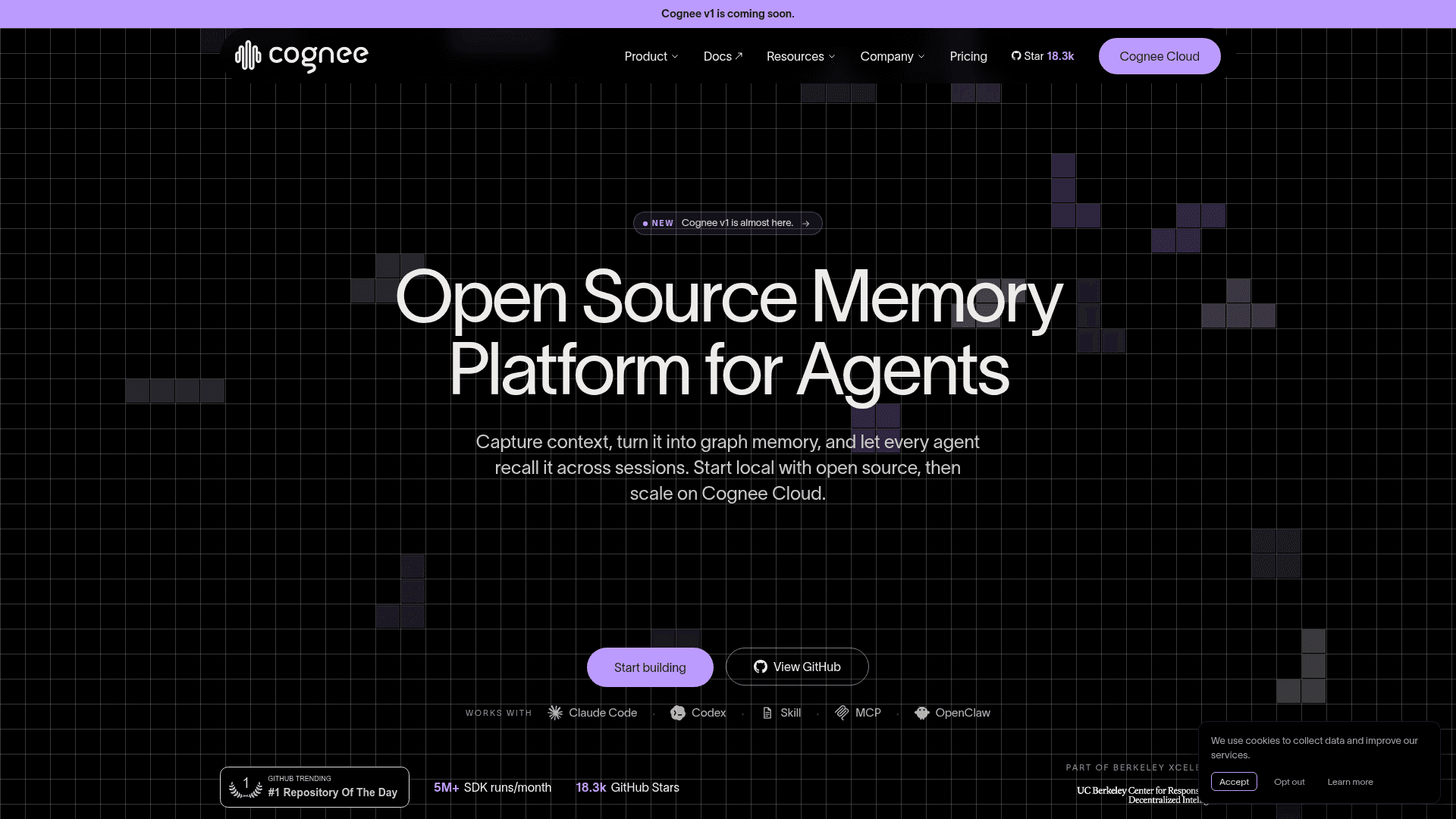
Open-source AI memory platform that turns data into a queryable knowledge graph, giving AI agents persistent long-term memory across sessions.
At a Glance
About Cognee
Cognee is an open-source AI memory platform built by Topoteretes UG, a Berlin-based company. It ingests data in any format, builds a self-hosted knowledge graph, and lets AI agents recall context persistently across sessions. The core SDK is licensed under Apache 2.0 and available on GitHub, while a managed cloud offering (Cognee Cloud) handles infrastructure for teams that prefer not to self-host.
What It Is
Cognee sits in the agent memory and GraphRAG category. Its core job is to replace ad-hoc vector retrieval with a richer memory layer that combines vector embeddings, graph relationships, and cognitive-science-grounded ontology generation. The result is a system where agents can not only find semantically similar content but also traverse connected relationships across documents, sessions, and data sources. The product exposes four primary operations — remember, recall, forget, and improve — through a Python SDK, an HTTP API, and an MCP server, so any MCP-compatible agent can read and write Cognee memory without custom integration code.
Architecture and Storage Backends
Cognee is designed to run locally, on self-hosted infrastructure, or on Cognee Cloud. Under the hood it supports multiple graph and vector storage backends:
- Graph stores: Kuzu, NetworkX, Neo4j, FalkorDB
- Vector stores: LanceDB, Qdrant, Milvus, Redis
- Relational metadata: handled in-process
The product page also describes a Cognee Rust Engine — an embedded AI memory engine that bundles vector store, graph store, relational metadata, and local embeddings into a single binary with no external services required. The page claims a cold-start-to-query-ready time of approximately 350 ms, which the team says makes it viable for serverless functions, CLI tools, mobile apps, and edge devices.
Integration Surface
Cognee ships first-party integrations for Claude Code, Cursor, Codex (OpenAI Agents SDK), LangGraph, CrewAI, and OpenClaw, plus a generic MCP server. The @cognee.agent_memory decorator wraps any async agent entrypoint and automatically composes graph memory and session memory, persisting the agent's execution history as queryable memory. Data source connectors for Slack, Notion, and Google Drive are available on higher-tier cloud plans.
Open-Source Lineage and Current Status
The repository was created in August 2023 and is actively maintained. The GitHub page reports 18,306 stars and 1,949 forks as of mid-2026. The latest release is v1.2.0, published on June 21, 2026, and the homepage notes that "Cognee v1 is coming soon," signaling a major version milestone in progress. The project is part of the UC Berkeley RDI Xcelerator program, according to the homepage. The vendor's homepage states the SDK processes over 5 million runs per month.
Deployment Paths
Teams can reach production through several routes:
- Local / self-hosted:
pip install cognee, configure an LLM API key, run the pipeline directly or via the CLI (cognee-cli) - Cognee Cloud: managed serverless hosting; connect any Python agent with
await cognee.serve(url=..., api_key=...) - One-click PaaS: Modal, Railway, Fly.io, Render, and Daytona configurations are included in the repository's
distributed/folder - On-premises / air-gapped: the product page states full GDPR compliance, data encrypted at rest and in transit, and support for air-gapped enterprise deployment
Why It Matters for Agent Builders
Standard RAG retrieves similar text chunks; Cognee adds graph traversal so agents can answer multi-hop questions that require connecting facts across sources. The vendor publishes benchmark comparisons against LightRAG, Graphiti, and Mem0 on human-like correctness, DeepEval F1, and DeepEval EM metrics. A research paper — "Optimizing the Interface Between Knowledge Graphs and LLMs for Complex Reasoning" (Markovic et al., arXiv 2505.24478, 2025) — accompanies the project. The open-source core means teams can start locally at no cost and migrate to managed cloud or enterprise deployment as workloads grow.
Community Discussions
Be the first to start a conversation about Cognee
Share your experience with Cognee, ask questions, or help others learn from your insights.
Pricing
Hobby
The perfect starting place for your first agent with memory. Free forever.
- 1M tokens included
- Unlimited users
- Unlimited API calls
- 1 tenant
- Agentic integrations (Claude Code, Codex, MCP)
Growth
Everything you need to ship multi-tenant memory to production.
- Unlimited tenants, $5 each per month
- Data source integrations: Slack, Notion, Google Drive
- In-app support
- All Hobby features
Enterprise
Dedicated support, your own cloud, and SLAs for memory at scale.
- Dedicated Slack channel
- Dedicated support engineer
- BYO cloud supported
- Support SLA
- All Growth features
Capabilities
Key Features
- Persistent long-term agent memory across sessions
- Knowledge graph construction from any data format
- Vector + graph hybrid search (GraphRAG)
- Four-verb memory API: remember, recall, forget, improve
- MCP server for any MCP-compatible agent
- Python SDK, HTTP API, and CLI
- Session memory with automatic graph sync
- @cognee.agent_memory decorator for async agents
- Custom ontology generation
- Multi-tenant isolation
- Permissions and access control
- Data source connectors (Slack, Notion, Google Drive)
- Support for multiple graph backends (Neo4j, Kuzu, NetworkX, FalkorDB)
- Support for multiple vector backends (LanceDB, Qdrant, Milvus, Redis)
- Cognee Rust Engine: embedded single-binary memory engine
- Air-gapped and on-premises deployment
- GDPR compliance with data encryption at rest and in transit
- OTEL collector and audit trails
- Self-improving memory from feedback
- Autoscaling compute on Cognee Cloud
Integrations
Demo Video