
CRM by Comp AI
An open-source, agentic-first CRM where a durable research agent autonomously enriches contacts, companies, and deals while the database serves as its persistent notes.
At a Glance
Fully open-source under the MIT License. Free to use, modify, and self-host.
Engagement
Available On
Listed Aug 2026
About CRM by Comp AI
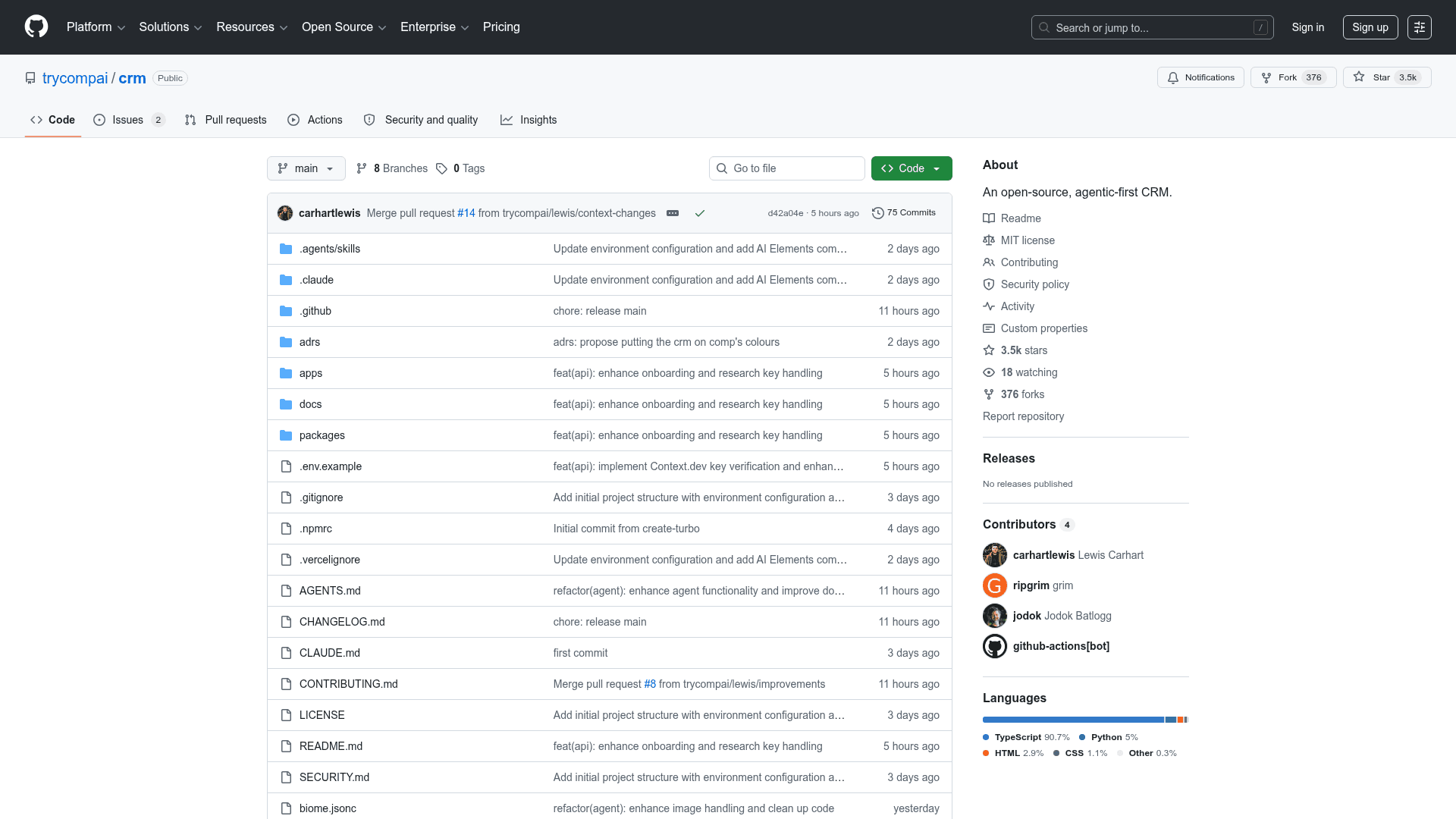
Comp AI's CRM is an open-source, MIT-licensed project that inverts the traditional CRM model: instead of a database with a form in front of it, the agent is the product and the database is simply where it writes things down. Built by the trycompai organization on GitHub, it has attracted over 3,300 stars since its launch in late July 2026, signaling strong early interest from the developer community.
What It Is
CRM is a self-hosted, single-tenant customer relationship management system built around a durable research agent rather than manual data entry. The agent runs on its own deployment, on its own schedule, and against its own work queue — it decides what to look at next, books its own follow-ups, spends a research budget, and continues running even when the browser is closed. The API layer deliberately contains no intelligence: it reports that something happened (a thread was ingested, a company was created, an attendee is unknown), and the agent decides what it means.
How the Agent Works
The agent is built on eve, Vercel's filesystem-first framework for durable agents, and ships with 18 authored tools, 4 skills (prose files the agent reads, versioned like code), one dispatch schedule, and a sandboxed shell environment.
Key design principles the README documents:
- Nothing about a person is guessed. Tools report only what they observed; a ledger prices the evidence. Strong evidence writes to the record; weak evidence becomes a human-settleable suggestion.
- Every outside source is optional. With no API keys, the agent still works by reading your own threads, meetings, and signature blocks. Each additional key (LinkedIn via RapidAPI, Perplexity for web search, Context for company brand data) opens one more research source.
- The sandbox has no network and no database. This removes the only path by which a customer's email body could leave through a shell command, and prevents a shell with credentials from becoming an exfiltration vector.
- The work queue is durable.
claimDueusesFOR UPDATE SKIP LOCKEDso two dispatchers take disjoint work and a crashed run frees its row when the lease expires.
Every contact, company, and deal has an Agent tab showing steps as they happen, leads discarded and why, and questions the agent cannot resolve surfaced for a human to settle.
The Stack
The project is a Turborepo monorepo on Bun, deployed on Vercel, with three independent deployments (Next.js front end, NestJS API, and the agent) sharing a Postgres database.
| Layer | Technology |
|---|---|
| Agent runtime | eve (durable sessions, tools, skills, schedules, sandboxes) |
| Model access | Vercel AI Gateway (OIDC on Vercel, no provider key to manage) |
| Sandbox | Vercel Sandbox in production; Docker or microsandbox locally |
| Front end | Next.js App Router, shadcn/ui, nuqs for URL state |
| API | NestJS with nestjs-trpc |
| Data | Prisma, Postgres (Neon), optional Redis (Upstash) |
| Auth | Better Auth, Google-only, one allow-list environment variable |
The front end communicates with the API over tRPC, with the router type generated from NestJS routers, making the stack type-safe from the Prisma row to the table cell.
Setup Path
Getting started requires Bun and Docker. After cloning and copying .env.example, only four values are required: BETTER_AUTH_SECRET, ALLOWED_SIGN_IN (the entire authorization model — an unset value means nobody can sign in), and a Google OAuth client ID/secret pair. DATABASE_URL defaults to the Docker Compose Postgres. Everything else — Perplexity, RapidAPI, Redis, the agent bridge — is optional and the app runs without any of it.
Current Status
The repository was created on July 31, 2026 and last pushed on August 3, 2026, making it a very recently launched project. It is licensed MIT, actively maintained, and open to contributions — the CONTRIBUTING.md explicitly notes a preference for human-written pull requests over agent-generated ones.
Community Discussions
Be the first to start a conversation about CRM by Comp AI
Share your experience with CRM by Comp AI, ask questions, or help others learn from your insights.
Pricing
Open Source
Fully open-source under the MIT License. Free to use, modify, and self-host.
- Full source code access under MIT License
- Durable research agent with 18 tools
- Self-hostable on Vercel or any platform
- Google OAuth authentication
- Gmail and Calendar sync
Capabilities
Key Features
- Durable research agent that runs autonomously on its own schedule
- 18 authored agent tools including contact identification, company enrichment, and fact recording
- Evidence-based data model: no guessing, only observed facts
- Agent tab on every contact, company, and deal showing live reasoning steps
- Mailbox sync via Gmail and Calendar APIs
- Single-tenant, Google-only authentication with allow-list authorization
- Optional integrations: LinkedIn (RapidAPI), web search (Perplexity), company brand data (Context)
- Sandboxed shell with deny-all egress for safe text processing
- Durable work queue with lease-based task claiming
- URL-driven list state (filters, sort, page) for shareable views
- Turborepo monorepo with Bun runtime
- Type-safe tRPC API from Prisma row to table cell
- Self-hostable on Vercel with Postgres (Neon) and optional Redis (Upstash)