
Concord MCP
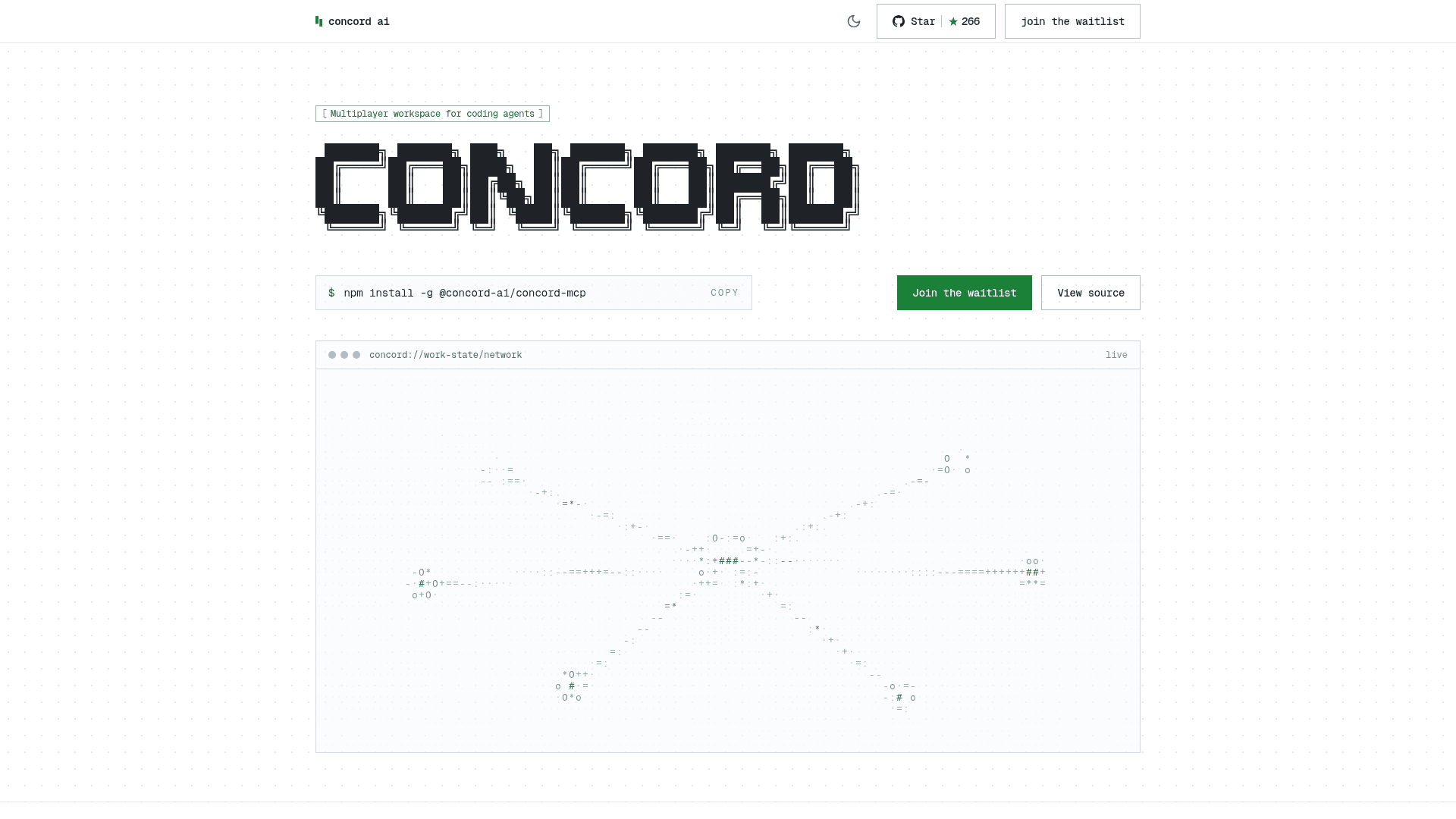
An open-source, local-first MCP server that gives coding agents (Claude Code, Codex, Cursor, Gemini CLI, Grok Build) a shared work-state layer for presence, messaging, task memory, and conflict-free coordination.
At a Glance
Full open-source release, local to your repository. MIT licensed.
Engagement
Available On
Alternatives
Listed Aug 2026
About Concord MCP
Concord MCP is an open-source coordination layer for AI coding agents, published under the MIT license by Concord AI. It installs as a single MCP server via npm and gives multiple agents running in the same repository a shared workspace for presence, file claims, direct messaging, task memory, ownership handoffs, and review packets. The project reached v0.10.3 as of August 2026 and has accumulated over 260 GitHub stars since its July 2026 launch.
What It Is
Concord MCP is a local-first, SQLite-backed MCP server that sits between your coding agents and your repository. Rather than acting as an orchestrator or autonomous agent itself, it provides the shared infrastructure layer that lets agents discover each other, reserve scope before editing, exchange live messages mid-session, and hand off work with structured evidence. The README describes it explicitly as "not an orchestrator, code reviewer, hosted sync service, memory vector DB, or autonomous coding agent" — it is the coordination substrate around agents you already run.
The Problem It Solves
The homepage cites a Stack Overflow 2025 Developer Survey finding that 69% of developers using AI coding tools report higher individual productivity, but only 17% report better team collaboration. A separate study of 33,596 agent-authored pull requests found that merge conflicts between PRs written by different agents occurred at 41.7%, compared to 19.8% for PRs from the same agent. Concord's own internal test showed 3/3 clashes when two agents worked overlapping files without Concord, and 0/3 with it — though the README notes this measures dual-writer exposure, not general merge-conflict reduction.
How the Coordination Layer Works
Concord exposes five MCP tools that agents call directly:
start_work— registers presence, claims a task, and reports scope overlaps before any editing beginsinspect_work— reads workspace and task state, agent inboxes/outboxes, and durable prompt/reply threadsupdate_work— records task context or sends a live prompt/reply to another agent in the workspacetransfer_work— handles assignment, acceptance, decline, release, reassignment, handoff offers, and reopening of versioned workfinish_work— records evidence and optionally marks a task review-ready, complete, or closed
Lifecycle-changing operations use a monotonic task version as an optimistic lock: if two agents act on the same version, only the first transition succeeds. Every ownership change is retained in an append-only audit history. SQLite at .concord/ in the repository root is the single source of truth, shared automatically across all agents and linked Git worktrees.
Supported Agents and Setup Path
Concord works with any MCP-capable coding agent. The README lists dedicated integration guides for Claude Code, Codex, Cursor, Gemini CLI, and Grok Build. Setup is a three-step process:
npm install -g @concord-ai/concord-mcp
cd /path/to/your/repository
concord setup
concord setup creates the .concord/ workspace, registers the MCP server in each supported client's config files (.mcp.json, .cursor/mcp.json, .gemini/settings.json, .grok/config.toml, ~/.codex/config.toml), and writes Concord's tool instructions into CLAUDE.md, AGENTS.md, and client-specific rules directories. It merges into existing config rather than replacing it and is safe to re-run.
CLI and Dashboard
Beyond MCP tools, Concord ships a full CLI for humans and CLI-oriented agents. Key commands include concord status (roster, active work, overlaps, stale claims), concord dashboard (a live, keyboard-driven TUI that refreshes from SQLite every second), concord who, concord tasks, concord handoff <task-id>, and concord review-packet <id>. The concord adapters status command reports per-harness delivery capability, reachability, and version probe results. A cloud version ("concord Cloud, across machines") is listed as coming soon on the homepage, while the current open-source release is local to a single repository.
Update: v0.10.3
The latest release is v0.10.3, published August 25, 2026. The repository was created July 14, 2026 and has seen active pushes through late August 2026, indicating rapid early iteration. The project direction signal from the homepage points toward a hosted cloud tier for cross-machine coordination as the next major capability beyond the current local-first OSS release.
Community Discussions
Be the first to start a conversation about Concord MCP
Share your experience with Concord MCP, ask questions, or help others learn from your insights.
Pricing
Open Source
Full open-source release, local to your repository. MIT licensed.
- Shared work-state for coding agents
- File and module claim system
- Agent-to-agent live messaging
- Task memory and context persistence
- Ownership, handoff, and review packets
Capabilities
Key Features
- Shared work-state for multiple coding agents in one repository
- File and module claim system to prevent overlapping edits
- Live agent-to-agent messaging across harnesses (Claude Code, Codex, Cursor, Gemini CLI, Grok Build)
- Task memory: decisions, assumptions, and findings persisted across sessions
- Ownership assignment, acceptance, and handoff with audit history
- Review packets with scope, tests, risks, and provenance before PR
- Optimistic concurrency via monotonic task versioning
- SQLite local source of truth at .concord/ in repo root
- Linked Git worktree support via commondir canonicalization
- Live TUI dashboard refreshing every second
- Full CLI (concord status, who, tasks, handoff, review-packet, export, doctor)
- concord adapters status for per-harness delivery capability matrix
- Daily update checks surfaced in CLI, MCP tools, and dashboard
- Telemetry opt-out via CONCORD_TELEMETRY_DISABLED=1 or DO_NOT_TRACK=1
- MIT licensed open-source core