
Constellation Gate AI
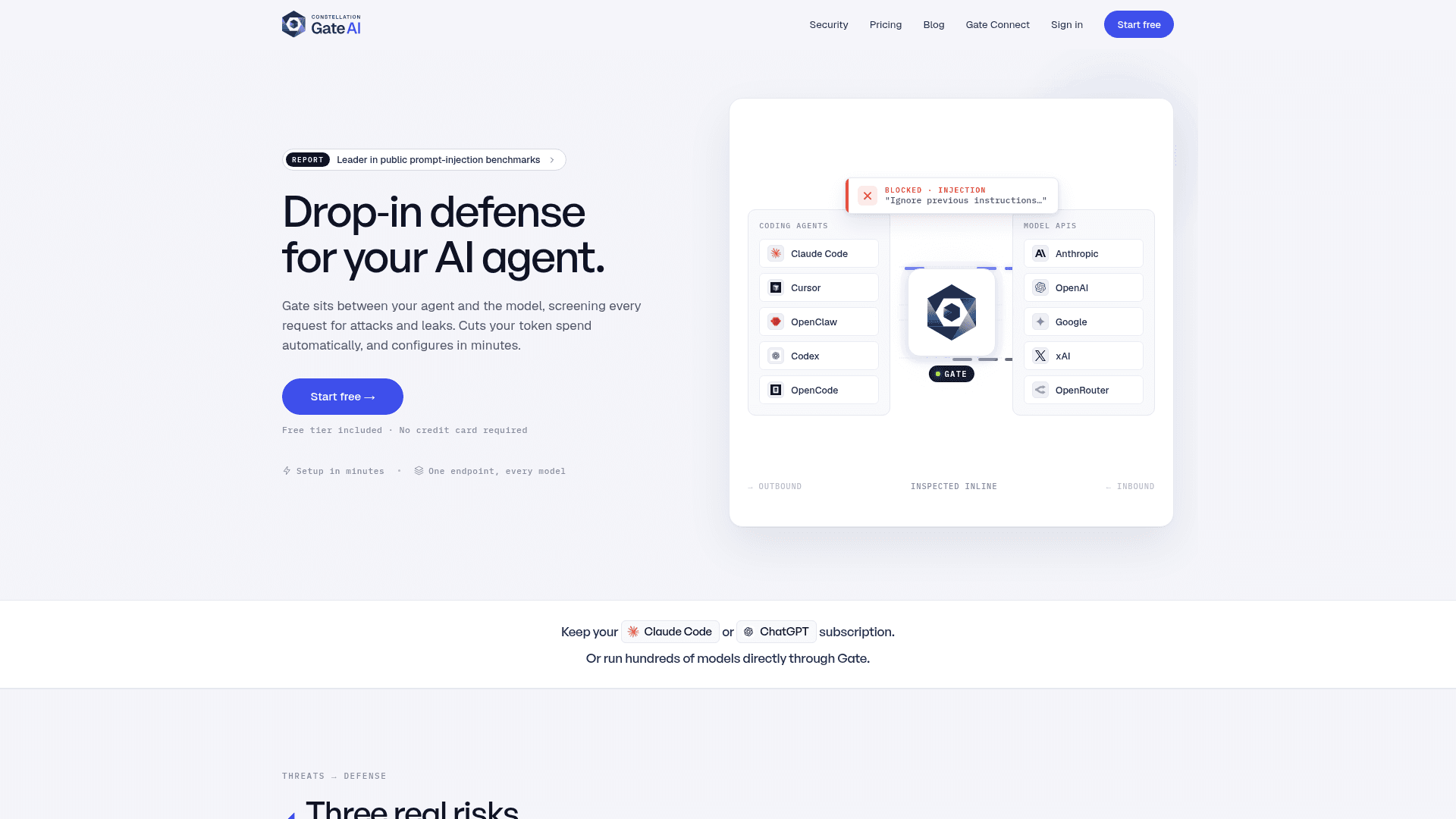
Gate AI is a drop-in security proxy that sits between your AI agent and the model API, blocking prompt injection attacks, redacting PII and credentials, and compressing tokens to cut costs.
At a Glance
About Constellation Gate AI
Gate AI is a security gateway built by Constellation Network that intercepts every request between an AI coding agent or application and the underlying model API. It screens for prompt injection attacks, redacts sensitive credentials and PII before responses return, and applies lossless token compression to reduce costs — all without requiring code changes beyond pointing an SDK at a new base URL. The product is self-serve, starts free, and the vendor claims setup completes in under a minute.
What It Is
Gate AI is an inline AI security proxy — a layer that sits between coding agents (such as Claude Code, Cursor, OpenClaw, and Codex) and model providers (Anthropic, OpenAI, Google, xAI, and others). Every outbound prompt and inbound response passes through Gate, where it is scanned, filtered, and logged before being forwarded. The core job is to enforce security policies that the model itself cannot reliably enforce: blocking prompt injection, stopping credential leakage, and preventing hijacked tool calls.
How the Defense Layer Works
Gate operates in three stages on every request:
- Connect: Gate accepts the same API calls an agent already makes, acting as a transparent proxy to the model.
- Inspect: Each call and response is scanned in both directions for injection attempts, credential leaks, and PII.
- Decide: User-defined policies are enforced inline — attacks are blocked, secrets are redacted, edge cases are flagged, and every decision is written to a tamper-evident audit trail.
The vendor specifically addresses OWASP LLM Top 10 #1 (prompt injection), credential and PII leakage, and indirect injection via hijacked tool outputs (e.g., attacker-controlled webpages or documents returned by agent tools).
Benchmark Position
Constellation Network publishes a benchmark report (dated May 26, 2026) comparing Gate against other vendors across 16 public prompt-injection datasets. According to that vendor-published report, Gate achieves 97.4% F1 across those benchmarks and ranks #1 on 8 of them at a 1% false-positive rate. In a head-to-head comparison against Lakera Guard across four shared public benchmarks, the report claims Gate averages 96.6% F1 versus Lakera's 83.7%.
Token Cost Reduction
Beyond security, Gate applies two cost-reduction techniques:
- Request compression: Lossless, cache-aware compression shrinks outbound prompts. The vendor claims 20%+ token savings per request without changing model outputs.
- Prompt-cache injection: Gate marks reusable prefixes (system prompts, tool definitions, conversation history) so upstream providers bill them at discounted cached rates. The vendor claims 2–10× cost reduction on the cached prefix.
An example on the homepage shows a 6,500-token request reduced by 1,338 tokens (−20.6%) via four transforms.
Immutable Audit Trail
Every prompt, reply, and rule decision is cryptographically chained and anchored to Constellation's Digital Evidence layer — a blockchain-backed record that is independently verifiable without going through Gate. The vendor states that proofs live on Constellation's infrastructure rather than Gate's servers, so the audit trail remains verifiable even if Gate ceases to operate.
Setup and Integration
Gate offers two connection paths:
- Gate Connect: A desktop app that detects installed AI tools and routes each through Gate with one click per tool. Supports Claude Code, Cursor, OpenClaw, and Codex.
- SDK redirect: Developers change one line — pointing the
base_urlof an existing OpenAI-compatible SDK to Gate's endpoint — and all requests are immediately scanned and audited.
For model access, users can bring their own provider keys (keeping existing Anthropic or OpenAI billing) or pay Gate directly on a pay-as-you-go basis to access hundreds of models from a single endpoint, including Claude, GPT-5, Gemini, Grok, Llama, Mistral, Qwen, and DeepSeek.
Community Discussions
Be the first to start a conversation about Constellation Gate AI
Share your experience with Constellation Gate AI, ask questions, or help others learn from your insights.
Pricing
Free
One gateway for every model, with logs and a tamper-evident record built in.
- Multi-provider routing: one base URL for OpenAI, Anthropic, and more
- 20,000 recorded requests per month
- 30-day log retention, 90-day metrics retention
- Request-level logs: cost, tokens, and latency across the workspace
- Basic compression on every request
Pro
The full defense layer: screening, redaction, caps, and savings on every request.
- Everything in Free, plus:
- 200,000 recorded requests per month
- 90-day log retention, 180-day metrics retention
- Prompt injection scanning: block or flag before tokens reach the model
- PII, PHI, and credential redaction before the response returns
- Spend, token, and rate limits at the org, project, or key level
- Advanced compression: 20%+ saved per message via lossless compression and cache injection
Enterprise
For larger teams with deployment, security, and procurement requirements.
- Everything in Pro, plus:
- Custom retention periods and volume pricing
- Custom security policies
- Private cloud deployment and VPC hosting
- Data isolation and data export
- Dedicated onboarding and priority support
- Procurement: security review, DPA, invoicing
Capabilities
Key Features
- Prompt injection detection and blocking
- PII and PHI redaction
- Credential and secret redaction
- Indirect injection (hijacked tool call) prevention
- Lossless token compression (20%+ savings)
- Prompt-cache injection for reduced provider billing
- Immutable blockchain-backed audit trail
- Tamper-evident per-request logs
- Multi-provider routing (one base URL)
- Spend, token, and rate caps at org/project/key level
- Gate Connect desktop app for no-code setup
- Conversation threading for agent run tracing
- Pay-as-you-go model access or bring-your-own-keys
- Request-level cost, token, and latency logs