
Covenant Framework
A governance framework for multi-agent AI systems providing structure, lifecycle management, and quality controls for AI agent orchestration inside Claude Code or OpenAI Codex CLI.
At a Glance
Fully functional open-source governance framework for multi-agent AI systems with the full Constitution, all 12 agent types, 16 core commands, and 4 runtime hooks.
Engagement
Available On
Alternatives
Listed Sep 2026
About Covenant Framework
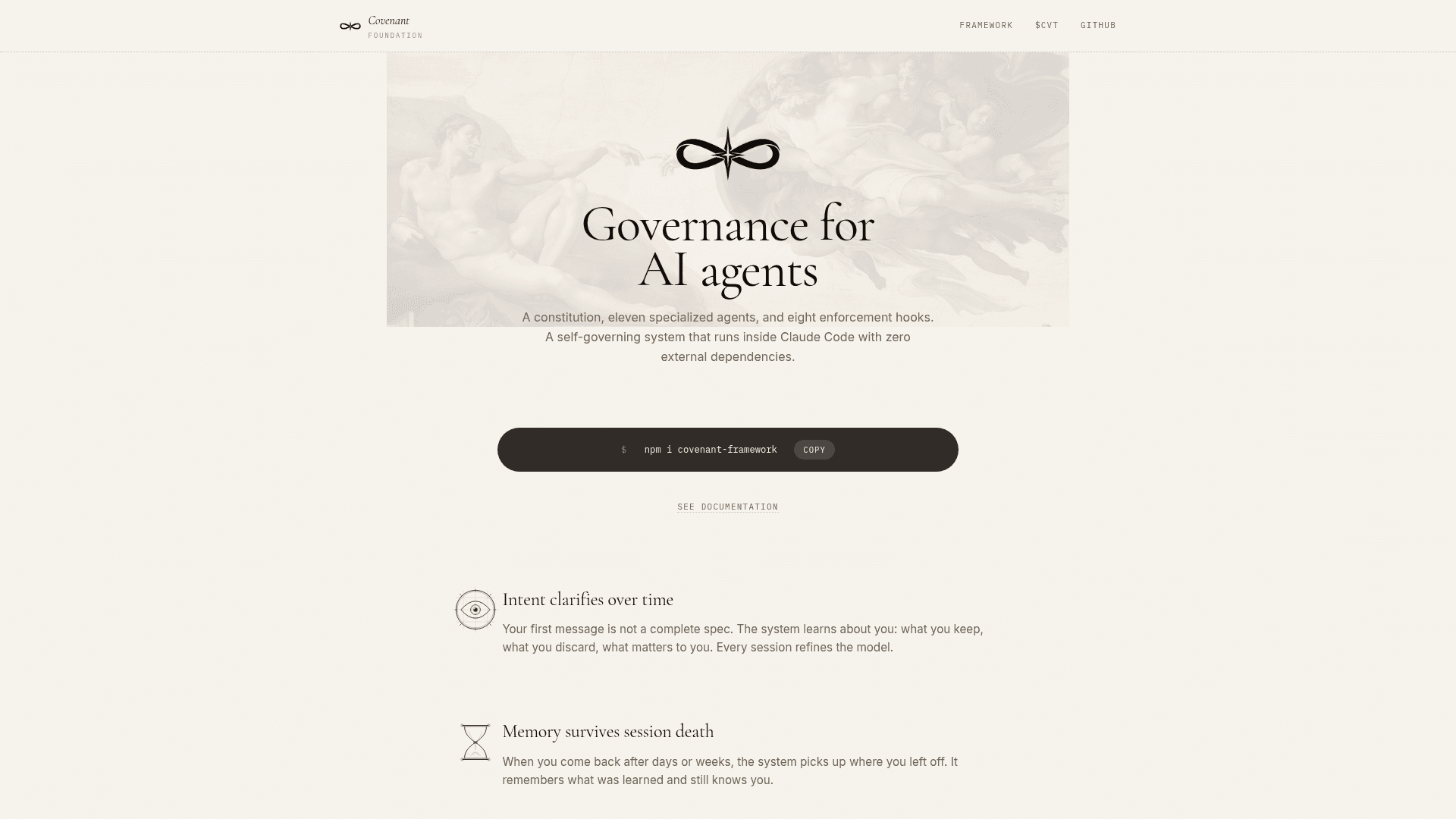
Covenant Framework is a governance layer for multi-agent AI systems, built by Alex Salsali under the Covenant Foundation. It runs natively inside Claude Code or OpenAI Codex CLI with zero external dependencies, providing a constitution, specialized agent types, commands, and runtime hooks that coordinate how agents spawn, execute, and shut down. The Community Edition (v1.0.0) is freely available on GitHub under the Covenant Public License v1.0.
What It Is
Covenant Framework is a structured orchestration system that solves coordination problems in multi-agent AI workflows. Rather than giving agents a flat list of instructions, it introduces four layers of governance: hard rules (the Constitution), heuristics, worked examples, and default personality traits. A single "Interpreter" agent acts as the user-facing interface, proposes plans, and spawns specialized agents with scoped mandates. Each agent reads the Constitution and prior learnings at genesis, executes within its mandate, writes an exit report, and shuts down — passing memory forward to the next session.
Architecture and Agent Lifecycle
The framework's architecture centers on a strict hierarchy:
- Constitution — 36 sections of immutable rules every agent inherits
- 12 Agent types — Interpreter, Analyst, Writer, Synthesist, Guardian, Shepherd, Scribe, Stress Tester, Futility Review, Goal Challenge, James, and Executor
- 16 Commands (Community) — including
/spawn,/consolidate,/checkpoint,/audit,/remember, and 11 more; 22 additional advanced commands are available in the Network tier - 4 Runtime hooks (Community) — agent gate, token logging, shutdown orchestration, and session checks; 7 advanced hooks in the Network tier
- Memory system — exit reports, structured memos, semantic memory, and consolidation cycles that persist across sessions
The lifecycle flows: SPAWN → GENESIS PHASE (read mandate, Constitution, prior learnings) → EXECUTE (work within mandate boundaries) → SHUTDOWN (write exit report, archive, notify parent).
The Covenant Ecosystem
The framework is the governance core, and several companion tools build on top of it:
- covenant-cli — scaffolds governed apps from a plain-language description, with exit reports, typed I/O, and memory inheritance (
pip install covenant-cli) - crewai-governance — adds Covenant governance to existing CrewAI projects in two lines of code
- covenant-hedge-fund — a production example of an AI hedge fund with constitutional governance
- synthex — multi-generational code synthesis through governed agent generations
- mandate — an agent-native programming language with intent, verify, synthesize, and handoff primitives
Performance Signal
The README cites a Terminal-Bench 2.0 result of 67.4% no-retry across 89 tasks, compared to a 42% ad-hoc baseline — a claim published by the Covenant Foundation in the project's own documentation.
Community vs. Network Tiers
The Community Edition is fully functional and free. A separate Network tier, available to ventures formally onboarded into the Covenant Network and operating under a Revenue Share Agreement with the Covenant Foundation, unlocks 22 additional commands and 7 advanced hooks. The Covenant Public License v1.0 governs both tiers, with Tier 2 source code not publicly redistributable.
Update: v1.0.0 Community Edition
The initial public release (v1.0.0) was published on July 4, 2026, with the repository last updated in August 2026. The project is actively maintained under the asalsali GitHub account, with topics including agents, ai, claude-code, framework, governance, multi-agent, and orchestration.
Community Discussions
Be the first to start a conversation about Covenant Framework
Share your experience with Covenant Framework, ask questions, or help others learn from your insights.
Pricing
Community Edition
Fully functional open-source governance framework for multi-agent AI systems with the full Constitution, all 12 agent types, 16 core commands, and 4 runtime hooks.
- Full Constitution (36 sections)
- All 12 agent definitions
- 16 core commands
- 4 core runtime hooks
- Memory system with exit reports and consolidation
Network Edition
Enhanced framework for ventures formally onboarded into the Covenant Network under a Revenue Share Agreement. Unlocks 22 additional commands and 7 advanced hooks.
- Everything in Community Edition
- 22 advanced commands
- 7 advanced runtime hooks
- Formal Covenant Network onboarding
- Revenue Share Agreement
Capabilities
Key Features
- 36-section immutable Constitution inherited by all agents
- 12 specialized agent types (Interpreter, Analyst, Writer, Synthesist, Guardian, Shepherd, Scribe, and more)
- 16 core commands including /spawn, /consolidate, /checkpoint, /audit, /remember
- 4 runtime hooks: agent gate, token logging, shutdown orchestration, session checks
- Persistent memory system with exit reports, structured memos, and consolidation cycles
- Four-layer governance: hard rules, heuristics, worked examples, default personality traits
- Single Interpreter agent as the only user-facing interface
- Agent lifecycle management: spawn, genesis, execute, shutdown with exit reports
- Zero external dependencies
- Native Claude Code and OpenAI Codex CLI support
- CrewAI integration via crewai-governance
- CLI scaffolding via covenant-cli
- Community Edition free and fully functional