
Deedglass
Checks what AI agents actually changed in databases and health records, using rules before each tool call and signed records afterward.
At a Glance
About Deedglass
Deedglass is an open-source, self-hosted layer built by Arjun Prabhakaran that sits between AI agents and the systems they change. Rules decide each tool call, a check compares what the system really changed with what the agent reported, and each result is sealed as a signed record anyone can check offline. The latest release listed is 0.15.0, and the core is Apache-2.0.
What It Is
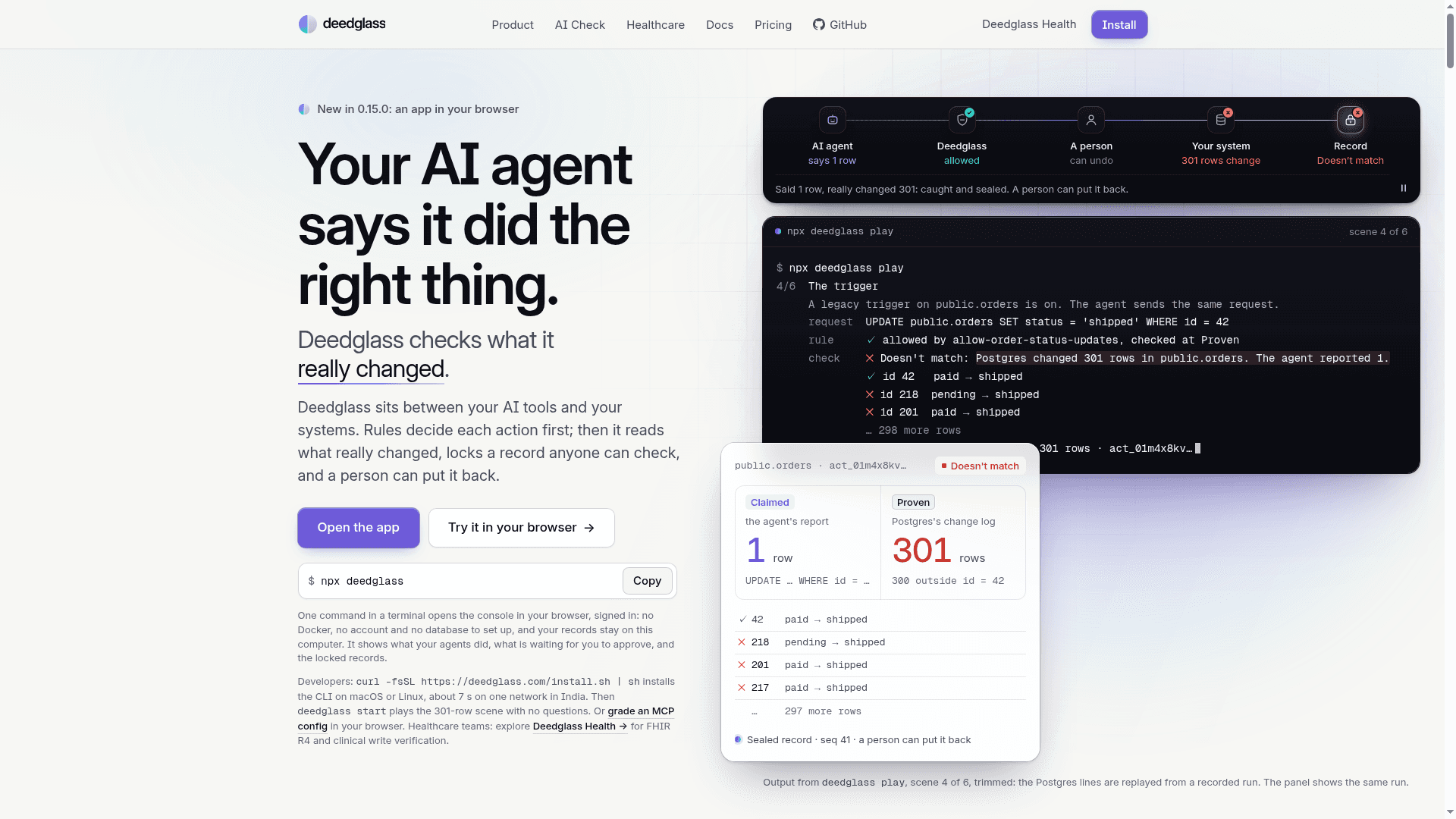
Deedglass is a safety and verification gateway for AI agents that write to databases and health records. Agents connect through Deedglass with a Deedglass key instead of the tool's real credentials. Rules allow, block or ask a person before the call runs. Afterward, Deedglass reads the result from the real system and records a verdict of Matches, Doesn't match or Can't check.
Its headline demo shows an agent reporting an update to 1 row while Postgres's change log shows 301 rows changed because of a legacy trigger. Deedglass seals the difference as a record and can plan an undo that runs after a person approves.
How the checks work
Each check carries one of three evidence levels. Claimed means the tool reported success. Checked means Deedglass read the result back from the target, such as GitHub, Slack, Notion or Stripe sandboxes. Proven means the system's own change log shows what committed, which applies to Postgres, to FHIR servers on Postgres (HAPI FHIR JPA 8.x and Medplum 5.x), and to MySQL through a Debezium change feed. Proven checks on Postgres need wal_level = logical and REPLICA IDENTITY FULL on watched tables.
Ways to use it
Running npx deedglass opens a local console in the browser with no Docker, account or database to set up. Developers can run a read-only scan that grades MCP configs and agent setups from A to F, wrap an MCP server with deedglass mcp wrap, or wrap a function with the TypeScript SDK. A shell guard can ask before commands such as prisma migrate reset or DROP TABLE run in Claude Code and other coding agents. Observe mode watches a session and reports which rows Postgres committed, and can save undo SQL.
Records, approvals and limits
Sealed records are Ed25519-signed and hash-linked, so they can be verified offline with the public key. Only a person can approve actions, and a stop switch halts agents. The project states it has no SOC 2 report, no outside penetration test and no SSO. A healthcare edition covers FHIR R4 write verification.
Community Discussions
Be the first to start a conversation about Deedglass
Share your experience with Deedglass, ask questions, or help others learn from your insights.
Pricing
Always free
Self-hosted, open source, every feature free while we grow. Core, SDKs and CLI are Apache-2.0; ee/ features are FSL-1.1-ALv2 (becomes Apache-2.0 two years after each release).
- Rules: allow, block or ask a person
- Checks: Matches, Doesn’t match, Can’t check
- Sealed records you can check offline
- Approvals, Stop and Insights
- Undo of one agent action, after a person approves
Capabilities
Key Features
- Rules that allow, block or require approval before each agent tool call
- Post-action checks at Claimed, Checked and Proven levels
- Postgres change-log (WAL) verification of committed rows
- Signed, hash-linked records verifiable offline
- Undo of rows changed by an action after human approval
- MCP server wrapping via deedglass mcp wrap
- TypeScript, Python and Go SDKs
- Shell guard for Claude Code, Cursor, Codex CLI, Gemini CLI and Copilot CLI
- Read-only scan grading agent setups A to F
- Observe mode for watching sessions with undo SQL
- Lockdown mode and stop-all switch
- FHIR R4 write verification for healthcare
- Local browser console via npx deedglass