
TrueForge
TrueForge is an open-source agent harness — the runtime layer that turns an LLM into a working agent, with MCP tools, skills, sandboxing, approvals, and subagents built in.
At a Glance
About TrueForge
TrueForge is an open-source agent harness built by TrueFoundry, released under the MIT License. It handles the full agent execution loop — model calls, MCP tools, skills, sandboxing, human-in-the-loop approvals, context management, and session state — and exposes everything through a chat UI, an HTTP API with a TypeScript SDK, and an embeddable React UI SDK. The GitHub repository reports 4,373 stars and 276 forks as of late August 2026.
What It Is
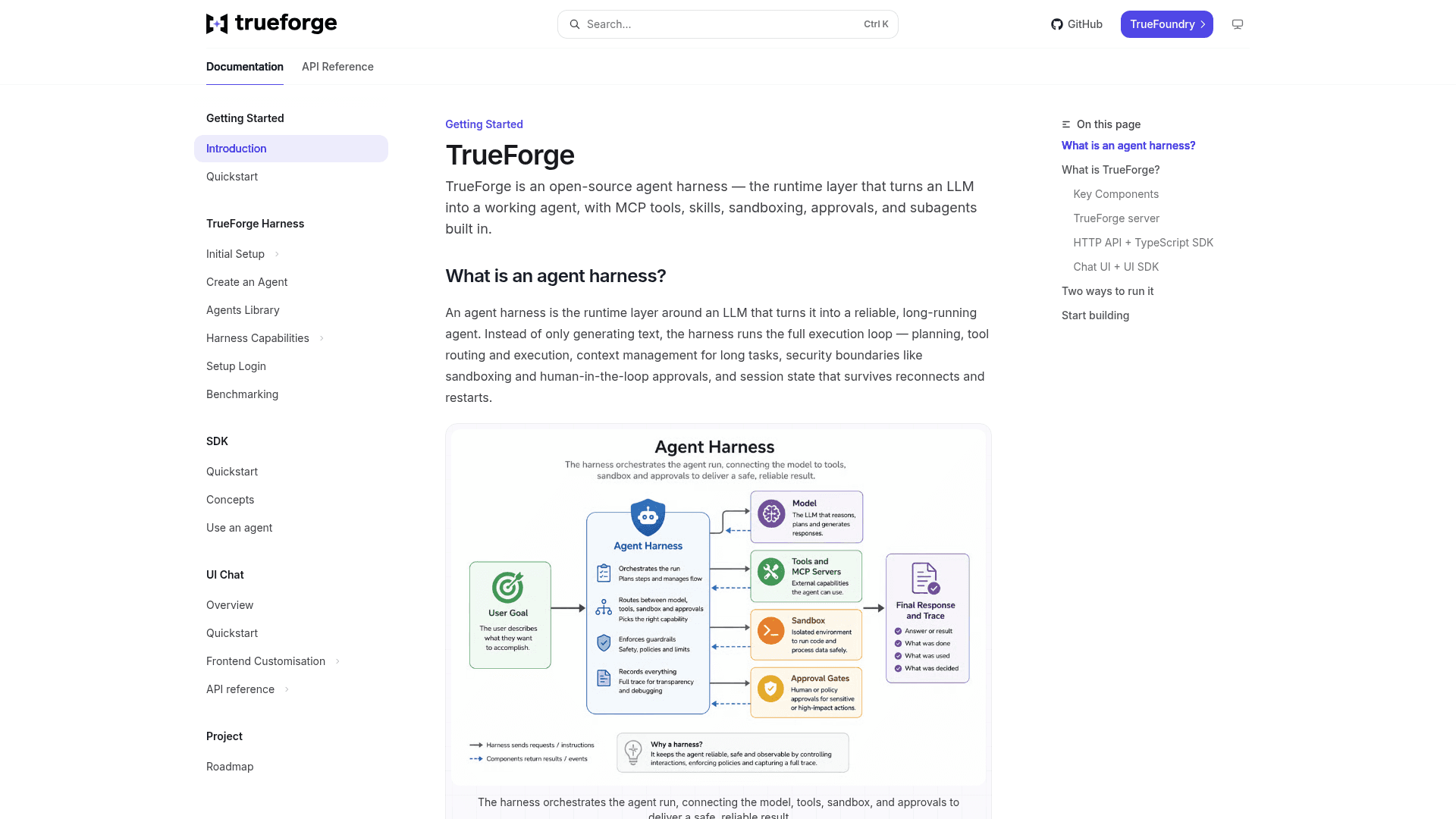
TrueForge sits between a user goal and the final agent response as the runtime orchestration layer. Rather than just generating text, it runs the full execution loop: planning, tool routing and execution, context management for long tasks, security boundaries like sandboxing and human-in-the-loop approvals, and session state that survives reconnects and restarts. The project describes itself as "the open-source agent harness — the runtime layer that turns an LLM into a working agent."
Architecture and Key Components
TrueForge has three main parts:
- TrueForge Server — runs the agent loop, streams every step back to the client, pauses for human approval on sensitive actions, and persists sessions in SQLite (local) or Postgres (hosted).
- HTTP API + TypeScript SDK — a REST + Server-Sent Events API with an OpenAPI spec, plus the
@truefoundry/trueforge-coreand@truefoundry/trueforge-sdknpm packages for programmatic agent control. - Chat UI + UI SDK — a bundled browser interface served on the same port as the server, plus
@truefoundry/trueforge-ui, a customizable React component library for embedding the chat experience in your own app.
The server treats the sandbox as a tool rather than running the agent inside a sandbox permanently. A sandbox is provisioned only when the agent actually needs to execute code, which allows one server to run many agents concurrently and keeps turns that don't need code execution cheaper and faster.
Deployment Model
TrueForge supports two modes with identical agent features:
- Local mode — a single process on your machine, launched with
npx @truefoundry/trueforge, backed by SQLite with no extra infrastructure. Intended for personal use only; not hardened for production or shared internet access. - Hosted mode — Docker Compose or Helm deployment backed by Postgres and Redis, supporting multiple replicas behind a load balancer. Redis peers replicas so streams and cancellations follow the client across replicas. Supports optional OIDC login for admin vs. user roles.
Harness Capabilities
TrueForge ships a set of built-in capabilities that go beyond basic tool calling:
- MCP tools — remote MCP servers with header auth or OAuth, including in-chat authorization flows
- Skills — git-backed
SKILL.mdinstruction packs loaded on demand in the sandbox - Human checkpoints — tool approval gates, ask-user-questions, and Generative UI in chat
- Context engineering — subagents, deferred tool loading, Code Mode, large-result offloading, and compaction for long tasks
- Any model provider — OpenAI, Anthropic, Google Gemini, and any OpenAI-compatible endpoint, configured from YAML catalogs
Update: @truefoundry/trueforge-ui@0.2.4
The latest published release is @truefoundry/trueforge-ui@0.2.4, published on August 19, 2026. The repository was last pushed on August 25, 2026, indicating active development. The project also includes a benchmarking suite comparing TrueForge against Claude Managed Agents and deepagents on the same tasks, tools, and model, with results reproducible from the benchmark/ directory in the repository.
Community Discussions
Be the first to start a conversation about TrueForge
Share your experience with TrueForge, ask questions, or help others learn from your insights.
Pricing
Open Source
Fully open-source under MIT License — free to use, modify, and self-host.
- Full agent execution loop
- MCP tools support
- Skills (git-backed instruction packs)
- Sandbox-as-a-tool
- Human-in-the-loop approvals
Capabilities
Key Features
- Open-source agent harness under MIT License
- Full agent execution loop with planning, tool routing, and streaming
- MCP tools support with remote servers, header auth, and OAuth
- Git-backed Skills (SKILL.md instruction packs) loaded on demand
- Sandbox-as-a-tool: isolated code/file execution provisioned only when needed
- Human-in-the-loop checkpoints: tool approval, ask-user-questions, Generative UI
- Subagents, deferred tool loading, Code Mode, and context compaction
- Session persistence across reconnects and restarts
- Local mode (SQLite, npx) and hosted mode (Postgres + Redis, Docker Compose or Helm)
- Bundled Chat UI served on the same port as the server
- Embeddable React UI SDK (@truefoundry/trueforge-ui)
- TypeScript SDK (@truefoundry/trueforge-sdk) for programmatic agent control
- REST + Server-Sent Events HTTP API with OpenAPI spec
- Support for OpenAI, Anthropic, Google Gemini, and any OpenAI-compatible endpoint
- Optional OIDC login for shared deployments with admin vs. user roles
- YAML-based catalogs for models, MCP servers, skills, and sandbox configuration
- Benchmarking suite comparing against Claude Managed Agents and deepagents