
Deep Chat
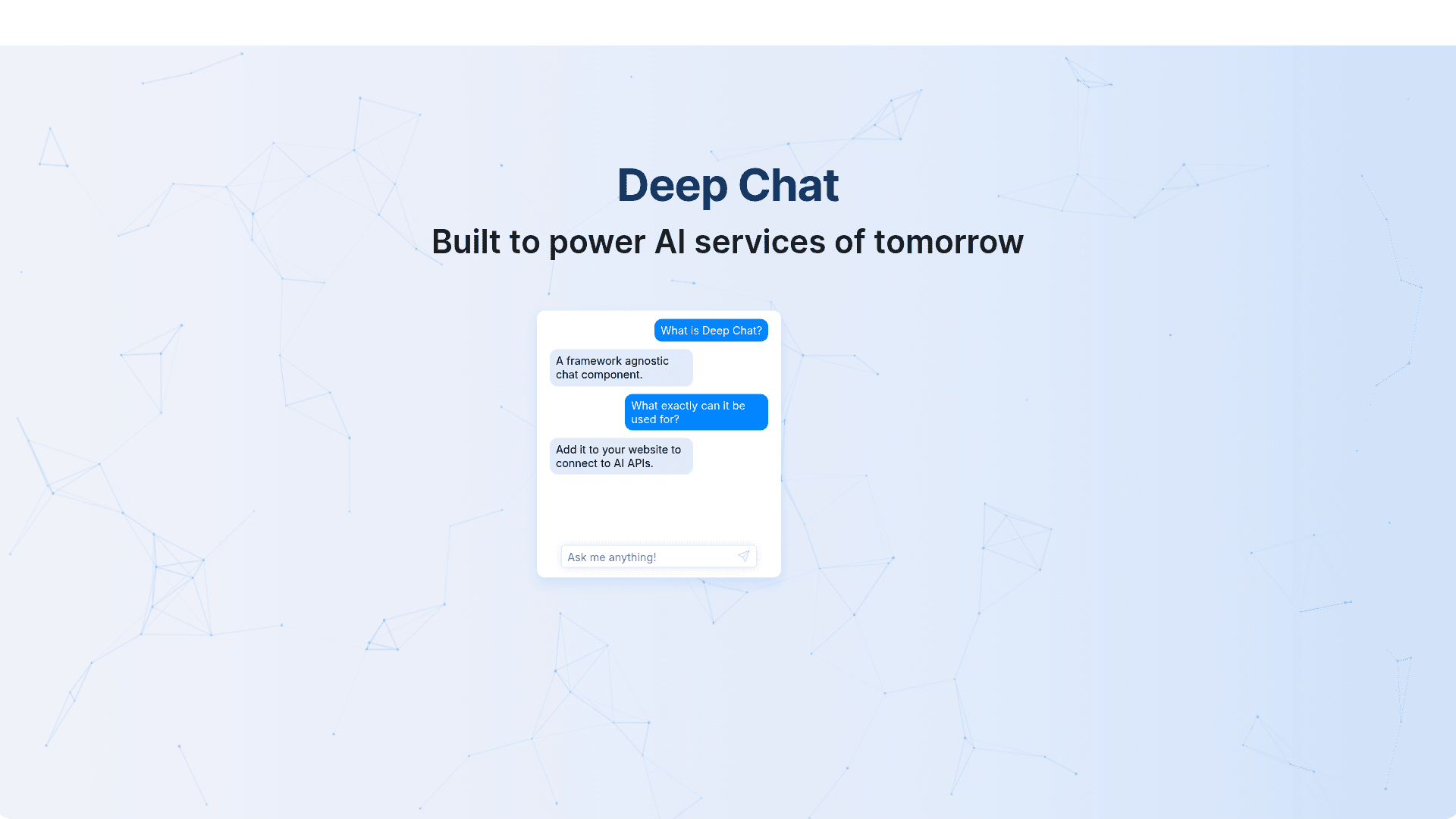
A framework-agnostic, customizable AI chat component that can be added to a website to connect to AI APIs or custom services.
At a Glance
Deep Chat core component released under the MIT License, free to use, copy, modify, and distribute.
Engagement
Available On
Alternatives
Listed Oct 2026
About Deep Chat
Deep Chat is an open-source, MIT-licensed chat component built by Ovidijus Parsiunas. It can be injected into a website with a single element and connect to popular AI APIs or to a custom backend service. The latest documented release is 2.5.1.
What It Is
Deep Chat is a web component for building chat interfaces. Developers install it via npm (a separate package exists for React) and add a <deep-chat> element to their markup. The documentation covers usage across major UI frameworks and libraries, including React, Vue, Svelte, Angular, Solid, Next and Nuxt, as well as vanilla JavaScript.
Connecting to Services
The request property defines the API details for connecting to a custom service, while interceptor and handler options let developers adjust requests and responses without changing the target service. The directConnection property connects straight from the browser to more than 20 AI providers, such as OpenAI and Claude. The README warns that direct connection exposes the API key to the browser and should be used only for local, prototyping, or demo purposes, with a proxy service used in production. Example server templates are provided for Express, Nest, Flask, Spring, Go, SvelteKit and Next.
Chat Features
- Send and receive images, audio, GIFs, spreadsheets and other files.
- Capture photos with a webcam and record audio with a microphone.
- Use speech-to-text for input and text-to-speech for responses; speech-to-speech models are also supported.
- Render Markdown and custom elements, with avatars, names, an introduction panel and modals.
- Run an LLM entirely in the browser using the deep-chat-web-llm module and the
webModelproperty. - Use a focus mode that shows only the latest messages.
- Customize styles extensively.
Setup Path
The site offers a no-code Playground for configuring components, framework examples, and an llms.txt file intended to help code assistants install and configure the component.
Recent Updates
The README lists version 2.5.1 as adding Requesty, liteLLM and Dify to directConnection, along with improved webModel support across modern browsers and multiple bug fixes. Version 2.4.0 introduced scrollButton, hiddenMessages and upwardsMode for long conversations.
Community Discussions
Be the first to start a conversation about Deep Chat
Share your experience with Deep Chat, ask questions, or help others learn from your insights.
Pricing
Open Source (MIT)
Deep Chat core component released under the MIT License, free to use, copy, modify, and distribute.
- MIT License
- Framework agnostic chat component
- Connect to more than 20 popular AI APIs directly from the browser
- Third-party AI API/provider costs are external
Capabilities
Key Features
- Connect to any API
- Direct browser connection to 20+ AI APIs
- Send and receive files
- Camera photo capture
- Microphone audio recording
- Speech to text
- Text to speech
- Speech to speech
- Markdown rendering
- Avatars and names
- Introduction panel and modals
- In-browser LLM hosting via webModel
- Focus mode
- Browser storage for messages
- Extensive customization
- Playground for no-code configuration