
deja-vu
Local memory tool that indexes existing coding-agent session transcripts and returns relevant past work to agents via hooks and MCP.
At a Glance
Local memory tool for coding agents, a single Go binary released under the MIT License. Free to use, copy, modify and distribute.
Engagement
Available On
Listed Nov 2026
About deja-vu
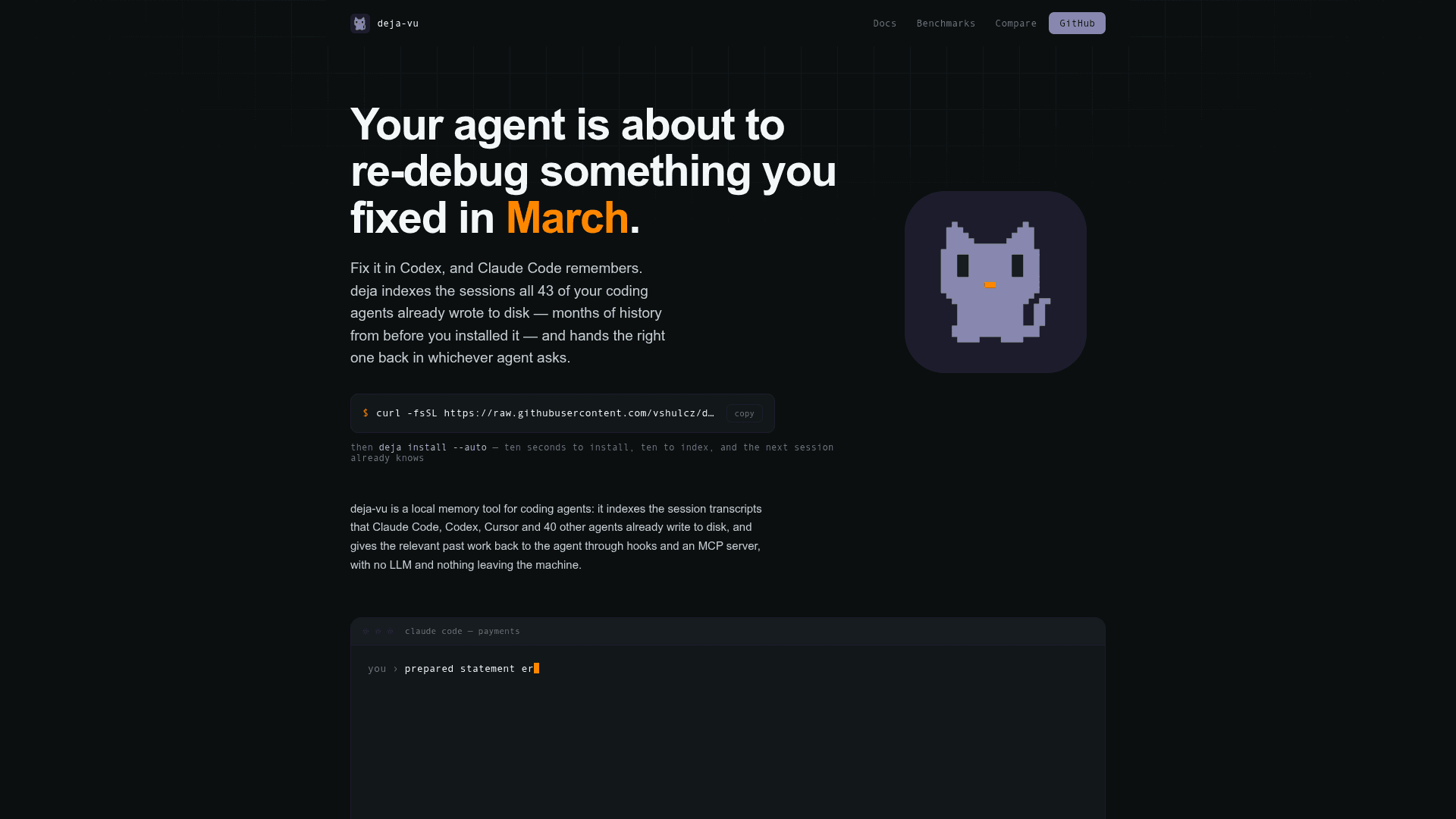
deja-vu is an open-source, MIT-licensed local memory tool for coding agents, maintained by vshulcz. It indexes the session transcripts that Claude Code, Codex, Cursor and dozens of other agents already write to disk, then hands relevant past work back to whichever agent is running through hooks and an MCP server. It ships as a single Go binary, with the latest release listed as v0.23.1.
What It Is
A memory layer for coding agents that treats existing transcripts as the memory, so there is no separate capture step. It parses each agent's session store in place, builds a local index, and strips credentials such as keys, tokens and PEM blocks as the index is built. Indexing and search run locally with no LLM; embeddings are used only if semantic recall is enabled.
How the Workflow Runs
After installing with the shell script, deja install --auto wires MCP recall into the agents it finds, enables session-start recall where supported, and builds the first index. Agents can then recall past work at session start, before a file is edited or a command runs, and after a command fails. Running bare deja opens a terminal search screen over every agent's history, where you can read a session, resume it in its own agent, or continue it in another agent with what it asked, decided and left open.
Commands and Outputs
The CLI includes search, wip, blame for tying files to sessions, fix and how for past errors and commands, ctx digests, handoff, sync between machines over SSH, stats --card for a shareable SVG summary, and secrets for finding credentials left in source transcripts. The MCP server exposes a single deja tool with several modes, including recall, context, blame, fix, how, orient, remember and handoff.
Privacy and Benchmarks
The docs state that nothing leaves the machine unless configured, with no account or telemetry. The author, who maintains the project, publishes benchmark results such as 97.2% R@5 on LongMemEval-S and a 17.6 s index of 19,195 sessions, and says the drivers and corpus are in the repository for re-running.
Community Discussions
Be the first to start a conversation about deja-vu
Share your experience with deja-vu, ask questions, or help others learn from your insights.
Pricing
Open Source (MIT)
Local memory tool for coding agents, a single Go binary released under the MIT License. Free to use, copy, modify and distribute.
- MIT License
- Indexes session transcripts from 43 coding agents locally
- Hooks and MCP server
- No LLM, nothing leaves the machine
- Runs on macOS and Linux, with Windows, Homebrew and npm install options
Capabilities
Key Features
- Indexes existing session transcripts from 43 coding agents
- Retroactive search over months of prior history
- MCP server with a single deja tool and multiple modes
- Auto-recall hooks at session start, before edits or commands, and after failures
- Terminal search screen with filters, resume and cross-agent continue
- Credential redaction at index time
- deja blame, fix, how, wip and ctx commands
- Handoff of sessions between agents
- SSH-based sync between machines
- Optional semantic recall via local or OpenAI-compatible embeddings
- Stats card export as SVG
- Local benchmarks via deja bench