
designlang
Open-source CLI that reverse-engineers any live website's design system into tokens, framework themes, and brand books.
At a Glance
Free, MIT-licensed CLI that extracts a website's design system; no signup or API key required.
Engagement
Available On
Listed Oct 2026
About designlang
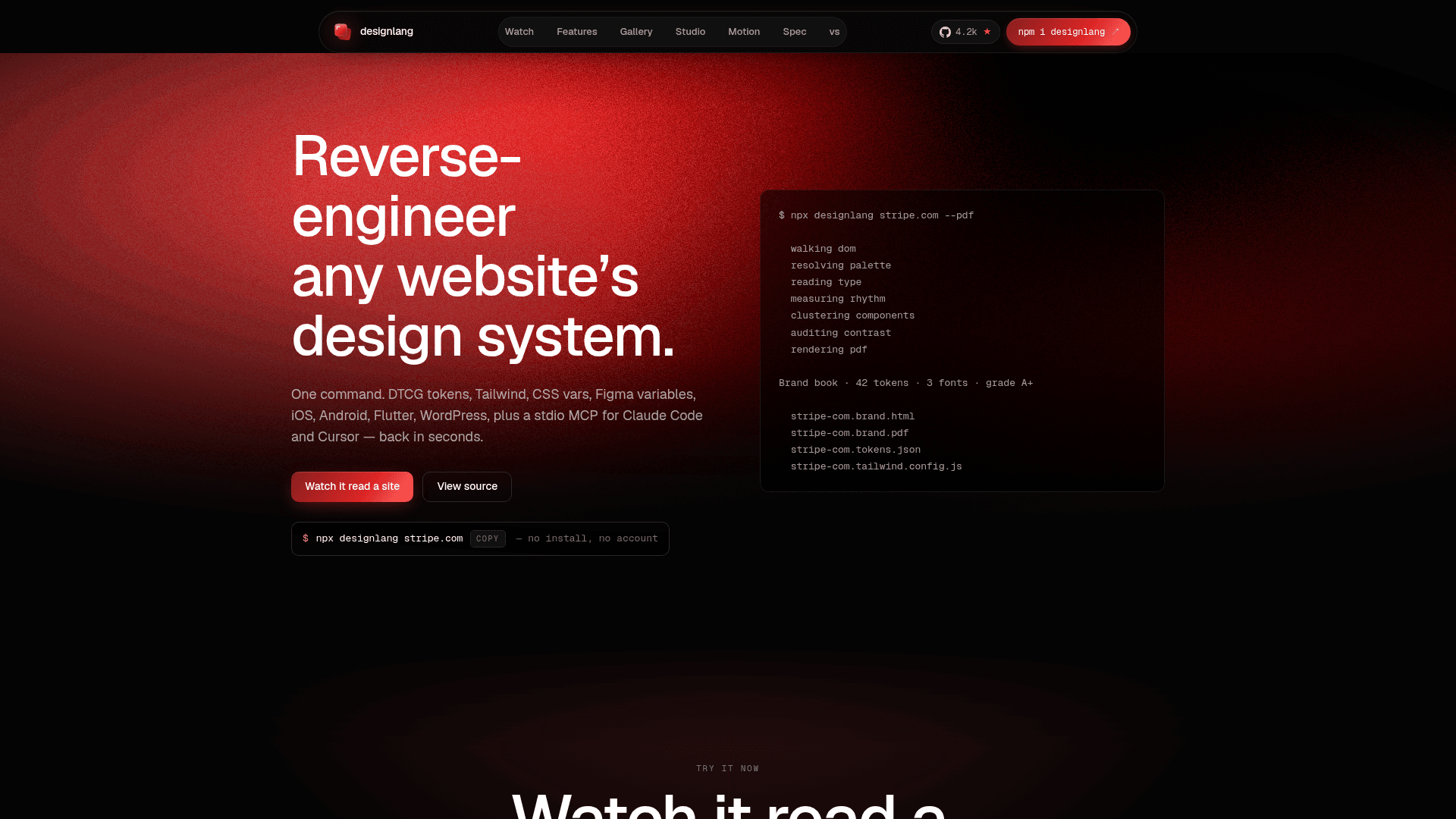
designlang is an MIT-licensed command-line tool by Manav Arya Singh that points a headless Chromium browser at a live URL and reads the design system off the rendered DOM. A single run emits W3C DTCG tokens, Tailwind and CSS variable files, Figma variables, native theme code, and a brand-book PDF. It also ships a stdio MCP server for AI coding editors.
What It Is
designlang is a design-extraction CLI. Instead of starting from a Figma file or hand-authored tokens, it takes a URL, drives a real browser, and reads computed styles for colours, typography, spacing, shadows, borders, motion, and component structure. It runs locally via npx designlang <url> and requires Node.js 20 or later, with no account or API key needed.
Outputs and Formats
Outputs include DTCG tokens (primitive, semantic, composite layers), a Tailwind config, CSS custom properties, Figma Variables JSON, a shadcn/ui theme, and React, Vue and Svelte theme objects. Native emitters produce iOS SwiftUI, Android Jetpack Compose, Flutter ThemeData, and a WordPress block theme. It can also generate a 13-chapter brand-guidelines PDF, typed component anatomy stubs, a brand voice file, and paste-ready prompt packs for tools like v0, Lovable, Cursor and Claude Artifacts.
Analysis and Audits
Beyond extraction, it performs a WCAG contrast audit with nearest-passing colour remediation, a CSS health audit (specificity, dead rules, duplicates, keyframes), semantic region classification, and component clustering with variant detection. Optional flags capture hover, focus and active states, responsive breakpoints, runtime motion, dark mode, and authenticated pages. Further commands cover design grading, head-to-head battles, remixing in other visual vocabularies, theme swapping, whole-site crawling, clone fidelity scoring, and a design DNA comparison against a corpus.
Editor and Agent Integration
designlang mcp starts a stdio MCP server exposing tokens, colours, typography, components, findings, drift computation and exports to Claude Code, Cursor and Windsurf. The CLI can also write AGENTS.md, .cursorrules and Claude skills into a repository, and the repo ships a Claude Code plugin with slash commands. Drift checks and linting are designed for CI, exiting non-zero on failure.
Community Discussions
Be the first to start a conversation about designlang
Share your experience with designlang, ask questions, or help others learn from your insights.
Pricing
Open Source (MIT)
Free, MIT-licensed CLI that extracts a website's design system; no signup or API key required.
- MIT-licensed core CLI, fully open source on GitHub
- No signup, no account, no API key
- CLI extraction is unlimited
- Requires Node.js 20 or later
- Hosted demo at designlang.app is rate-limited to two extractions per IP per day
Capabilities
Key Features
- Extracts palette, typography, spacing, shadows, borders and motion from live DOM
- W3C DTCG tokens with primitive, semantic and composite layers
- Tailwind, CSS variables, Figma variables and shadcn/ui theme output
- iOS SwiftUI, Android Compose, Flutter and WordPress emitters
- 13-chapter brand-book PDF generation
- Stdio MCP server for Claude Code, Cursor and Windsurf
- Auto-generated AGENTS.md, .cursorrules and Claude skills
- WCAG contrast audit with remediation
- CSS health audit
- Semantic region classification and component clustering
- Dark mode extraction and authenticated page crawling
- Hover, focus and active interaction state capture
- Drift, lint and visual-diff commands for CI
- Design grading, battle, remix, theme-swap and pair commands
- Clone fidelity scoring and design DNA comparison
- Whole-site crawl with consistency grade