
Discobox
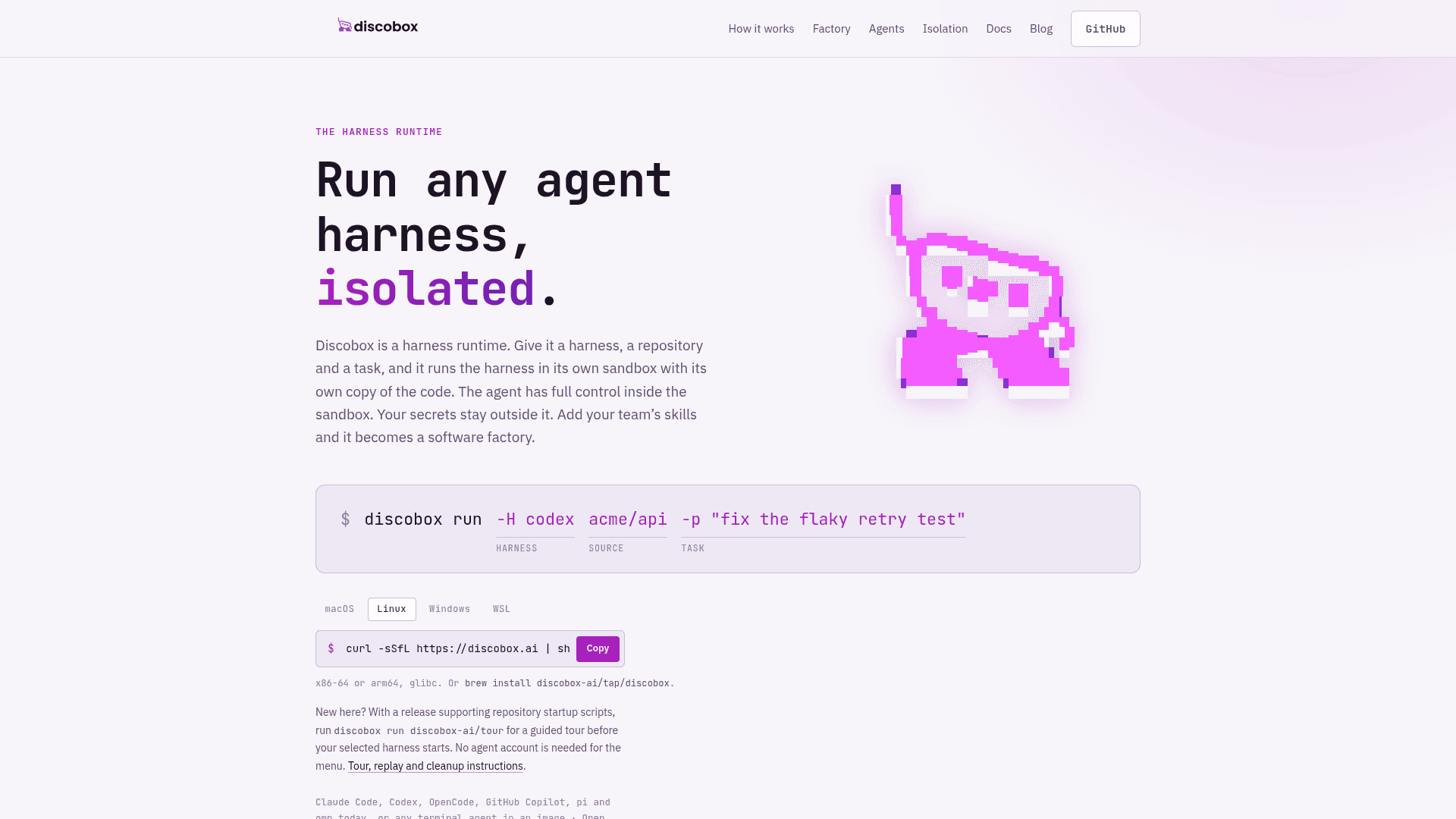
Harness runtime that runs coding agents in isolated sandboxes, each with its own copy of your source and credentials kept outside.
At a Glance
Discobox core runtime is licensed under Apache License 2.0 and can be installed and used at no cost.
Engagement
Available On
Alternatives
Listed Nov 2026
About Discobox
Discobox is an open-source harness runtime from the discobox-ai organization. Given a harness, a source repository and a task, it runs the agent in its own sandbox with its own copy of the code, while credentials stay outside the sandbox. The project describes itself as under active development and supports macOS, Linux and Windows (WSL).
What It Is
Discobox runs coding agents such as Claude Code, Codex, OpenCode, GitHub Copilot, pi and omp, or any terminal agent packaged as an image, inside disposable environments. Inside the box the agent has passwordless sudo, nested Docker, a desktop and a browser, and it never stops for approval prompts. You start a run with discobox run, naming a harness, a source (a GitHub repository, any Git URL or a local directory) and a prompt. Runs can be attached to interactively or started detached, and the agent's work comes back through ordinary git: the agent commits in the box and pushes a branch or opens a pull request, while your own checkout is untouched.
Many sessions, one repository
Each box has its own git repository, services and Docker, so several agent sessions can work on one repository in parallel without competing for files, branches or ports. Management commands include ls, attach, exec, cp, proxy, stop, start and rm. Boxes can be reached through a terminal, SSH, VS Code or Zed, or a VNC desktop, and the CLI and an OpenAPI API support scripting.
Factories and persistent agents
The site describes a software-factory pattern: shared state (for example GitHub issues and labels), a skill for each step, and a long-lived manager box that starts worker boxes for whichever step is due. Runs can also be given a name and a standing job, becoming long-lived agents that keep their files and logins across stops and restarts and can be sent messages from scripts.
Isolation and credentials
All outbound traffic leaves through a proxy with per-box mTLS identity, destination policy and request auditing. Managed credentials stay outside the box; the agent holds placeholder sentinels and the proxy substitutes the real value only on routes the binding allows. Network deny-by-default rules, route-level credential bindings with expiry, and on-demand access requests that a human approves are documented. Sandbox providers are Virtualization.framework on macOS, WSL on Windows, and libkrun microVMs or Docker on Linux.
Community Discussions
Be the first to start a conversation about Discobox
Share your experience with Discobox, ask questions, or help others learn from your insights.
Pricing
Open Source
Discobox core runtime is licensed under Apache License 2.0 and can be installed and used at no cost.
- License: Apache License 2.0 (Apache-2.0)
- Runs Claude Code, Codex, OpenCode, GitHub Copilot, pi and omp, or any terminal agent packaged as an image
- Isolated sandbox per run with proxy-based credential control, policy and audit logging
- Supports macOS, Linux, Windows (WSL)
- Server is downloaded separately by the client; harness/model provider costs are external
Capabilities
Key Features
- Run agent harnesses in isolated sandboxes with their own copy of the source
- Supports Claude Code, Codex, OpenCode, GitHub Copilot, pi, omp, or any terminal agent packaged as an image
- Attached and detached runs
- Parallel boxes against one repository
- Git-based source flow with branches and pull requests
- Credential proxy with sentinel placeholders
- Network deny-by-default egress policy
- Route-level credential bindings with expiry
- On-demand access requests approved by a human
- Persistent named agents
- Skills-based software factory workflows
- SSH, VS Code, Zed and VNC desktop access
- CLI and OpenAPI API for scripting
- Request auditing through a per-box mTLS proxy