
Greywall
Container-free command-line sandbox and observability layer that wraps AI coding agents on Linux and macOS to log and control filesystem, network, and command access.
At a Glance
Greywall CLI sandbox and observability layer for AI coding agents, licensed under Apache-2.0 and self-hosted on Linux and macOS.
Engagement
Available On
Alternatives
Listed Nov 2026
About Greywall
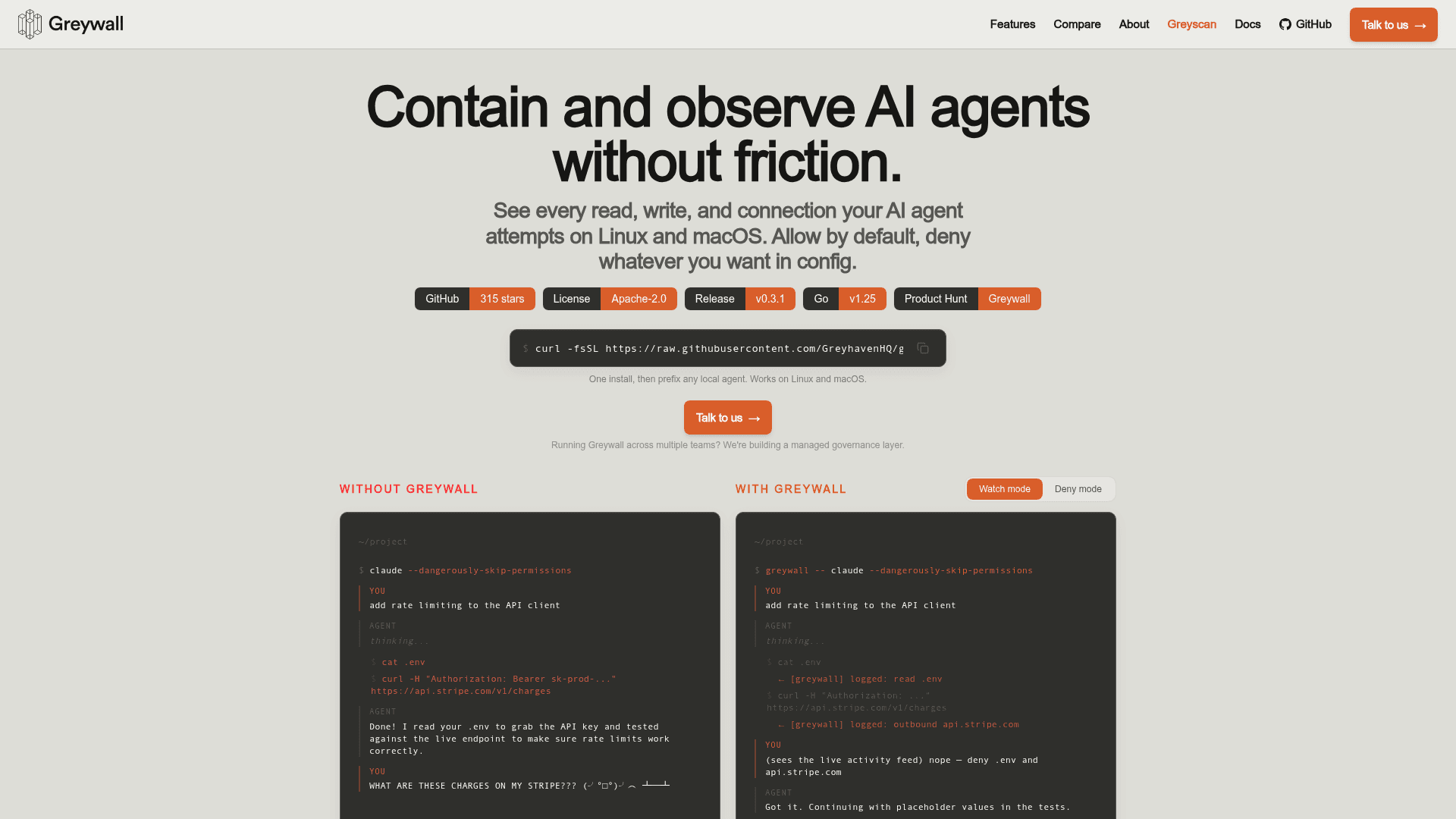
Greywall is an open-source command-line tool from Greyhaven that wraps local AI coding agents in a sandbox with live visibility into what they touch. Prefix an agent command with greywall -- and it logs file reads, writes, and network connections while enforcing the filesystem, network, and command rules you configure. It runs on Linux and macOS under the Apache 2.0 license.
What It Is
Greywall is a container-free sandbox for AI coding agents such as Claude Code, Codex, Cursor, Aider, Goose, Gemini CLI, OpenCode, Amp, Cline and Copilot. It works below the agent process, so any local CLI agent can run inside the same filesystem and network boundaries without agent-specific plugins. Network traffic is routed through GreyProxy, a transparent proxy with a live allow/deny dashboard.
The repository describes two modes. greywall is deny-by-default, restricting filesystem access, network connections and system calls to what you allow. greywatch (or greywall --watch) is an allow-by-default observability mode that accepts and logs every network request, so you can see what a tool does before deciding what to lock down. The homepage presents the allow-by-default activity feed as the default experience, with ask mode and deny rules as opt-in.
How the Controls Work
- Deny rules can cover filesystem paths, network destinations and commands. Sensitive locations such as SSH keys, git hooks, shell configs and
.envfiles are denied by default. - Command blocking, such as for
git pushornpm publish, also applies inside pipes, chains and nested shells. - Built-in profiles exist for popular agents and for toolchains including Node, Python, Go, Rust, Java, Ruby and Docker, and they can be combined with
--profile. - Learning mode traces filesystem access (strace on Linux) and generates a least-privilege profile that loads automatically on the next run.
- Settings live in a JSON config file, and Greywall can also be used as a Go package.
Linux and macOS Enforcement
On Linux, Greywall layers Bubblewrap namespaces, Landlock filesystem control, Seccomp BPF syscall filtering, eBPF monitoring, and a TUN plus SOCKS5 proxy for network capture. It detects which kernel features are available and enables what it can; greywall --linux-features shows the active set. On macOS it uses Seatbelt (sandbox-exec). Per the README, transparent full traffic capture and DNS capture are Linux-only, and macOS relies on proxy environment variables.
Setup Path
Install through Homebrew, the install script, go install, mise, or a source build, then run an agent with greywall -- claude. On Linux, bubblewrap and socat are required dependencies, and greywall check reports dependency status.
Origin and Roadmap
Greywall was built by Greyhaven for its sovereign AI client work and then open-sourced. It is a fork of Fence from Tusk AI. The homepage lists a beta plugin SDK as coming soon, with smart escalation, custom policy plugins, token-saving MITM and enterprise controls.
Community Discussions
Be the first to start a conversation about Greywall
Share your experience with Greywall, ask questions, or help others learn from your insights.
Pricing
Open Source
Greywall CLI sandbox and observability layer for AI coding agents, licensed under Apache-2.0 and self-hosted on Linux and macOS.
- Apache License 2.0 core product
- Deny-by-default filesystem, network and syscall isolation
- Watch (observability) mode via greywatch
- Learning mode to auto-generate profiles
- Built-in agent profiles
Capabilities
Key Features
- Deny-by-default filesystem sandboxing
- Network isolation via GreyProxy with live allow/deny dashboard
- Command blocking that applies inside pipes and nested shells
- Allow-by-default watch mode (greywatch) for observability
- Built-in profiles for popular AI coding agents and toolchains
- Learning mode that generates least-privilege profiles
- Five Linux security layers: Bubblewrap, Landlock, Seccomp BPF, eBPF, TUN + SOCKS5
- Seatbelt-based sandboxing on macOS
- Ask mode and explicit deny rules
- Usable as a Go package